49 works in this view — arrow keys or swipe to move between them.
Dance in Art
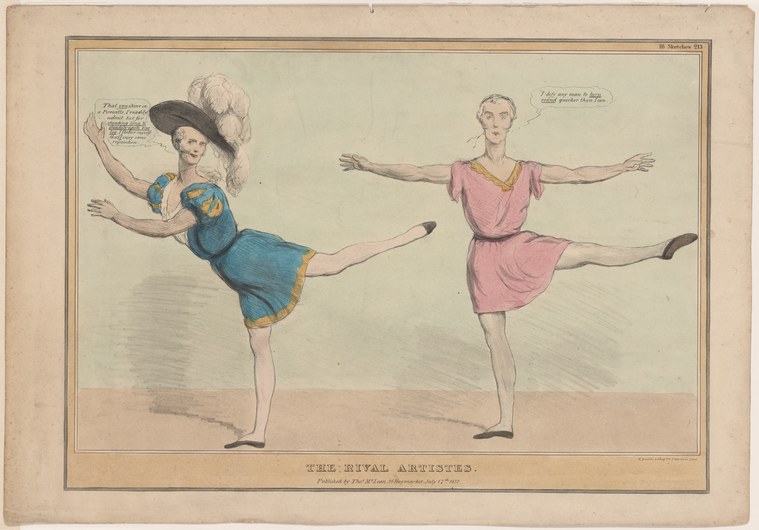
The rival artistes
Unknown artist
- Collection:
- Prints depicting dance
- Source:
- New York Public Library
- Rights:
- Public domain — free to use, share and adapt.
- Recorded as:
- Public Domain
The print offers rare visual evidence of how early 19th-century audiences perceived female stage dancers and ballet technique, filtered through satire. It captures a moment when the technical vocabulary of Romantic ballet (high extensions, pointed work, arabesques) was novel enough to parody, suggesting these were recognizable markers of theatrical pretension or modernity rather than yet-normalized classical technique. It also documents the competitive public personas and celebrity culture surrounding female performers in the Regency or early Romantic era.
What you are looking at
Two female performers stand in mirror-image poses against a plain background, each balanced on one leg with the other extended high to the side in a dramatic arabesque or attitude. The figure on the left wears a short blue dress with gold trim and an enormous feathered hat; she holds her raised arms in a sweeping theatrical gesture. The figure on the right is dressed in a simpler pink gown and strikes an identical leg position with arms outstretched for balance. Both wear dark shoes and ankle-length stockings. Speech bubbles appear above each figure, suggesting satirical commentary—the left figure's text is partially legible, the right's reads roughly "Take care & work / what greater learning." The composition is tightly framed, with both figures centered and isolated against a neutral beige ground, the setting entirely undefined. The title "THE RIVAL ARTISTES" appears below in capital letters. This is a hand-colored engraving or aquatint, suggesting satire or caricature of competitive female performers.
The dancing
Both dancers demonstrate equivalent physical control: a high leg extension with the supporting leg locked and straight, the free leg raised to or above hip height with a pointed foot, and the torso held upright with arms extended for balance and display. The poses are symmetrical and deliberately matched, emphasizing the parallel rivalry. The left figure's extravagant costume and hat suggest greater social pretension or theatrical excess. Both bodies show the lightness and lift expected of trained dancers, but the exaggerated height of the leg extension and the flatness of the poses suggest parody rather than naturalistic movement—each figure is locked into a moment of display rather than caught in the flow of choreographed action.
The dance depicted
This appears to be a satirical print mocking female stage performers or ballet dancers of the early 19th century, possibly Regency or Romantic era. The poses derive from the vocabulary of theatrical ballet or pantomime—the high arabesque or attitude and the extended arm positions are recognizably balletic—but the exaggerated costumes, the competitive parallel stance, and the mocking captions suggest the work is not celebrating the dance itself but rather commenting on rivalries, vanity, or absurdity in theatrical performance. The high leg extension and pointed foot work align with the emerging technique of Romantic ballet, but without further documentation it is impossible to identify specific dancers or a particular rivalry being depicted.
How it was made
This is a hand-colored engraving or aquatint, identifiable from the fine line work, the subtle tonal modeling in the background and clothing, and the evidence of hand coloring in the blue, pink, and gold pigments. The technique allowed wide circulation as a satirical print, suggesting this was meant for a popular audience rather than a specialized art market. The inscription and speech bubbles indicate it was part of a visual satire or humor tradition common to early 19th-century London and Paris publishing. The medium's accessibility and reproducibility made it an ideal vehicle for topical commentary on stage personalities.
About this work
This is a satirical engraving of two rival female stage performers poised in identical, exaggerated balletic attitudes—high leg extensions, pointed feet, extended arms. One wears an absurdly large feathered hat and a blue dress trimmed in gold; the other a plainer pink gown. The print, titled "The Rival Artistes," mocks competitive female performers of the early 19th-century stage, likely the Regency or early Romantic period. Speech bubbles above each figure deliver satirical commentary, though only portions are clearly legible. The poses reference the emerging vocabulary of Romantic ballet—the high arabesque, the pointed foot, the theatrical arm positions—but deploy these forms for comic effect rather than as celebration of dance skill. The work sits at the intersection of dance history, theatrical satire, and the social anxieties surrounding female performance in the period.
How to look at it
Notice how the artist has frozen both dancers in identical poses—a deliberate choice that emphasizes their rivalry and mutual mimicry rather than showing them in different moments of choreographed action. The exaggerated height of the leg extension and the locked, static quality of the arabesque or attitude are themselves satirical: real dancers in motion flow through and out of such positions, but these figures are pinned like specimens. The contrast between the ornate costume on the left and the plain dress on the right may suggest a comment on theatrical excess versus simplicity, or on the pretensions of one performer versus another. The speech bubbles invite the viewer to read the print as a narrative of competitive boasting or self-promotion.
The period
This print dates from the early 19th century, a period of rapid change in stage dance and female theatrical performance. The Romantic ballet was emerging across Europe, characterized by ethereal heroines in white tutus, pointe work, and an emphasis on lightness and otherworldliness. London and Paris were hubs of this innovation, but it was also a moment of social anxiety: female dancers occupied an ambiguous social position, celebrated on stage yet regarded with suspicion off it. Their skill, their bodies, their rivalries, and their costumes were constant subjects of satire and commentary in the popular press and caricature prints. This work participated in a vigorous tradition of theatrical satire that both mocked dancers' pretensions and capitalized on public fascination with them.
Where it lives
The work is held in the New York Public Library's collection of prints depicting dance. It is an example of early 19th-century popular satirical printmaking, a genre widely distributed to London and Paris audiences through print shops and periodicals.
Dance in this work
Questions about this work
Are these real dancers, or is this fictional?
Without documentation, it is impossible to say whether the "rival artistes" refer to specific named performers or are generic types mocking female stage dancers of the era. The title and speech bubbles suggest the print may have referenced a known rivalry or scandal, but the image alone does not identify them. Such satirical prints often targeted celebrities of the day, and audiences of the time would have recognized the allusions; we have lost that context.
What dance are they doing?
The pose is a high arabesque or attitude, a core vocabulary of classical and Romantic ballet. The pointed foot, the extended leg at or above hip height, and the lifted, controlled posture all derive from ballet technique. However, this is satire: the artist exaggerates and mocks the pose rather than celebrating it. The rivals are frozen in mirror-image positions, suggesting the print is mocking theatrical showiness rather than illustrating actual choreography.
When was this made?
The catalogue record does not supply a date, but the style of costume, the printing technique, the theatrical conventions, and the pointe work all suggest early 19th century, likely 1810s–1830s. The emergence of Romantic ballet and the exaggerated feathering of the hat point to the Regency or early Victorian era.
More dance artwork





