49 works in this view — arrow keys or swipe to move between them.
Dance in Art
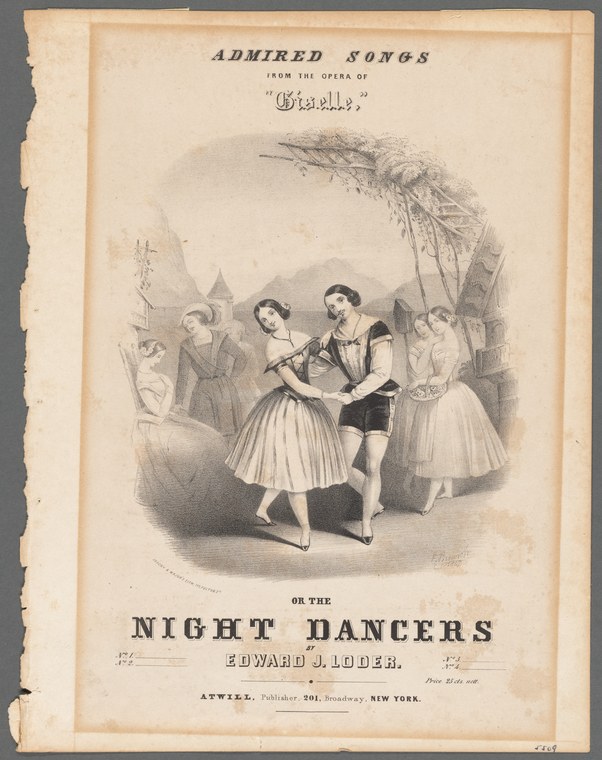
Admired songs from the opera of Giselle, or the night dancers by Edward J. Loder
Unknown artist
- Collection:
- Prints depicting dance
- Source:
- New York Public Library
- Rights:
- Public domain — free to use, share and adapt.
- Recorded as:
- Public Domain
This image captures the exact cultural moment when Romantic ballet—with its obsession with weightlessness, supernatural females, and erotically charged otherworldliness—penetrated American domestic culture through sheet music and home piano performance. It documents not just a choreographic moment but an entire aesthetic ideology of the 1840s–1850s, when ballet was at the height of its cultural prestige and the Willis of *Giselle* became an iconic figure in European and American imagination.
What you are looking at
A theatrical scene depicting supernatural beings in a moonlit setting. The composition centers on three female figures in elaborate Romantic-era dress—flowing white tulle skirts with fitted dark bodices—arranged in a semicircle. The leftmost figure gestures upward with one arm, her body twisted in an attitude of alarm or supplication. The central figure stands with arms extended, palm outward, in a posture of control or command. The rightmost figure, similarly posed with extended arm, anchors the composition. In the background, architectural elements suggest a church or graveyard setting—a pointed spire and what appears to be gravestones or monuments are visible in shadow. A gnarled tree with wind-swept branches leans over the scene from above. Male figures in period costume appear at left and right, observing. The engraving's tonal range emphasizes the eerie, nocturnal quality through strong contrasts of light and shadow, with the dancers' white garments glowing against darker surroundings. The overall mood is Gothic and dreamlike—this is the famous scene of the Willis, the ghostly maidens of the ballet *Giselle*.
The dancing
The three central figures are positioned in a line that curves across the picture plane, creating depth and visual rhythm. Their arms are raised and extended in attitudes rather than in balletic first or second positions—the gestures suggest otherworldly agency or supernatural command. The bodies are upright and elongated, with the weight appearing to be lifted through the torso rather than grounded. The costumes—tutus, fitted bodies, and the characteristic bell-shaped silhouette—place these figures as ballet dancers of the mid-19th century. The male observers are posed as spectators or participants in the dramatic action, standing outside the arc of the dancing figures.
The dance depicted
This depicts a scene from Adolphe Adam's *Giselle* (1841), one of the cornerstones of Romantic ballet. The scene shown is the second act, in which Giselle appears as a Willis—one of the ghostly maidens said to be the spirits of jilted brides, who dance men to death on moonlit nights. The engraving illustrates the supernatural aesthetic central to Romantic ballet: weightlessness, otherworldliness, and an erotically charged combination of beauty and danger. The raised arms and extended attitudes are consistent with Romantic choreography, which valued arabesques, attitudes, and port de bras that emphasized line and ethereal carriage. This is not classical court dance or folk gesture, but theatrical ballet of the mid-19th century in its most celebrated and influential form.
How it was made
This is a steel or copper engraving, recognizable from the fine parallel hatching that models form and shadow, the crisp line work, and the overall tonal subtlety. The inscription at the foot identifies it as sheet music cover art for a piano reduction of the operatic score by Edward J. Loder (a rival composer to Adam who also wrote on the *Giselle* theme). The engraving technique allowed for mass reproduction and wide circulation—this would have been sold as cover art for home piano performances, making it accessible to the broad middle-class audience for Romantic ballet. The quality of the engraving work is high, suggesting a professional commercial print produced in New York by Atwill (Broadway), a major music publisher of the period.
About this work
This engraving documents the second-act supernatural scene of *Giselle* as it was performed and imagined in mid-19th-century American theatrical and domestic contexts. The print is a cover for a piano score, indicating how deeply ballet penetrated not just the theater but the home music-making culture of the era. It preserves an iconic moment from one of Romantic ballet's most canonical works—the apotheosis of weightlessness and otherworldly feminine power that defined the genre. The composition emphasizes the visual and gestural language of Romantic ballet: the elongated silhouettes, the raised and extended arms, the interplay of human dancers and supernatural setting. For anyone studying the visual culture of Romantic ballet in America, this image is primary evidence of how the ballet was understood, circulated, and domesticated.
How to look at it
The viewer should note the moment of supernatural stasis the artist has chosen: the dancers are suspended in a moment of otherworldly gesture rather than captured mid-movement. Their arms reach upward and outward not in classical positions but in expressive attitudes that suggest agency and power. The setting—the gnarled tree, the church spire, the shadows—creates a Gothic theatrical space distinct from the ballroom or court settings of classical ballet. The observer should attend to how the engraver uses light and shadow to suggest the eerie, nocturnal quality of the scene: the dancers glow against darkness, their white tutus and skin rendered luminous through the contrast. This is not realism but theatrical convention made visible—the supernatural rendered through the visual language of Romanticism.
The artist
The engraving is not signed or attributed in the catalogue record. The work was published by Atwill, a New York music publisher specializing in theatrical and popular music. It was produced to accompany a piano score by Edward J. Loder, an English-born composer who worked extensively in America during the 1840s and 1850s. Loder was a rival to Adolphe Adam in attempting to capitalize on the success of *Giselle*; his own version was performed in America. The print represents the commercial music publishing industry's engagement with theatrical ballet.
The period
This engraving dates to the 1840s–1850s, the height of the Romantic ballet era. *Giselle* premiered in Paris in 1841 and was performed in America by the mid-1840s. The Romantic movement in ballet, visual art, and literature was at its peak, characterized by an obsession with the supernatural, the exotic, the ethereal female body, and the transcendence of material constraint through art and desire. Lithography and engraving were the dominant media for mass-producing and circulating theatrical imagery and operatic scores. Sheet music covers were a major form of visual culture, comparable in circulation and cultural penetration to theatrical playbills and popular prints. This engraving sits at the intersection of theater, commerce, and domestic leisure—it brought the spectacle of the stage into the parlor.
Where it lives
The print is held in the New York Public Library's collection of prints depicting dance. It is identified as a cover for a published piano score, making it part of the commercial music publishing industry's output. The printer and publisher, Atwill of Broadway, New York, places it squarely within the American theatrical and commercial music world of the mid-19th century.
Dance in this work
Questions about this work
What is a Willis?
In *Giselle*, the Willis are the supernatural spirits of maidens who died of broken hearts or were jilted before marriage. According to the ballet's Romantic mythology, they rise from their graves on moonlit nights and dance mortal men to death. Giselle, betrayed by her lover Albrecht, becomes a Willis in the second act and is forced to dance with the corps of ghostly maidens. The Willis embody the Romantic era's fascination with female supernatural power and the erotics of transcendence through dance.
Why did *Giselle* inspire so many composers and publishers?
The unprecedented success of Adolphe Adam's *Giselle* in 1841 made it a model for theatrical ballet and operatic drama. American publishers and composers quickly sought to capitalize on its popularity by producing piano reductions, cover art, and rival versions. Edward J. Loder's score was one of several American attempts to ride the wave of *Giselle* mania. Publishing a score with an engraved cover depicting the ballet's most famous scene was a marketing strategy designed to appeal to music-loving households who wanted both the aesthetic prestige and the entertainment value of contemporary theatrical ballet.
How does the dress tell us this is Romantic ballet?
The tutu, the fitted bodice, the pale color, and the overall silhouette are all hallmarks of mid-19th-century ballet costume. The bell-shaped tutus with their gathered, layered appearance are characteristic of the 1840s–1850s. Romantic ballet prioritized the female body's seeming weightlessness and ethereality, and the costume was engineered to support that aesthetic: tight at the torso to show a lifted carriage, full and flowing below to suggest movement and transcendence. The pale coloring and the way the fabric catches light reinforce the supernatural, otherworldly quality the Romantic ballet choreographers and designers sought.
Why was sheet music cover art important?
In the 19th century, sheet music was a primary medium for disseminating theatrical and popular music to domestic audiences. Piano-playing was a central accomplishment and leisure activity for middle- and upper-class households. A beautiful cover engraving made the score more desirable and collectible, and it also advertised the theatrical production—anyone purchasing this score would see the image of the ballet's most famous scene and would want to attend a performance. The cover art was both a commercial investment and a form of theatrical publicity that reached beyond the theater into the home.
More dance artwork





