49 works in this view — arrow keys or swipe to move between them.
Dance in Art
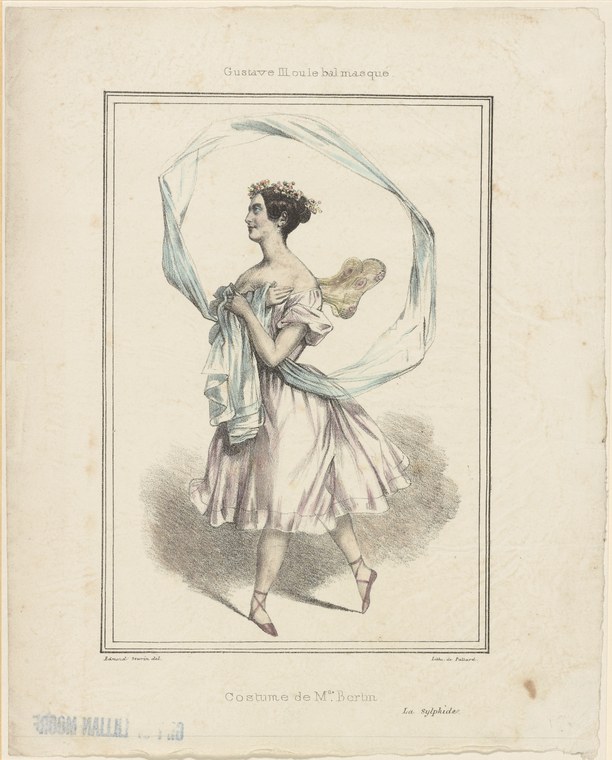
Costume de Mlle. Bertin [sic] La sylphide
Unknown artist
- Collection:
- Prints depicting dance
- Source:
- New York Public Library
- Rights:
- Public domain — free to use, share and adapt.
- Recorded as:
- Public Domain
La Sylphide is the foundational work of Romantic ballet and one of only two ballets from that era still regularly performed; this engraving is direct visual evidence of how the ballet and its central character were designed and executed when it premiered. For theater historians and dance scholars, such costume studies are primary sources on performance practice, lighting effects, and the dancer's body as shaped by the aesthetic demands of a specific moment in dance history.
What you are looking at
A young woman in Romantic-era theatrical costume stands in a graceful, weightless pose against a plain background. She wears a pale muslin dress with a fitted bodice and a skirt that falls to mid-calf, typical of 1830s ballet costume, with flat ballet slippers on her feet. A diaphanous veil or scarf billows around her upper body and extends upward in sweeping curves that frame her figure, suggesting movement or the supernatural lightness central to Romantic ballet. Her body is turned in profile, her left arm extended forward as if reaching or gliding through space, while her right arm curves gracefully at her side. Her gaze is directed outward and slightly upward, and her posture conveys an ethereal quality—she appears to be suspended or floating rather than grounded. The engraving technique creates fine hatching in the background that emphasizes her isolation and the dreamlike quality of the image.
The dancing
A single figure occupies the composition, posed in the characteristic stance of Romantic ballet: weight lifted, body elongated, limbs extended in soft curves rather than sharp angles. The extended left arm and the lift through the torso suggest an arabesque or similar suspended position. The pose is static but reads as momentary—the balletic vocabulary is legible in the relaxed épaulement (shoulder placement), the gentle turnout, and the refined carriage of the head. This is not a portrait of a woman but a study of a dancer's ideal line and the illusion of weightlessness that Romantic ballet prized.
The dance depicted
This is a costume study for Romantic ballet, almost certainly representing La Sylphide, the canonical work of the genre. The title identifies the figure as Mlle. Bertin, likely a dancer who performed in this role. La Sylphide (1832) tells of a mortal man's infatuation with a supernatural sylph—a spirit of the air—and the ballet was revolutionary for its use of pointe work, ethereal costuming, and the illusion of flight achieved through gas lighting and the dancer's technical control. The veil and the weightless pose are the visual vocabulary of this illusion: the sylph is not bound by gravity or the earth. The engraving documents both the costume as designed and the dancer's body as trained to inhabit it—the two together create the effect of the supernatural.
How it was made
This is a hand-colored engraving (intaglio process), evident from the fine parallel lines of hatching that model form and suggest depth. The delicate cross-hatching in the background and the careful gradation of tone in the fabric folds indicate skilled engraving work. Hand-coloring was applied afterward in watercolor or gouache, visible in the pale tints of the dress and the subtle pinks and grays. As a printed work, this was reproducible and circulated widely—it served as both a souvenir of performance and a record of costume design, reaching audiences who could not attend the theater. Such engravings were standard in 19th-century dance promotion and were sold or distributed to cultivate the mystique of celebrated dancers.
About this work
This is a costume study engraving of a dancer in the title role of La Sylphide, the most iconic work of Romantic ballet. It documents the visual language of Romantic ballet at its height: the ethereal costuming, the illusion of weightlessness, and the refined technique required to sustain that illusion. The work is both a portrait of a specific dancer and a record of the choreographic and design innovations that defined the era. For dancers and historians, it preserves a visual archive of how Romantic ballet looked and how the sylph—the supernatural ideal that animated the ballet—was materialized on stage.
How to look at it
Notice the veil: it is not merely decorative but structural to the design, meant to enhance the sense of weightlessness and movement. The artist has drawn it in graceful, ascending curves that frame the body and suggest flight or buoyancy. Observe the dancer's port de bras (arm carriage)—it is soft and rounded, never rigid or geometrically sharp, embodying the Romantic ideal of the body as fluid and yielding rather than controlled. The pose itself is unstable-looking; the weight appears to rest on a single foot, and the torso and limbs seem to float above it. This is the technical achievement the engraving records: the illusion that the dancer is lighter than air.
The artist
The artist is not recorded, but the engraving is signed in the plate. Such costume studies were often commissioned by impresarios or published by printsellers in Paris, the center of Romantic ballet. The work was produced in the 1830s when La Sylphide was at the height of its popularity and when such engravings were a standard part of theatrical commerce. The quality of the engraving suggests a professional atelier, likely one specializing in theatrical and portrait work.
The period
La Sylphide premiered in 1832 and defined the Romantic movement in ballet—a sharp break from the classical court ballet and neoclassical styles that preceded it. The Romantic era in dance (roughly 1830–1850) privileged narrative, the supernatural, the exotic, and the idealization of the female dancer as ethereal and otherworldly. The ballerina on pointe became the norm during this period, and the sylph became the archetypal Romantic heroine—beautiful, unattainable, and fatal to the mortal man who loves her. This engraving dates to the early years of that dominance, when the visual language of Romanticism in ballet was still being codified and circulated through prints like this one.
Where it lives
This engraving is held in the New York Public Library's collection of prints depicting dance, a substantial archive of theatrical and choreographic imagery from the 18th and 19th centuries. It is a commercial print, produced for circulation among theaters, collectors, and the ballet-going public.
Dance in this work
Questions about this work
Who was Mlle. Bertin?
The catalogue identifies her only by name. She was a dancer who performed the role of the Sylph in La Sylphide, likely in Paris in the 1830s. This engraving was her visual record—a form of theatrical celebrity. Without further archival research, little more can be said with certainty, but the fact that her name appears on the print suggests she was a notable performer of the role.
What is a sylph?
In Romantic ballet and Romantic literature, a sylph is a supernatural spirit of the air—beautiful, ethereal, and ultimately unattainable by mortal men. La Sylphide tells the story of a Scottish man who falls in love with a sylph and is destroyed by the attempt to possess her. The sylph became the ideal female figure of Romantic ballet: weightless, otherworldly, and tragic.
Why is the dancer on pointe?
Pointe work—dancing on the tips of the toes in stiffened shoes—became standard in Romantic ballet as a way to enhance the illusion of weightlessness and ethereal movement. The elevation and delicacy it allowed fit perfectly with the Romantic ideal of the supernatural ballerina. By 1832, when La Sylphide premiered, pointe technique was already established, though it was still relatively new and demanded great physical strength and skill.
Is this a real historical costume or an idealized design?
Both. The costume shown here is real—it is the design that was actually made and worn on stage—but it is also idealized in the sense that the engraving presents it in isolation and in a carefully posed, lighting-perfect moment. The veil, the pale muslin, and the pointe shoes are historically accurate to 1830s La Sylphide; the engraving itself is both a record and a kind of advertisement, designed to make the costume and the dancer look as ethereal as possible.
More dance artwork





