49 works in this view — arrow keys or swipe to move between them.
Dance in Art
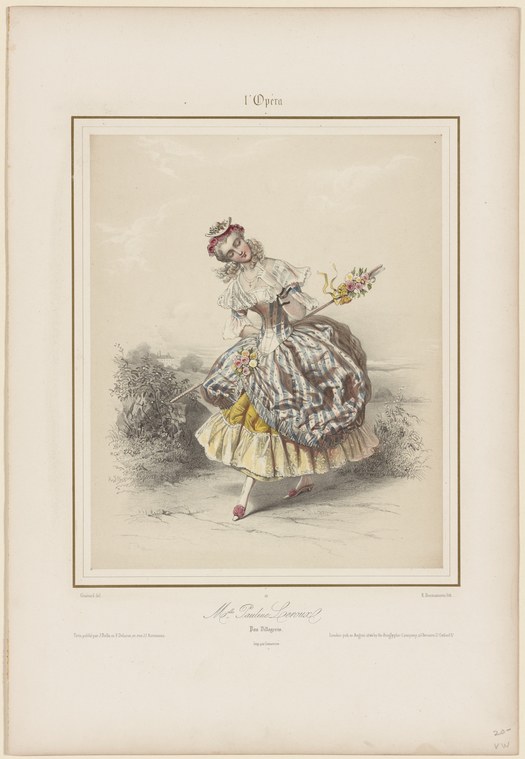
Melle Pauline Leroux. Pas villagèois
Unknown artist
- Collection:
- Prints depicting dance
- Source:
- New York Public Library
- Rights:
- Public domain — free to use, share and adapt.
- Recorded as:
- Public Domain
This print documents a now-obscure but once-central category of theatrical dance and preserves the visual record of a specific performer in a signature role. The *pas villagèois* reveals the hierarchy of dance styles in the Romantic era and the gendered nature of character work: it is a window into what audiences of the 1840s–50s expected to see when a female dancer took the stage as a village girl.
What you are looking at
A young woman in mid-nineteenth-century dress performs a village dance against a softly rendered landscape background. She wears a full-skirted dress with a striking design: the skirt features bold brown and white vertical striping in the lower portion, topped with a yellow or cream-colored gathered section and a white lace fichu or collar. Her head is tilted with an expression of gaiety, crowned with a small wreath or bonnet trimmed in pink ribbons. She holds flowers in her raised right hand—a spray of blossoms that echoes the decorative flowers scattered in the landscape at left. Her left arm is extended in an open gesture. The setting is parkland or countryside rendered in soft greens and grays, creating a theatrical pastoral atmosphere. The composition is intimate and focused entirely on the figure, who occupies the center of the frame. The print has the warm cream tone and fine detail of a hand-colored engraving or lithograph from the 1840s–50s.
The dancing
A single female figure stands in an open, unballasted pose with her weight appearing to rest on the right leg while the left extends freely. Her torso is turned three-quarter to the viewer; her right arm is raised to shoulder height holding flowers, her left arm extended outward in a relaxed, open position. Her gaze is directed upward and to the side, suggesting a moment of joyful abandon. The stance and arm carriage suggest a turn or pivot captured mid-motion rather than a held position; there is a sense of weight shifting and movement through the body.
The dance depicted
This is a *pas villagèois*, a village or country dance popular in European theatrical entertainment of the mid-nineteenth century. The title identifies the performer as Mlle Pauline Leroux, likely a dancer of the Romantic era. The *pas villagèois* was a light, character dance designed to contrast with the ethereal classical ballet of the period, depicting rural or peasant life with charm and comedic warmth. The costume—especially the striped skirt and folk-inspired headdress—and the open, unselfconscious pose all signal the dance's role in the entertainment hierarchy: spirited, gendered female, and knowingly picturesque. The flowers in hand and the upward gaze suggest the flirtatiousness and sentiment that characterized such village dances on the nineteenth-century stage.
How it was made
This is a hand-colored engraving or lithograph, identifiable from the fine linear detail, the cream paper tone, and the delicate watercolor or gouache coloring applied after printing. The technique allowed wide circulation as a print—affordable for middle-class collections and suitable for theatrical publicity. The precise lineework captures the texture of the lace and the bold graphic quality of the striped skirt, while the hand coloring permitted the artist to emphasize the warmth and charm of the scene. The aesthetic is consistent with theatrical costume prints and souvenir engravings of the 1840s–1860s, a period when such prints were widely collected as records of famous performers and roles.
About this work
A mid-nineteenth-century engraved portrait of Mlle Pauline Leroux in a *pas villagèois*, a character dance that was a staple of European Romantic ballet. The print combines precise costume documentation with an idealized, theatrical representation of rural femininity. The village dance served as a foil to classical ballet in the entertainment of the era: lighter in mood, closer to spoken comedy, and designed to display a different kind of feminine charm—spontaneity and earthiness rather than ethereal transcendence. The work belongs in a gallery of dance imagery because it records both a specific performer and role and the aesthetic conventions through which mid-nineteenth-century audiences understood the dancing body as a vehicle for character and social meaning.
How to look at it
Observe the moment of the pose: the dancer is not static but captured mid-turn or mid-gesture, with her weight shifting and her body opening outward. The raised arm and upward gaze are choreographic choices that convey emotion—joy, flirtatiousness, or innocent delight—rather than technical display. The costume is hypervisible and symbolic: the striped skirt and folk-inspired bonnet are theatrical conventions signaling 'village' or 'peasant' to the audience, not documentary accuracy. Notice how the artist has rendered the lace and the striped pattern with precision; these details mattered to contemporary viewers as markers of fashion and taste.
The period
The *pas villagèois* emerged in the late eighteenth century and flourished throughout the nineteenth as a contrast genre within ballet. While the classical line represented aspiration and transcendence, the character dances—including the village, Polish, Spanish, and other regional types—offered narrative and personality. This print dates to the height of Romantic ballet (roughly 1830–1860), when dancers like Carlotta Grisi, Fanny Cerrito, and Marie Taglioni were celebrated for their versatility across both classical and character roles. Costume prints like this one were a major form of theatrical publicity and fan merchandise, circulated to theaters and sold through print shops. They served as both records and marketing tools, immortalizing celebrated performers and allowing audiences to study the details of costume and character at leisure.
Where it lives
Held in the Prints depicting dance collection at the New York Public Library. This is a theatrical souvenir print, one of thousands produced in the mid-nineteenth century to capitalize on the fame of successful performers and roles.
Dance in this work
Questions about this work
What is a *pas villagèois*?
A character dance popular in nineteenth-century ballet, designed to depict rural or peasant life in a charming, often comedic way. It typically featured faster, lighter movement than classical ballet and was often performed by female dancers in costume as peasant girls or village maidens. These dances provided narrative and contrast within longer ballet productions and were beloved for their warmth and humor.
Who was Pauline Leroux?
A dancer of the mid-nineteenth century whose fame was sufficient to warrant a commemorative engraving, but whose biography is now largely lost. The print itself is the primary historical evidence of her career and of her signature role in the *pas villagèois*.
How were theatrical prints like this one used?
They were sold as souvenirs after performances, displayed in shop windows, and collected by enthusiasts. They served as promotional material for theaters and dancers, allowing audiences to own a memento of a favorite performer or role. They were also studied for costume and choreographic detail.
Why does the costume look so stylized?
The striped skirt, folk bonnet, and flowers are theatrical conventions—instantly recognizable signals to the audience that the character is a village girl. The costume was not meant to depict real peasant dress but rather an idealized, charming version of it, designed for visual impact on stage and in prints.
More dance artwork





