49 works in this view — arrow keys or swipe to move between them.
Dance in Art
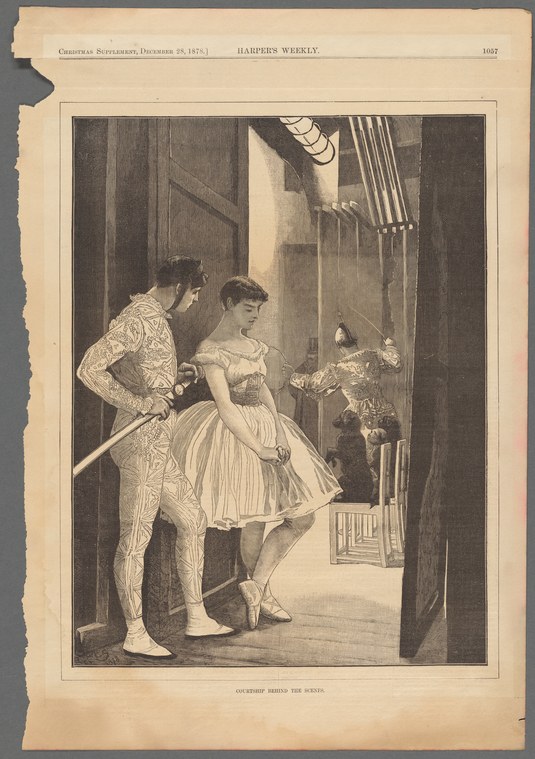
Courtship behind the scenes: Christmas supplement
Unknown artist
- Collection:
- Prints depicting dance
- Source:
- New York Public Library
- Rights:
- Public domain — free to use, share and adapt.
- Recorded as:
- Public Domain
The work captures Victorian fascination with the backstage world and the dancers who inhabited it, a fascination that shaped both theatrical practice and popular culture. It also documents the visual codes of late-19th-century ballet—the pointe shoe, the tutu, the posture—at a moment when those codes were becoming international currency.
What you are looking at
A male dancer in ornate Renaissance or Commedia dell'arte costume—richly patterned doublet and hose with a sword at his side—stands in a dramatic pose, bending slightly forward with one arm extended toward a female dancer in a classical ballet skirt and pointe shoes. She wears a pale, diaphanous tutu typical of 19th-century Romantic ballet. The setting is a narrow backstage corridor or entrance, suggested by vertical drapery and architectural elements in shadow. A figure in the distance, barely visible, seems to be observing or waiting. The lighting is theatrical, with strong shadows that emphasize the depth of the space and isolate the two principal figures. The composition captures a moment of courtship or flirtation, the title's "behind the scenes" suggesting this is a private or rehearsal moment rather than a staged performance.
The dancing
The male figure leans forward in an exaggerated, almost courtly bow or gesture of address, his torso inclined and his extended arm offering or requesting engagement. The female dancer stands upright in a modest pose, her weight apparently centered, her arms held with the repose typical of academic ballet. The spatial relationship between them—close but not touching—conveys hesitation or propriety. Their costume disparity (his Italianate theatrical dress against her classical ballet uniform) creates a visual tension that the gesture play emphasizes: he is performative and insistent; she is restrained and formal.
The dance depicted
This appears to depict an imagined or allegorical encounter between Romantic-era ballet and an older male theatrical or courtly tradition, possibly Commedia dell'arte. The scene is not a staged dance but rather a moment of social or romantic interaction—"courtship"—between two figures of the theatrical world. The male's posture and costume suggest courtly or commedia tradition; the female's pointe shoes and tutu place her firmly in 19th-century ballet. The title's reference to a Christmas supplement for Harper's Weekly suggests this was a humorous or sentimental illustration rather than documentary evidence of a particular dance or tradition.
How it was made
This is a wood engraving or steel engraving, recognizable from the fine parallel hatching, the precise linear control, and the tonal subtlety achieved through line density. The medium allowed for mass reproduction in periodical pages, and the work's appearance in Harper's Weekly confirms it was made for a weekly illustrated newspaper. Engraving of this finesse required both skill and time, and its use in a Christmas supplement suggests the subject was topical and appealing to an educated urban readership.
About this work
This is a humorous or sentimental Christmas illustration published in Harper's Weekly, depicting an encounter between a male figure in ornate theatrical dress and a classical ballet dancer in backstage shadow. The engraving plays on the contrast between old theatrical tradition and contemporary ballet, framing the moment as one of courtship or flirtation. The work sits at the intersection of theatrical fashion, gender play, and the Victorian appetite for stage-world imagery—a genre particularly strong in the illustrated press of the 1870s. It belongs in a dance gallery not as documentation of actual dance technique, but as evidence of how 19th-century audiences imagined theatrical romance and the social dynamics of the stage.
How to look at it
Attend to the costume contrast: the male's heavy, ornate, historically weighted dress against the female's ethereal, contemporary ballet uniform. The male's active, forward-leaning posture against her vertical, reposed stance embodies a narrative about gender and initiative. The backstage setting—the drapery, the shadowed figure in the distance—signals this as a private moment, not a public stage scene. The engraver's use of line to suggest fabric texture and shadow depth makes clear that this is a skilled illustration, not a quick sketch, and the care invested signals the subject's appeal to the paper's readership.
The period
This engraving was published in Harper's Weekly's Christmas supplement, a moment when illustrated humor and sentimental seasonal imagery dominated periodical culture. The 1870s were a high point for wood and steel engraving in American newspapers, before photomechanical reproduction displaced hand-engraved illustration. Ballet in America was becoming fashionable but still carried associations with continental Europe and courtly or bohemian worlds; the encounter between a commedia figure and a ballet dancer would have read to readers as witty juxtaposition of old and new theatrical traditions.
Where it lives
This engraving is held by the New York Public Library in its collection of prints depicting dance. It was published as part of Harper's Weekly's Christmas supplement in December 1875, which means it was one of many illustrations commissioned for a mass-circulation weekly magazine read in thousands of American households.
Dance in this work
Questions about this work
Is this a real dance or a made-up scene?
It appears to be a theatrical or allegorical scene created for illustration, not a depiction of an actual named dance or staged routine. The title and setting suggest it is a romantic or humorous moment set backstage, playing on the contrast between old theatrical tradition (the ornately dressed male figure) and contemporary ballet (the woman in pointe shoes and tutu). The scene is likely the artist's invention rather than reportage of something witnessed.
Why is the man dressed so differently from the woman?
The costume contrast appears intentional and is probably the point of the image. His ornate, heavily patterned doublet and hose suggest Commedia dell'arte or an older European theatrical tradition, while her pointe shoes and tutu mark her as a 19th-century classical ballet dancer. The engraving plays on the idea of an encounter between theatrical old and new—a timely joke for readers who knew both traditions from the stage.
What is happening between these two figures?
The title identifies it as courtship, and the male's forward-leaning posture and extended arm suggest he is making an approach or request of attention. The female's upright, composed stance suggests reserve or propriety. The scene captures a moment of social or romantic negotiation, played out in a theatrical register—a backstage moment rather than a stage performance. Whether the intent is romantic, comic, or both is left ambiguous.
More dance artwork





