49 works in this view — arrow keys or swipe to move between them.
Dance in Art
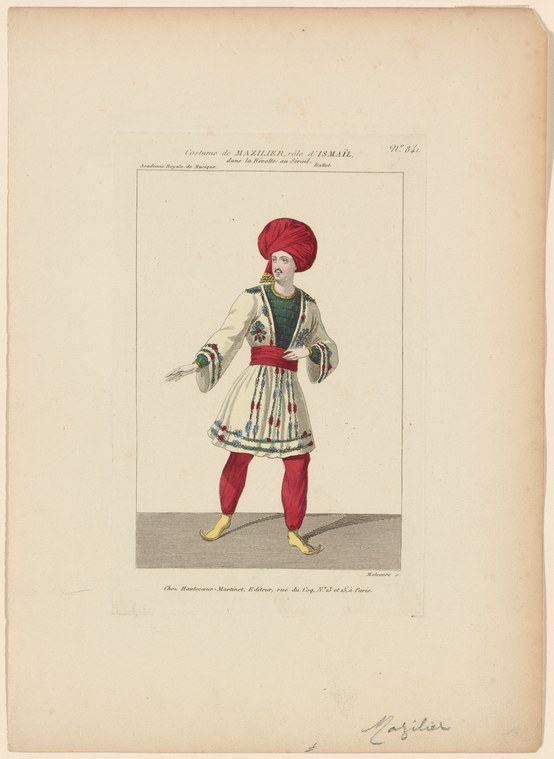
Costume de Mazilier, rôle d'Ismaïl, dans La révolte au sérail, ballet, Académie royale de musique
Unknown artist
- Collection:
- Prints depicting dance
- Source:
- New York Public Library
- Rights:
- Public domain — free to use, share and adapt.
- Recorded as:
- Public Domain
Costume plates are essential primary documents for understanding how nineteenth-century ballet was performed and received. This print shows not choreography but the visual language through which dancers inhabited character roles—what the audience saw, how the performer was dressed and positioned, and what the theatre considered significant enough to record and circulate. Without such plates, much of the material reality of Romantic ballet performance would be invisible to historians.
What you are looking at
A single male dancer stands in a frontal contrapposto pose against a neutral ground, wearing the costume of an Ottoman or Middle Eastern character. His ensemble comprises a fitted green tunic or chemise with decorative gold embroidery at the collar and cuffs, worn beneath a pale cream or ivory sleeveless overdress with pleated skirts that fall to mid-thigh. A wide red or crimson silk sash cinches the waist. His legs are clad in red tights or stockings, and his feet wear gilt or yellow slippers with upturned toes in the Ottoman style. A tall wrapped red turban crowns his head. His right arm extends outward at shoulder height with an open palm in a gesture of address or declamation; his left arm hangs at his side. His weight settles on his left leg in a relaxed stance. The pose suggests a moment of dramatic presentation—a character pausing to speak or gesture to an audience—rather than active movement. The painting employs careful figure study, with clean lines defining the silhouette and subdued watercolour or gouache tones for the fabrics, set within a ruled rectangular frame.
The dancing
The single dancer occupies the full height of the frame, positioned centrally with weight shifted onto the supporting leg. The extended right arm and open palm suggest rhetorical or dramatic gesture rather than balletic port de bras; the posture is one of address or pronouncement. The stance is upright and formal, without the turned-out legs or pointed feet of academic ballet. The body is presented frontally to the viewer in a classical artist's pose—the kind used to display costume and character to an audience reading the figure as an actor or dancer in a specific role.
The dance depicted
This is a costume study for a named role—Ismaïl—in the ballet *La révolte au sérail* (The Revolt in the Seraglio), performed at the Académie royale de musique (the Paris Opéra). The work documents theatrical dance at the French court in the nineteenth century, when Oriental and Ottoman settings were fashionable subjects for romantic ballet. The pose is not a captured step but a presentation of the character's dress and dramatic bearing. No evidence of technique, turnout, or specific choreographic vocabulary is visible; the work functions as a costume plate for theatrical documentation rather than as a record of movement.
How it was made
This is a hand-coloured engraving or aquatint, executed with fine linear definition and finished with watercolour or gouache for the fabric tones—a standard format for theatrical costume documentation in the nineteenth century. The technique allowed rapid, economical distribution to audiences, company members, and archives, and implied a broad readership interested in opera-ballet production detail. The crisp outline and careful colour separation suggest a professional workshop production, likely from the 1830s–1850s based on the costume style and printing method. Such prints were issued singly or in series and functioned as both artistic records and commercial merchandise.
About this work
This is a costume plate—a theatrical documentation print—depicting the character Ismaïl from the ballet *La révolte au sérail* as performed at the Paris Opéra. It dates to the height of French Romantic ballet, when exotic Oriental settings and characters provided fashionable subjects for the stage. The work does not depict dance itself but rather the costuming and character presentation that framed it, showing how the ballet dancer inhabited a named role through dress, posture, and dramatic presence. It belongs in a dance gallery as a primary historical record of how nineteenth-century theatrical dance was costumed, marketed, and understood by its contemporary audience. The print preserves visual information about production practice, performer presentation, and the aesthetics of Romantic-era ballet spectacle that exists nowhere else.
How to look at it
Read this as a costume document first: note the specificity of the tailoring, the embroidery, the dye colours, the jewellery, the footwear. These details show what a dancer wore on stage. Then observe the pose: the contrapposto stance, the open-palmed gesture, the frontal address to the viewer. This is a presentational pose, designed to show the character to an audience, not to capture mid-movement. The artist chose stillness and clarity over motion because the purpose was documentary—to record what the role looked like, not how it moved. Pay attention to the frame and title: they tell you this is one plate from a series documenting a specific production, preserved for historical study.
The period
This work dates to the era of French Romantic ballet (1830–1850s), when the Paris Opéra dominated European theatrical dance and set aesthetic standards for the continent. Costume and spectacle were central to Romantic ballet's appeal; the genre delighted in exotic settings, supernatural narratives, and elaborate dress. The *Académie royale de musique* was the premier venue for ballet, and documentation through printed costume plates was standard practice—not only for archival purposes but as commercial merchandise sold to ballet enthusiasts. Hand-coloured theatrical engravings were a major art form of the period, circulating widely among audiences, performers, and collectors. The Ottoman or harem setting (*révolte au sérail*) reflects the period's fascination with orientalism as a vehicle for fantasy, spectacle, and erotic intrigue.
Where it lives
The work is held in the Prints collection of the New York Public Library, part of a larger assemblage of theatrical costume documentation from the nineteenth century. Such prints were common products of theatre archives and commercial printsellers and were acquired by libraries and institutions as historical records of performance and design.
Dance in this work
Questions about this work
Is this a real dance, or just a costume?
It is a real dance—*La révolte au sérail* was an actual ballet performed at the Paris Opéra. But this print is not documenting choreography or technique; it is documenting how the character Ismaïl was costumed and presented on stage. Think of it as a theatrical playbill or production photograph, not a record of movement.
Why are there no other dancers in the frame?
This is a costume plate—a study of a single character role. Such prints often showed dancers singly or in pairs, isolated against a neutral ground so the viewer could study the costume, silhouette, and bearing without distraction. They functioned like fashion plates for theatre.
What does the pose tell us about Romantic ballet?
Romantic ballet valued dramatic presence and visual spectacle. The open-palmed gesture and frontal address suggest a dancer expected to communicate character and emotion through posture and bearing as much as through movement. There is no evidence here of the strict geometric positioning of classical ballet; the pose is theatrical and naturalistic.
What was an Ottoman-themed ballet doing in Paris?
Orientalism was fashionable in European Romantic art and theatre. Exotic or harem settings allowed ballets to explore fantasy, spectacle, eroticism, and narrative conflict in ways that European settings could not. The *révolte au sérail* probably used the seraglio as a stage for intrigue, romance, and rebellion—common Romantic themes.
More dance artwork





