49 works in this view — arrow keys or swipe to move between them.
Dance in Art
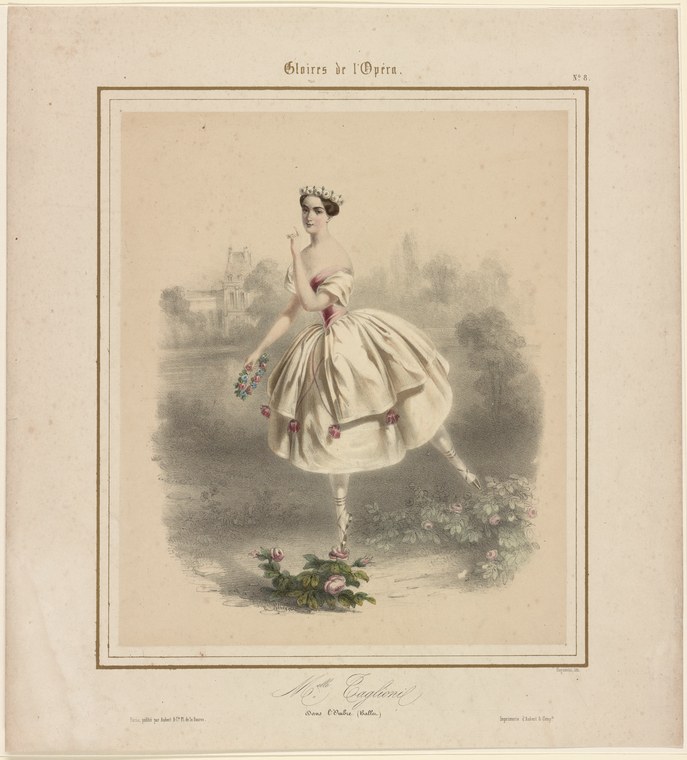
Melle Taglioni dans L'ombre (ballet)
Unknown artist
- Collection:
- Prints depicting dance
- Source:
- New York Public Library
- Rights:
- Public domain — free to use, share and adapt.
- Recorded as:
- Public Domain
This image preserves a record of how Romantic ballet characters were costumed, posed, and presented to audiences—knowledge that cannot be recovered from written sources alone. The refinement of the pose and the delicacy of the hand-coloring demonstrate the high production standards of mid-nineteenth-century ballet promotion, showing that dance was already understood as a subject worthy of fine-art print techniques. For anyone studying Romantic ballet aesthetics, the evolution of ballet costume, or the role of prints in dance history, this work is essential visual evidence.
What you are looking at
A young woman in a voluminous white ball gown stands in a graceful pose against a softly shaded landscape background. She wears a jeweled tiara and holds a small bouquet of flowers in one hand while her other arm is raised expressively. Her posture is elongated and refined, with her weight shifted onto one leg in a balletic stance. The gown is gathered at the waist with colored ribbons and has the characteristic silhouette of 1840s Romantic ballet costume. Behind her, a misty architectural structure—possibly a castle or palace—rises among trees, establishing an aristocratic theatrical setting. The entire composition is rendered in a hand-colored lithographic print with soft gradations of tone that emphasize the ethereal, otherworldly quality of the figure.
The dancing
The dancer stands in a single-figure composition occupying most of the frame. Her weight rests on her supporting leg while the other leg is relaxed, suggesting a moment of pause or balance rather than active movement. Her upper body is upright and elongated, with one arm extended downward holding flowers and the other raised at shoulder height in an open, expressive gesture. The raised arm and lifted posture suggest classical ballet port de bras. Her head is held high and tilted slightly, her gaze directed outward with a serene, theatrical expression. The overall frame is one of control and refinement rather than vigorous motion.
The dance depicted
This is a Romantic ballet portrait, almost certainly representing a specific dancer or character in a ballet performance, most likely from the 1840s. The title references 'L'ombre' (The Shadow), suggesting this may depict a moment from a narrative ballet involving a ghostly or ethereal figure. The dancer's costume, posture, and the dreamlike landscape setting are all characteristic of Romantic ballet aesthetics—the genre favored pointe work, ethereal female figures in white tutus, and supernatural or fantastical themes. The bouquet and tiara suggest a character of aristocratic or magical status. The image preserves a record of how Romantic ballet heroines were costumed and presented to audiences of the period.
How it was made
This is a hand-colored lithographic print, a medium well-suited to the soft, atmospheric effects visible here. Lithography allowed for subtle tonal gradations and a broader tonal range than wood engraving, making it ideal for capturing the ethereal quality demanded by Romantic ballet imagery. The soft shading in the background and the delicate rendering of fabric folds and facial features show the technique at its most refined. Hand-coloring was applied after printing, allowing the publisher to produce multiple copies with consistent coloring. This combination made lithographic ballet prints affordable and accessible to middle-class audiences who could not attend live performances, and they circulated widely as souvenirs and promotional images.
About this work
This is a hand-colored lithographic portrait of a Romantic ballet dancer, likely from the 1840s, depicting a character in white ballet costume posed in a graceful, elongated stance against a dreamlike landscape. The work is one of hundreds of similar prints produced during the height of Romantic ballet in Europe, serving both as a record of costume and choreography and as a commodity for audiences. The specific dancer's identity is not recorded in the catalogue, but the costume, pose, and ethereal setting mark this unmistakably as a document of Romantic ballet practice and aesthetics.
Romantic ballet prints like this one were the primary means by which performances reached audiences beyond the theater. They circulated as collectible images, allowing people to own pictures of celebrated dancers and to study the costumes and movements of fashionable ballets. This particular print belongs to the visual archive of one of ballet's most transformative periods.
How to look at it
Attend to the precision of the pose: the elongation of the spine, the placement of weight, and the open port de bras all signal a trained classical dancer. The artist has frozen a moment of poised balance rather than dynamic motion—a moment of stillness within the dance. This was a common compositional choice in ballet prints of the period, emphasizing the dancer's control and elegance rather than the spectacle of jumping or turning. The soft, atmospheric background is not naturalistic; it is a theatrical convention meant to suggest the magical or dreamlike worlds that Romantic ballet inhabited. The bouquet and tiara are narrative props that would have signaled the character's identity to a contemporary viewer familiar with the ballet.
The artist
The artist is not recorded in the catalogue. However, the style and technique are consistent with mid-nineteenth-century Parisian lithographic workshops that specialized in theatrical prints. The refinement of the hand-coloring and the composition suggest work by an established printmaker catering to the opera and ballet market. Similar prints were produced by firms such as Martinet and Imp. Lemercier in Paris during the 1840s, though attribution would require additional research.
The period
This print dates to the height of Romantic ballet in Europe, approximately 1840–1850, when the genre was at the peak of its popularity and artistic innovation. The ethereal female figure, supernatural narrative, and Orientalist or exotic settings characteristic of works like *La Sylphide* (1832) and *Giselle* (1841) dominate the visual culture of dance during this period. Lithographic printing had become the dominant medium for theatrical portraiture, allowing mass production of images that fed a growing public appetite for ballet. The white tutu and pointe work visible here represent technologies that were still relatively new—pointe shoes had been refined only in the previous decade, and the aesthetic of weightlessness and otherworldliness that they enabled became the defining visual language of Romantic ballet. This print circulated in a market that spanned Europe and included both elite collectors and middle-class opera-goers.
Where it lives
The print is held in the NYPL's Prints collection documenting dance. It is catalogued as depicting a ballet, but the specific work, date, and dancer's name have not been recorded. The print's dimensions, publication information, and printer's mark (if visible) would help establish its origin within the 1840s Parisian ballet print market more precisely.
Dance in this work
Questions about this work
Who was Mlle Taglioni and why would she be the subject of a print?
Marie Taglioni (1804–1884) was one of the most celebrated dancers of the Romantic era and the first great ballerina to perform en pointe. She danced in *La Sylphide* (1832), which became the defining work of Romantic ballet. Taglioni's name and image were widely reproduced in prints, drawings, and photographs throughout Europe because she was an international celebrity and her performances established the aesthetic of Romantic ballet. However, this specific print cannot be confirmed as depicting Taglioni without additional documentary evidence; it may instead represent an unnamed dancer or another performer in a similar Romantic ballet role.
What does the title 'L'ombre' mean and what does it tell us about the ballet?
'L'ombre' means 'The Shadow' in French. This suggests the print depicts a character associated with shadow, ghosts, or the supernatural—a common theme in Romantic ballet narratives. Many Romantic ballets featured encounters with otherworldly female figures (sylphs, spirits, ghosts) who appeared to mortal men, and this aesthetic of ethereality and mystery is reflected in the dreamy landscape and the dancer's ethereal pose and costume.
How were these prints made and distributed?
Lithographic prints were created by drawing an image on a specially prepared limestone surface, which was then chemically treated and printed using oil-based ink. The resulting prints were hand-colored by teams of workers, typically women, who applied watercolor or gouache in a production-line process. These prints were affordable compared to oil paintings and were sold at theaters, in shops, and through print dealers. They were collected by middle- and upper-class consumers as souvenirs of favorite dancers and performances.
Why would anyone want a print of a dancer?
In the nineteenth century, before photography became widespread, prints were the primary way to own an image of a favorite performer. Ballet audiences were as devoted then as modern fans are to theater and film; prints allowed them to study a dancer's costume, posture, and expression, and to display admiration for celebrated artists. They also served as promotional material for ballet companies and could be sold at the theater as part of the entertainment experience.
More dance artwork





