49 works in this view — arrow keys or swipe to move between them.
Dance in Art
Die Maskerade
Unknown artist
- Collection:
- Prints depicting dance
- Source:
- New York Public Library
- Rights:
- Public domain — free to use, share and adapt.
- Recorded as:
- Public Domain
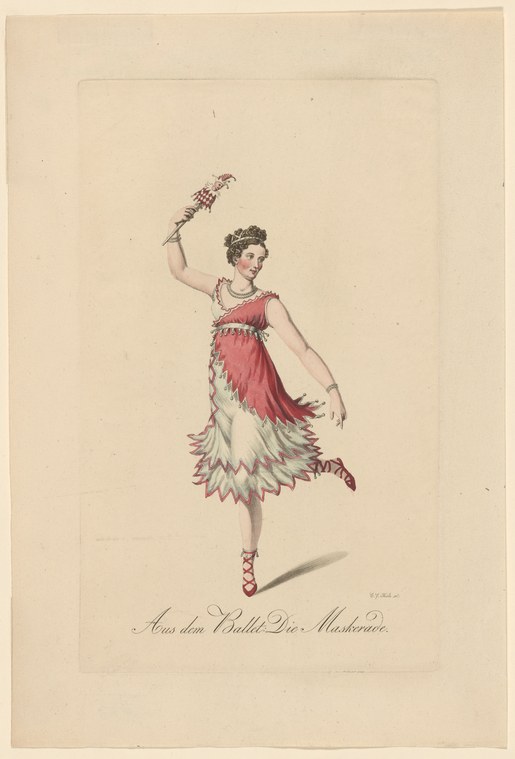
This print documents the visual culture of Romantic ballet and the central role of elaborate costume in creating theatrical character and fantasy. For historians and dancers, it reveals how nineteenth-century audiences experienced the dancer as a visualized, costumed figure, and how classical technique was adapted to support fantastic and whimsical characters rather than pure classical form.
What you are looking at
A single female dancer stands in a graceful pose against a pale background, captured in what appears to be a hand-colored engraving or lithograph. She wears a striking costume: a fitted bodice in coral or salmon pink with a classical waistline, from which hangs a short skirt composed of layered white and pink feathers or scalloped panels that create a feathered or fish-tail silhouette. Her legs are bare, and she wears pink laced or strapped heeled shoes. Her dark hair is styled up in a classical arrangement, and she wears what appears to be a small decorative headdress or wreath. Her left arm is raised overhead in an elegant arc, holding what looks like a small floral wreath or garland, while her right arm extends gracefully to the side. She stands in a nearly profile view, balanced on one leg with the other leg extended or lightly touching the ground, creating an impression of weightless, arrested motion. The composition suggests a moment of theatrical poise rather than dynamic movement—the dancer appears poised, almost statuary, as if caught between steps or presenting herself to an audience.
The dancing
The single dancer demonstrates a refined, upright carriage typical of early-to-mid-nineteenth-century theatrical dance. Her raised arm forms an elegant overhead arc—a position associated with classical ballet vocabulary—while her lower body maintains a light, poised stance suggestive of turnout and control. The extended leg and the balletic frame of the torso indicate training in formal dance technique. Her posture conveys balance and restraint rather than dynamic propulsion; the lifted headdress and upraised arm suggest she is presenting or displaying herself, a convention of masquerade or costume performance.
The dance depicted
This is almost certainly a Romantic-era theatrical dance costume study, most likely depicting a character from a popular pantomime or ballet-pantomime of the 1820s–1840s. The coral-and-white feathered skirt, the mask-like headdress, and the title "Die Maskerade" (The Masquerade) suggest this is a masked ball or masquerade figure—possibly a sylph, fairy, or fantastical creature rendered in the picturesque and whimsical vocabulary of Romantic ballet. The dancer's pose and refined technique place her squarely within the classical ballet tradition, yet the exotic costume and emphasis on display suggest this is character or specialty dance rather than pure classical technique. The upraised wreath and the lightness of the composition evoke the ethereal quality prized in mid-nineteenth-century ballet.
How it was made
This is a hand-colored engraving or lithograph, a reproductive print technique that allowed wide circulation of theatrical costume designs and dance imagery in the nineteenth century. The delicate hand-coloring—visible in the pink tones of the bodice and shoes, the subtle shading of the feathered skirt—indicates this was colored after printing, a labor-intensive process that suggests the work was valued and intended for affluent collectors or theatre aficionados. The technique allowed for detailed rendering of the costume's construction and the dancer's refined posture, making this a document of both theatrical design and pedagogical interest.
About this work
This is a costume study of a Romantic-era theatrical dancer in masquerade dress, rendered as a hand-colored engraving. The work documents both the refinement of classical ballet technique and the taste for exotic, fanciful costume that characterized popular entertainment in the 1820s–1840s. The German title and the stylistic conventions suggest this is a European print, likely German or Austrian, produced for the theatre-going public or dance pedagogy market.
The image preserves a moment in the history of theatrical spectacle when ballet was becoming a dominant form of popular entertainment and when the printed image of the dancer—the costume, the pose, the refinement—was as important as the dance itself. This is not a representation of movement in its fullness, but rather a display of the dancer as a designed, composed figure: the masquerade costume, the classical pose, and the wreath held aloft as attributes of a theatrical role.
How to look at it
Attend to the dancer's posture and the precision of her pose: the lifted arm, the extended leg, and the upright carriage all demonstrate classical training and theatrical composure. Notice how the feathered skirt, despite its fantastical appearance, hangs and moves in relationship to the dancer's body—the costume is designed to show the line and carriage of the trained dancer, not to obscure it. The hand-coloring of the print is delicate and controlled; the pink and white color scheme emphasizes the lightness and ethereality of the figure. The dancer's gaze and profile position suggest a moment of presentation or display rather than active movement; this is a theatrical pose, frozen for the print, meant to convey character and costume rather than the flow of dance.
The period
This work belongs to the height of Romantic ballet in Europe (approximately 1820–1850), when ballet companies across major cities were producing elaborate pantomime-ballets and shorter divertissement pieces featuring exotic costumes, fantastical themes, and a visual aesthetic that prized lightness, delicacy, and theatrical surprise. Hand-colored prints documenting individual dancers and their costumes were a significant medium of theatrical promotion and circulation; they allowed dancers to be recognized and celebrated beyond the theatre, and allowed designs to be shared across cities and nations. The masquerade theme was a perennial favorite in theatrical dance, drawing on the carnival tradition of eighteenth-century Venice and the masked ball scenes in contemporary literature and opera. The feathered, high-waisted costume reflects the Romantic taste for natural, organic forms and for the silhouette of the 1820s–1830s fashionable dress.
Where it lives
This work is part of the New York Public Library's collection of prints depicting dance. It is a hand-colored engraving or lithograph, likely a European production of the nineteenth century, created as a costume study or promotional image for theatrical use.
Dance in this work
Questions about this work
What does the title 'Die Maskerade' refer to?
The German title indicates this is a figure from a masquerade or masked ball scene, possibly a character from a ballet or pantomime performed in a German-speaking region. The feathered costume and the wreath held aloft are attributes of a masked or fantastical character, rather than a realistic figure.
What dance form is this?
This appears to be Romantic-era ballet or ballet-pantomime, likely a character or specialty dance within a longer theatrical work rather than a classical solo. The refined posture and technique indicate classical ballet training, but the costume and presentation suggest this is a supporting or featured character role.
When was this made?
The style of the costume, the hand-coloring technique, and the overall aesthetic suggest this was produced in the 1820s–1840s, during the height of Romantic ballet in Europe. The German title and printing conventions point to a German or Austrian origin.
Why would this image have been made and circulated?
Hand-colored costume prints were important promotional and documentary tools in nineteenth-century theatre. They allowed dancers to be publicized, allowed designs to be shared across cities, and served as a record of successful productions. They were sold to theatre enthusiasts and collectors.
More dance artwork





