49 works in this view — arrow keys or swipe to move between them.
Dance in Art
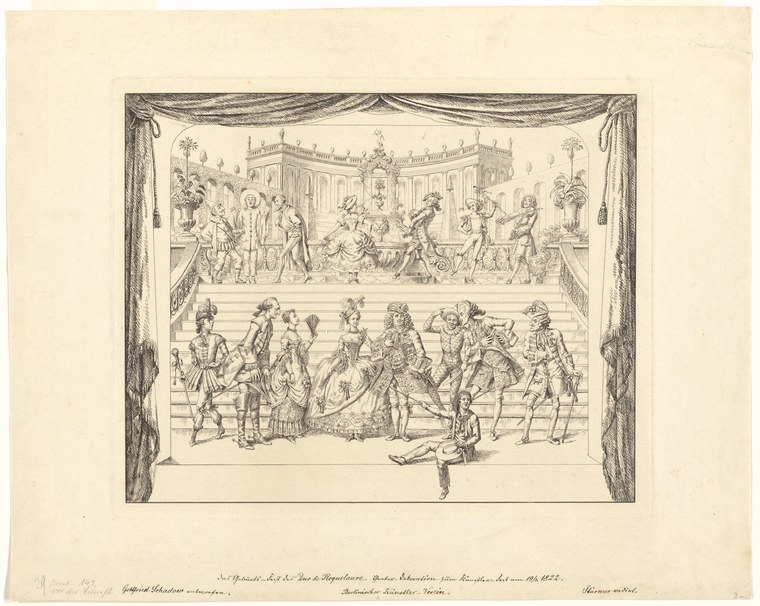
Das Geburtstagsfest des Duc de Roquelaure: [uncolored etching]
Unknown artist
- Collection:
- Prints depicting dance
- Source:
- New York Public Library
- Rights:
- Public domain — free to use, share and adapt.
- Recorded as:
- Public Domain
For historians of 18th-century court dance, this image documents how the minuet, cotillion, or related court forms were actually staged and positioned within the social geography of the ballroom. The composition reveals that formal court dancing was fundamentally theatrical: a performance of rank and elegance as much as a display of movement. The image is one of very few surviving visual records that show the full spatial and social context of these dances, rather than isolating individual figures or couples.
What you are looking at
An uncolored etching depicting an elaborate indoor celebration or court festivity. The composition is divided into two registers: an upper stage or platform where elaborately dressed courtiers and musicians perform or gather beneath a grand architectural backdrop with classical columns and a draped canopy, and a lower foreground where additional figures in 18th-century dress stand or move across a checkered floor. The setting suggests a palace ballroom or great hall, with ornate furnishings, potted plants, and formal architectural elements. The overall effect is one of theatrical ceremony—the event appears staged or choreographed, with figures arranged to display their dress, position, and participation. Light is created through the contrast of fine etched lines, with denser cross-hatching defining shadows and spatial depth.
The dancing
The figures throughout the composition are rendered in the formal postures characteristic of 18th-century court dress and deportment. In the upper register, some figures appear to be in motion or in posed attitudes suggesting performance; in the lower foreground, several figures stand in the closed holds or near-proximity typical of couple dances of the period, with one woman's full skirts prominent. The arms and bodies are upright and controlled, consistent with the restrained aesthetic of court dancing. No obvious footwork is visible, but the overall arrangement suggests a carefully choreographed or at least formalized grouping of dancers and attendants.
The dance depicted
This appears to document a formal court dance or ball, most likely a ball given by or for French nobility in the late 18th century (the title references the Duc de Roquelaure). The dominant dance forms at such events were the minuet, cotillion, and quadrille. The composition—with couples standing ready or in conversation, the formal dress, the architectural setting, and the orchestration of space—is consistent with the minuet or cotillion as social theater. The image is not precise enough to identify specific steps or holds, but the overall choreography of the scene reflects the structure of formal court dance: a structured event in which rank, dress, and comportment were as important as movement itself.
How it was made
This is an etching, as noted in the title, executed with fine parallel lines and cross-hatching to establish tone and depth. The uncolored state was standard for prints of this kind, allowing for wider distribution and lower cost; hand-coloring could be added by purchasers. The technique of etching—with its capacity for fine detail and repeatability—made such theatrical and court scenes popular subjects for documentation and circulation among educated audiences. The presence of framing drapes and the theatrical composition suggest the print was intended to record and commemorate a specific event or to serve as a souvenir of court life.
About this work
This etching documents a formal court celebration, likely a ball or festivity at a French nobleman's residence in the late 18th century. The artist has composed the scene in two registers—a staged performance or gathering above and courtiers or dancers below—to capture both the theatrical and social dimensions of court dancing. The work is a record of how elite dance was performed, seen, and commemorated in the period: not as a display of pure movement, but as a carefully orchestrated public presentation of dress, rank, and deportment. The etching format and the care taken to represent architectural and sartorial detail suggest the work was intended for circulation among the educated elite who patronized such events.
How to look at it
Look first at the two-register composition: the upper stage is where the formal choreography and performance occur, while the lower register shows the social reality of the ballroom—the waiting, the conversation, the next couple preparing to dance. Notice how the artist has used architectural detail and drapery to create a sense of occasion and formality. The figures' upright posture and the distance maintained between bodies (except in the few couples clearly dancing) reflects the restrained physical vocabulary of court dance. The etched line is finest in the foreground figures and the architectural elements, showing where the artist concentrated detail; this precision in dress and setting underscores that the dance itself was inseparable from the costume and ceremony.
The period
The late 18th century was the golden age of the French court ball and the height of the minuet's popularity as both a social dance and a performance art. By this period, the minuet had become increasingly formalized and theatrical, often opening grand balls as a kind of ceremonial prelude. The cotillion, a more complex and sociable figure dance, was also gaining ground. The etching medium was the primary means by which such events were recorded and circulated; engraved and etched prints of court life, fashion, and festivity were sought after by the aristocracy and by a growing middle-class audience interested in court culture. This work sits within a rich tradition of French court imagery that documented both the dances and the social rituals surrounding them.
Where it lives
The work is held in the New York Public Library's collection of prints depicting dance. It is part of a broader archive of theatrical and social imagery from the 18th century, documenting customs and entertainments of the European court.
Dance in this work
Questions about this work
What dance is this showing?
The image does not show a single identifiable dance, but rather a formal court ball or festivity. The setting and attire are consistent with the minuet, cotillion, or other court dances of the late 18th century. The composition emphasizes the theatrical and social aspects of the event—the dress, the architecture, the arrangement of figures—rather than specific choreography or steps.
Why is the image divided into two levels?
The two-register composition is a compositional device that allows the artist to show both the performance (upper stage) and the social context (lower foreground). This structure was common in theatrical and court imagery of the period, and it reflects the actual experience of the ball: some figures were actively dancing while others watched, waited, or socialized.
Who was the Duc de Roquelaure?
The title identifies this as a celebration given by or for a French nobleman of that name. Without further information, we cannot identify which Roquelaure is meant or the date of the event, but the reference suggests this was a documented or notable occasion in French court life.
How was this image circulated?
As an etching, this work could be printed repeatedly from the copper plate and distributed to patrons and collectors. Hand-coloring could be added by buyers. Such prints were popular among the nobility and educated middle classes as records of court fashion, dance, and festivity, and as souvenirs of important social events.
More dance artwork





