49 works in this view — arrow keys or swipe to move between them.
Dance in Art
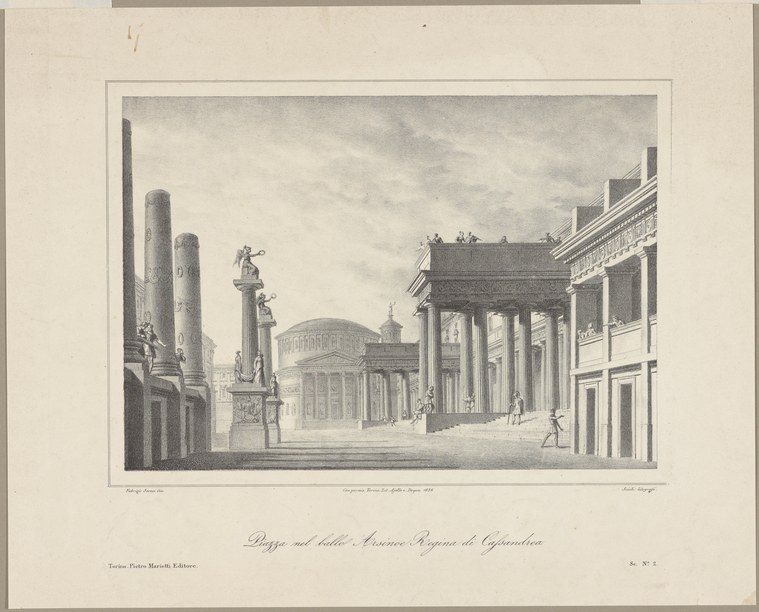
Piazza nel ballo Arsinoe regina di Cassandrèa
Unknown artist
- Collection:
- Prints depicting dance
- Source:
- New York Public Library
- Rights:
- Public domain — free to use, share and adapt.
- Recorded as:
- Public Domain
This work preserves evidence of how dance functioned within courtly operatic spectacle—not as independent art but as one element within a total theatrical composition that privileged architecture and stately decorum. For dance historians, it illustrates the aesthetic principles governing court ballet: geometric spacing, restraint, and the body's subordination to grand formal design. The print medium allowed such stage designs to circulate as records of artistic achievement, making them valuable sources for understanding what eighteenth-century spectacle actually looked like.
What you are looking at
A formal neoclassical plaza viewed from within a colonnade, with dancers positioned across an expansive paved courtyard. The space is bounded by monumental architecture: tall fluted columns and pedestals with figural sculptures on the left, a domed building at center distance, and a porticoed structure on the right with a mansard roof and regularity of fenestration. The sky is luminous but overcast. Several small human figures are scattered across the plaza—some appear to be dancing or in graceful postures, others standing or conversing. The perspective and scale emphasize the grandeur of the setting over the human action. The light is even and cool, with subtle tonal gradations typical of eighteenth-century engraving, giving the scene an idealized, theatrical quality.
The dancing
The dancers are rendered in small scale against the monumental setting, making precise movement analysis difficult. What bodies are visible show upright postures in what appears to be classical or courtly bearing, with arms in various positions suggesting formal gesture rather than vernacular movement. The scattered placement across the plaza suggests a processional or ceremonial arrangement rather than closed partnership. No dancers are in tight physical contact; spacing is formal and expansive.
The dance depicted
This appears to depict a court or operatic ballet of the late eighteenth century, most likely a scene from the opera-ballet *Arsinoe, Queen of Cyprus* (title translates as 'Piazza in the ballet Arsinoe, Queen of Cassandra'). The neoclassical setting and formal spacing are consistent with the grand ballet de cour tradition in which dance was integrated into larger theatrical spectacles. The idealized architectural backdrop suggests this is a designed stage set rather than a real plaza, and the small scale of the figures emphasizes decorum and stately geometric arrangement over individual virtuosity. This appears to be theatrical dance of the courtly or operatic tradition rather than social dance.
How it was made
This is an engraving, rendered in the fineline etching and cross-hatching technique characteristic of eighteenth-century theatrical prints. The fine detail and tonal range achieved through closely spaced parallel lines and varying densities of mark-making allowed for the subtle gradations of light across the plaza and on the architecture. Such engravings were commonly produced as documentation of stage designs and operatic productions, serving as circulating images for aristocratic audiences and within the theatrical profession. The medium was well-suited to the linear perspective and architectural grandeur that the artist emphasizes.
About this work
This is a theatrical scene from an eighteenth-century opera-ballet, depicting dancers posed in a grand neoclassical plaza. The work documents both the choreographic and architectural ambitions of late Baroque/early Rococo court theatre, where dance was integrated into elaborate staged spectacles designed by master architects. The emphasis is on the stage design and spatial composition rather than the movement itself—the dancers are participants in a monumental architectural fantasy rather than the primary focus. As theatrical documentation, it reveals how dance was conceived as part of total spectacle: the bodies must fit within and subordinate themselves to the designed space.
How to look at it
Attend to the relationship between bodies and architecture. The dancers are positioned like figures in a painting by Poussin—distributed across the plaza in attitudes of classical decorum, their movements muted and formal. The artist has chosen to depict a stately moment rather than one of vigorous action. Notice how the eye is drawn first to the monumental colonnade and dome, and only secondarily to the small human figures—this hierarchy reflects the period's conception of dance as part of architectural spectacle. The even illumination and cool tonality create a sense of timeless, idealized grandeur.
The period
This engraving dates from the era when opera-ballet was the dominant theatrical form in European courts, particularly at Venice, Rome, and Vienna. Dance in this period was increasingly integrated into larger spectacular productions rather than existing as independent social practice. The neoclassical aesthetic visible in the architecture—the strict geometry, the Doric columns, the dome—reflects the mid-eighteenth-century embrace of classical antiquity as a model for both art and design. Theatrical prints like this one were a significant genre, circulating among aristocrats and theatre professionals as records of prestigious artistic productions.
Where it lives
This engraving is held as part of the New York Public Library's collection of prints depicting dance. The inscription at bottom suggests it was produced as documentation of an operatic production, likely circulating among court audiences or theatre professionals.
Dance in this work
Questions about this work
What is the dance in this picture?
This depicts a scene from an eighteenth-century opera-ballet, a theatrical form in which dance was integrated into larger staged spectacles. The specific work appears to be *Arsinoe, Queen of Cyprus*. The dancers are positioned in a formal, processional arrangement that emphasizes courtly decorum and geometric spacing rather than the display of individual virtuosity.
Who would have danced this?
Court dancers trained in the classical ballet technique of the period, performing in an aristocratic or princely theatre. Such performers were highly trained professionals, not amateurs, though their movement style emphasized restraint and formal bearing rather than the virtuosic technique associated with later Romantic and modern ballet.
Why is the architecture so prominent?
The monumental neoclassical setting is integral to the work's meaning. Theatre of this period conceived dance as one element within a total spectacle that included lavish scenery, costumes, and music. The grand plaza and colonnade were designed to create an atmosphere of timeless classical grandeur in which the dancers' restrained movements would be seen as part of an idealized world.
How was this print made?
This is an engraving, produced by incising fine lines into a metal plate and inking to create prints. The technique allowed for the subtle tonal gradations and linear detail visible here, and made it possible to produce multiple copies for circulation among court audiences and theatre professionals as a record of the production.
More dance artwork





