49 works in this view — arrow keys or swipe to move between them.
Dance in Art
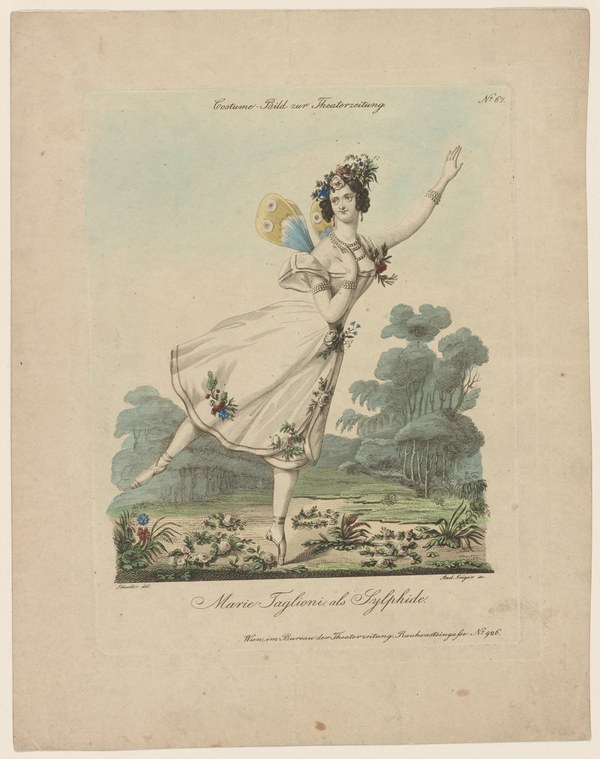
Marie Taglioni als Sylphide
Unknown artist
- Collection:
- Prints depicting dance
- Source:
- New York Public Library
- Rights:
- Public domain — free to use, share and adapt.
- Recorded as:
- Public Domain
Taglioni's Sylphide defined Romantic ballet for a generation and made her the first truly international superstar of dance. This print, circulated widely during her career, shaped how audiences across Europe understood what ballet was and could be—ethereal, technically virtuosic, otherworldly. For a historian or dancer studying the history of ballet technique, Romantic aesthetics, or 19th-century dance celebrity, this image is documentary evidence of how the period's most celebrated artist was seen and celebrated.
What you are looking at
A single female dancer is posed mid-leap or mid-arabesque against a Romantic landscape, her body captured in a dramatic upward thrust. She wears a white or pale muslin dress with a fitted bodice and a long, flowing skirt decorated with floral garlands or wreaths that wrap around her waist and legs. Her dark hair is elaborately styled with flowers and feathers piled high on her head. She holds a large fan or palette-like object (possibly a theatrical prop) in her raised hand, painted in pale yellow with blue accents. The background shows a pastoral woodland scene with green foliage, trees, and what appears to be a classical garden or forest setting rendered in soft greens and warm tones. The ground beneath her feet displays flowering plants and garden elements. The entire composition is framed in the characteristic hand-colored engraving style of the early 19th century, with a cream or aged paper tone suggesting a historical print.
The dancing
The single figure is positioned in what appears to be an arabesque or soaring leap, with her torso lifted and extended, her right arm raised holding the theatrical prop, and her body weight seemingly suspended in air. Her posture shows the characteristic lifted carriage and elongation of line associated with Romantic ballet technique. The raised arm, extended leg line, and ethereal quality of the pose suggest technical control and training in the classical manner. Her costume—particularly the pale, lightweight muslin with its flowing panels and floral decoration—allows for visibility of the body's line and movement.
The dance depicted
This is almost certainly a representation of Marie Taglioni performing in La Sylphide, the titular role of the most celebrated Romantic ballet of the 1830s. The work's premiere at the Paris Opéra in 1832 made Taglioni an international star, and she danced the role for decades. The pale muslin dress, floral wreaths, the ethereal, gravity-defying pose, and the woodland setting are all iconic to Sylphide iconography. The dramatic upward arabesque and the theatrical prop (possibly representing the magic or otherworldliness of the Sylph character) capture the essence of Romantic ballet at its height—a dance form emphasizing weightlessness, supernatural themes, and technical display on pointe. This particular image was clearly made to commemorate Taglioni's fame in this role.
How it was made
This is a hand-colored engraving, a reproductive print technique common in the 1830s–1850s for theatrical celebrity portraiture and dance documentation. The fine line work visible in the figure and background, combined with the careful watercolor or gouache hand-coloring, indicates this was a commercial print, likely created for a broad audience hungry for images of famous dancers. The technique allowed rapid production of multiple copies from a single engraved plate, making such celebrity images widely accessible. The quality of coloring and the refined engraving suggest this was a relatively high-end example, distributed to an educated audience with interest in the arts and theater.
About this work
This is a hand-colored engraving documenting Marie Taglioni, the most celebrated dancer of the Romantic era, in her signature role as the Sylph in Marius Petipa's La Sylphide (1832). Taglioni effectively invented the visual vocabulary of Romantic ballet—the weightless arabesque, the pale muslin dress, the ethereal supernatural character—and this print captures her at the apex of her fame. The work is both a portrait of a historical dancer and a document of the Romantic ballet aesthetic: it shows how the period understood and valued ballet technique, how the dancer's body was framed in performance, and what theatrical innovation looked like in the early 19th century. It belongs in a gallery of dance because it is one of the canonical images of Western theatrical dance, reproduced across Europe and responsible for fixing in visual culture the very idea of "ballet" that persists to this day.
How to look at it
Look first at the pose itself: the dramatic upward thrust of the body, the extended leg and lifted carriage, the sense of weightlessness despite being frozen in an engraving. The artist has chosen the moment of maximum elevation and extension—the apex of the leap or arabesque—which is the quintessential Romantic ballet image. Notice how the pale, flowing costume and floral decoration reinforce the ethereal effect; this was a deliberate costume innovation by Taglioni and her collaborators to support the visual fantasy of the supernatural Sylph. The woodland background and the palette-like object in the dancer's hand are clues to the narrative: this is not abstract dance but a scene from a story. Finally, observe how the print's hand-coloring creates luminosity and depth, making the figure seem to glow against the darker forest—a technique perfectly suited to conveying the magical quality the role demanded.
The artist
The artist of this print is not recorded. However, the work's inscription credits it to Vienna (Wiener Verlag, or a Vienna publisher), suggesting it was produced as part of the European-wide frenzy for Taglioni images in the 1830s–1840s. Many theatrical celebrities of the period were documented by multiple engravers; this particular example follows the conventions of mid-19th-century lithographic and engraved theatrical portraiture. The unsigned state is typical for reproductive prints of this era, where the engraver's craft and the celebrity of the subject mattered more than the artist's individual identity.
The period
This print dates to the height of Romantic ballet (approximately 1830s–1850s), when ballet became a vehicle for exploring themes of the supernatural, the exotic, and the fantastical. La Sylphide, premiered in 1832, was central to this shift: it replaced the spectacular, human-centered spectacle of Neoclassical ballet with an emphasis on the ethereal and otherworldly. The new technology of pointe work (soft blocked shoes) allowed dancers like Taglioni to appear weightless and unearthly. In the broader art world, this period saw Romanticism's full flowering—an emphasis on emotion, nature, and the transcendent. Reproductive prints of dancers became a major commercial and cultural product, spreading images of theatrical stars across Europe and establishing visual conventions for how dance should look. This print is both a piece of theatrical ephemera and a cultural artifact documenting the moment when ballet became a mainstream European obsession.
Where it lives
This hand-colored engraving is held in the New York Public Library's collection of prints depicting dance. It was produced in Vienna (as indicated by the publication credit) in the early-to-mid 19th century, likely between 1832 and 1850. It is one of many theatrical celebrity prints that formed a commercial culture of dance documentation in this period.
Dance in this work
Questions about this work
Who was Marie Taglioni?
Taglioni (1804–1884) was an Italian-Swedish dancer who became the most famous performer of the Romantic era. She was celebrated for her technical innovation (she was among the first to master pointe work), her ethereal stage presence, and her starring role in La Sylphide, which premiered in Paris in 1832. She danced across Europe for decades and became the first international superstar of ballet. After her retirement from performance, she became a teacher and a living legend of the art form.
What is La Sylphide and why was it important?
La Sylphide, choreographed by Filippo Taglioni (Marie's father) with music by Jean Schneitzhoeffer, premiered at the Paris Opéra in 1832. It was the defining work of Romantic ballet, establishing the genre's characteristic themes (the supernatural, the exotic, the unattainable beloved) and aesthetic (weightlessness, ethereal beauty, pointe work as a visual metaphor for otherworldliness). The ballet remains in the repertory today in versions by Bournonville and others; Taglioni's role as the Sylph is still considered one of the greatest roles in the ballet canon.
Why are there so many prints of Taglioni?
Taglioni was the first truly global superstar of dance, and her fame created a commercial market for images. Hand-colored engravings and lithographs were an affordable, widely-distributed medium in the 19th century, and publishers across Europe produced and sold prints of famous actors and dancers. These served as souvenirs, publicity, and objects of fandom. The proliferation of Taglioni images is evidence both of her historical celebrity and of the new mass culture of theater that emerged in this period.
How did the Romantic ballet aesthetic change dance?
Romantic ballet shifted focus from spectacle and narrative clarity (the Neoclassical model) to mood, atmosphere, and the visual expression of emotion and transcendence. Soft pointe work, pale costumes, supernatural themes, and an emphasis on the female dancer's weightlessness and beauty became the new aesthetic. This period established many conventions that still define classical ballet today: the ethereal female lead, the emphasis on line and carriage, the use of narrative ballet to explore themes beyond the human or rational.
More dance artwork





