49 works in this view — arrow keys or swipe to move between them.
Dance in Art
Fanny Elsslers dances
Unknown artist
- Collection:
- Prints depicting dance
- Source:
- New York Public Library
- Rights:
- Public domain — free to use, share and adapt.
- Recorded as:
- Public Domain
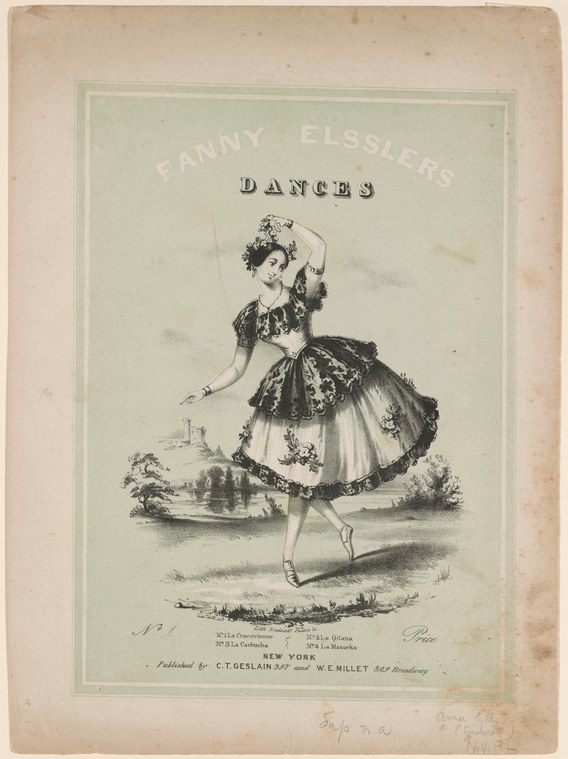
This print preserves the appearance and theatrical style of one of the nineteenth century's most influential dancers at a moment when photography could not yet capture stage performance. It documents both how Elssler was promoted to the public and what the physical ideal of Romantic dancing looked like in her era.
What you are looking at
A young female dancer in theatrical costume stands in a graceful pose against a landscape background. She wears a short tulle skirt with a floral or patterned decoration, a fitted bodice with short sleeves, and what appears to be a decorative headpiece or tiara. The skirt is caught mid-gesture, lifted on one side, revealing the dancer's legs and emphasizing the line of the pose. Her arms are positioned expressively—one raised, one lowered—in an attitude suggesting arrested motion. The background shows a distant landscape with trees or foliage, rendered in soft wash technique. The whole composition is framed by a pale green border. Text at the top reads "FANNY ELSSLER'S DANCES" in both script and roman capitals. A publication line at the bottom indicates New York printing.
The dancing
A single dancer is shown en attitude, the raised leg and lifted skirt indicating elevation or a balletic pose. The dancer's upper body is upright; the arms frame the figure without crossing the body. The weight appears on the supporting leg, with the body angled to display the silhouette of the lifted skirt. The pose is controlled and formal, consistent with early nineteenth-century theatrical vocabulary—the elongated line of the neck, the angle of the head, and the placement of the arms all follow the aesthetic conventions of the era.
The dance depicted
This is a print commemorating Fanny Elssler, the celebrated Austrian dancer of the Romantic era. Elssler was one of the most famous stage performers of the 1830s–1840s, known for both classical ballet and for character dances—particularly Spanish and Eastern European folk-derived pieces that brought her international renown. The pose and costume here suggest a moment from one of her theatrical roles. The tulle skirt, headdress, and the specific attitude of the body are consistent with the Romantic ballet aesthetic, and the pose may depict a scene from one of her famous performances, though without further documentation the specific role cannot be confirmed.
How it was made
This is a lithographic print, identifiable by the fine linework, tonal wash, and the characteristic pale green tinted border typical of theatrical prints of the period. Lithography allowed for relatively rapid reproduction and broad distribution, making theatrical prints an accessible and popular form of fan merchandise and publicity during the nineteenth century. The print was produced in New York and published by C. T. Geslain, indicating it was intended for the American market during Elssler's North American tours.
About this work
This print celebrates Fanny Elssler at the height of her international fame as a Romantic-era dancer. It captures a single pose—a moment of theatrical grace—and was circulated as a form of popular fan merchandise during her performing career. Elssler's fame and her influence on theatrical dance, particularly in bringing character and national dances to the concert stage, made her one of the most recognizable performers of her generation, and prints like this one were key to building and sustaining that celebrity.
The work belongs in a dance history collection as a document of early nineteenth-century theatrical practice, celebrity culture, and the visual conventions used to represent female dancers on stage. It testifies to the international reach of Romantic ballet and to the ways that lithography democratized access to images of famous performers.
How to look at it
Attend to the pose itself: the dancer is shown not in motion but in a held attitude, a moment of balance and control. This was the standard convention for representing dancers in prints—not the peak of a jump or a dramatic gesture, but a stable, repeatable position that displayed the line of the body and the skill of the performer. Notice the care taken with the skirt, which is lifted to show the leg and the bodice beneath; this was a new and celebrated feature of Romantic ballet costume. The distant landscape setting, though minimal, locates the dancer in a theatrical space rather than a studio, and the decorative border frames her as a subject of celebrity and admiration.
The artist
The artist is not recorded. However, the print is credited to publication by C. T. Geslain of New York, a lithographic printer who produced theatrical and portrait prints in the 1830s–1840s. Such prints were typically created by theater house artists or commercial lithographers working from life drawings, dance notations, or descriptions provided by theaters and performers' representatives.
The period
This print dates to the era of Romantic ballet (c. 1830–1850), when the ethereal female dancer in tulle, pointe shoes, and ghostly makeup became the dominant image of theatrical dance. Elssler herself straddled two modes of performance: she was trained in classical ballet technique but became equally famous for cachucha (Spanish dance), tarantella (Italian folk dance), and other character pieces that celebrated national and folk traditions. Her success helped establish the respectability of these vernacular forms on the concert stage. Lithographic prints of famous dancers were a major form of theatrical publicity and fan culture during this period, circulated widely in cities where performers appeared.
Where it lives
This print is held by the New York Public Library in a collection of prints depicting dance. It was published in New York and is part of the documentary record of Romantic-era theatrical performance and celebrity in North America.
Dance in this work
Questions about this work
Who was Fanny Elssler?
Fanny Elssler (1810–1884) was an Austrian dancer who became one of the most celebrated performers of the Romantic era. She was trained in classical ballet but achieved international fame largely through her performances of character dances, especially the Spanish cachucha and Italian tarantella. She performed in Europe and North America and was a major box-office draw of the 1830s and 1840s.
What dance is shown in this print?
The specific dance cannot be identified with certainty from the image alone. The pose and costume are consistent with Romantic ballet, and the print may depict a moment from one of her famous roles, but without documentation or inscription on the print itself, we cannot name the exact piece.
Why was she printed so often?
Elssler was a superstar of her time, and prints were a major form of theatrical publicity and fan merchandise. Before photography could capture stage performance, lithographic prints like this one were the primary way audiences could own an image of their favorite performers and circulate that image among friends and family.
What does the pose tell us about Romantic ballet?
The pose—held, balanced, displaying the line of the leg and the tulle skirt—embodies the Romantic ideal of ethereal femininity. The dancer appears weightless and controlled, and the emphasis on the lifted skirt and elongated silhouette shows how Romantic ballet used costume and pose to create a visual ideal of grace and otherworldliness.
More dance artwork





