49 works in this view — arrow keys or swipe to move between them.
Dance in Art
Contredanse monarchique
Unknown artist
- Collection:
- Prints depicting dance
- Source:
- New York Public Library
- Rights:
- Public domain — free to use, share and adapt.
- Recorded as:
- Public Domain
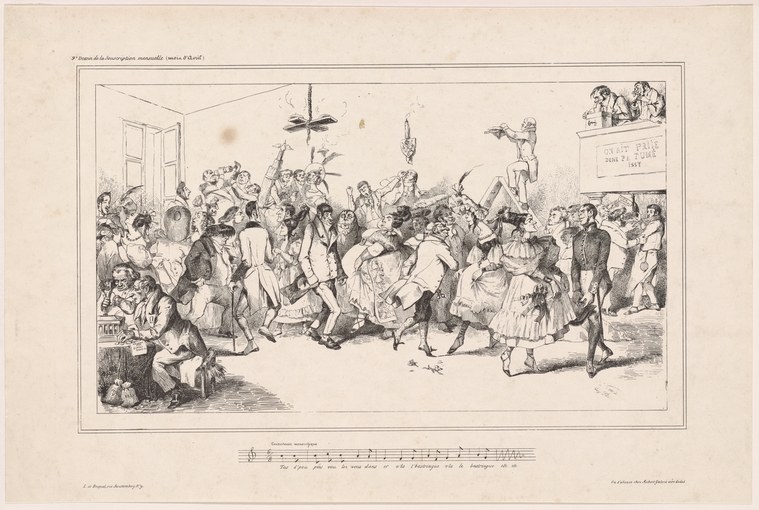
This work preserves visual and musical evidence of how contredanses—one of the 18th century's most important social dances—were actually performed in aristocratic spaces, complete with musicians and the social context in which they occurred. The combination of detailed engraving and musical notation makes it an invaluable historical document for understanding both the choreography and the social meaning of the dance.
What you are looking at
A crowded indoor ballroom or assembly hall is filled with well-dressed figures engaged in a formal group dance. The space is densely populated, with dancers arranged in loose formations across the floor; several couples occupy the foreground while others cluster in the middle distance and around the periphery. The figures wear 18th-century dress—men in coats and breeches, women in full skirts and corseted gowns—and the scene captures a moment of social dancing rather than theatrical performance. A musical ensemble plays at the upper right, and a small raised platform or gallery with spectators is visible above the dancers. The composition is energetic and slightly chaotic, suggesting the lively, somewhat improvisational nature of the gathering, with figures in various attitudes: some in paired formation, others turning or gesturing, a few appearing to address or greet one another. The engraving technique creates strong contrasts and rhythmic line work that emphasizes the movement and social interaction of the crowd.
The dancing
The dancers move in what appears to be a social setting rather than a strictly choreographed line. Some couples are visible in close proximity, though the formal closed ballroom holds of later centuries are not clearly established. Many figures stand or turn with arms raised or extended, suggesting animated conversation and social engagement rather than synchronized arm positions. The density of bodies and variety of poses—some dancers appear mid-turn, others face outward to converse or observe—suggests the informal social structure of a country dance or contredanse where formations shift and regroup. Weight distribution and footwork cannot be determined from the engraving, but the overall posture is upright and formal, consistent with 18th-century courtly deportment.
The dance depicted
This is almost certainly a contredanse, the title 'Contredanse monarchique' confirming the identification. Contredanses were the dominant social dance form of 18th-century Europe, performed by mixed groups arranged in lines, squares, or circular formations. Unlike the stationary patterns of earlier baroque dances, contredanses were characterised by lively footwork, frequent partner changes, and figures that moved dancers through the formation. The title's reference to 'monarchique' suggests this may document a version danced at court or in aristocratic contexts. The crowded, animated scene—with its mix of couples, observers, and musicians—accurately reflects how contredanses functioned as both dance and social event, where the pleasure lay in the figures' complexity and in the frequent regrouping of partners.
How it was made
This is an engraving, created through incised lines on a metal plate (likely copper) that held ink to transfer the image onto paper. The technique is evident in the fine parallel hatching used to create shadow and modelling, the precise linear definition of figures and clothing, and the overall clarity and reproducibility of the image. Engravings were among the most economical and widely distributed prints of the 18th century, allowing this dance scene to circulate to a broad audience—dance masters, nobility, and middle-class music lovers alike. The presence of musical notation at the lower edge of the sheet confirms this was a practical document, likely from a dance manual or instructional publication, meant to teach the dance and preserve its form.
About this work
This is a satirical or documentary engraving of an 18th-century contredanse in a royal or aristocratic setting, presented as an instructional plate combining image and musical notation. Contredanses dominated European social dance for much of the century, and this image captures both the dance's characteristic energy and the social world in which it was performed—a crowded assembly hall where dancing was inseparable from courtship, status display, and sociability. The engraving's title invokes monarchy, suggesting that this particular version held prestige or had courtly association, yet the crowded, somewhat chaotic composition conveys the actual lived experience of group dancing rather than an idealized or staged version. Such prints served dual purposes: they documented how dances were executed and circulated dance culture to people who might learn from them.
How to look at it
Observe the density and arrangement of figures: they form a loose assembly rather than the rigid geometric lines of baroque court dances, reflecting the contredanse's structure of changing partnerships and flowing formations. Notice the variety of poses—some dancers are clearly paired and moving together, while others turn, gesture, or stand at angles that suggest the constant regrouping characteristic of the dance. The presence of the orchestra at the right and the spectators above reminds us that this was a social and public event, not a private performance; the liveliness of the engraving's line work conveys the animation and energy that witnesses reported of these dances. The musical notation below provides the melody and rhythm that would have driven the movements recorded above.
The period
The contredanse rose to prominence in France during the late 17th century as an alternative to the stately, geometrically precise dances of the baroque court. By the 18th century it had become the dominant social dance across Europe, taught by professional masters and performed at every level of aristocratic society. The dance's appeal lay in its relative accessibility—simpler than the sophisticated court dances of the previous era—and in its social dynamism: the frequent changes of partner and formation created opportunities for flirtation and the constant renewal of social bonds. Engraved dance manuals and instructional prints proliferated during this period, serving both as teaching aids and as cultural documents that helped standardise dance forms across different regions and social contexts. The presence of musical notation here places the image within a tradition of combined text-image instruction that characterised 18th-century dance pedagogy.
Where it lives
This is part of the New York Public Library's collection of prints depicting dance. The engraving was likely published as part of a dance manual or as a separate instructional print, designed to circulate knowledge of the contredanse and its performance.
Dance in this work
Questions about this work
What is a contredanse?
A contredanse was a lively social dance performed in lines or squares by groups of mixed dancers, popular across Europe during the 18th century. It emphasised frequent partner changes, flowing figures, and energetic footwork, and required musicians. The form originated in France and spread rapidly to courts and assembly halls throughout Europe, becoming the most fashionable social dance of the era.
How does this engraving document the dance?
The image shows the dancers in their formation and in various positions within the figure, while the musical notation at the bottom provides the melody and timing. Together they form a practical instructional document—a dance master could use the notation to play or sing the tune and refer to the engraving to understand the spatial arrangement of dancers and the character of the movement.
What does 'monarchique' mean in the title?
It likely indicates that this particular version of the contredanse was performed at court or had royal association, or was considered the formal, proper version of the dance. The French royal court was the arbiter of taste in dance during the 18th century, and to name a dance 'monarchique' was to claim prestige and proper form for it.
Who danced contredanses?
Contredanses were performed across the social hierarchy, from royal courts to middle-class assembly halls and country estates. They required at least four dancers, and the social nature of the dance—with its regular partner changes—made them ideally suited to events where diverse social groups mingled and where courtship and alliance-building occurred.
More dance artwork





