49 works in this view — arrow keys or swipe to move between them.
Dance in Art
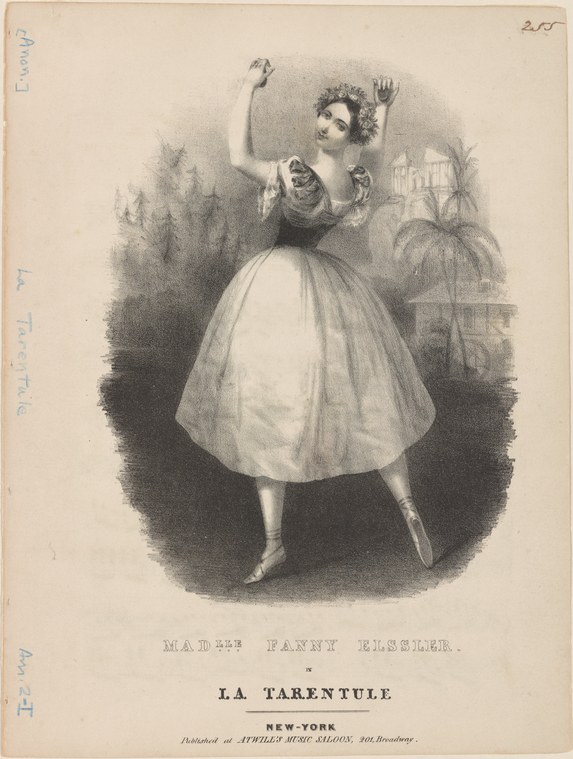
Madlle. Fanny Elssler in La tarentule
Unknown artist
- Collection:
- Prints depicting dance
- Source:
- New York Public Library
- Rights:
- Public domain — free to use, share and adapt.
- Recorded as:
- Public Domain
Fanny Elssler was one of the dominant ballerinas of the romantic era, and *La Tarentule* was one of her signature roles; this print is documentary evidence of how her performance was marketed and remembered. The image also reveals the visual conventions of romantic ballet—the tulle skirt, the uplifted port de bras, the moment of aerial suspension—at the historical moment when these became the language of theatrical dance. For historians of dance imagery and 19th-century celebrity culture, this print is a primary source in understanding how performance was mediated to audiences before photography.
What you are looking at
A young woman in mid-leap occupies the center of this theatrical print, captured in a moment of virtuosic elevation. She wears a white tulle skirt that billows around her legs and a dark corset or bodice, with her hair dressed in the style of the 1830s–40s. One arm reaches upward while the other extends to the side; both legs are in the air, suggesting the height and buoyancy of her jump. The background, rendered in atmospheric wash, suggests a theatrical interior with draped fabrics and what may be a colonnade or portico visible in soft focus. The figure is isolated against this misty setting, spotlit by the artist's use of light and shadow, creating the impression of a stage moment frozen in time. The overall composition emphasizes the ethereal quality and technical facility of the dancer—her body weightless, her control absolute.
The dancing
A single female dancer is shown in what appears to be an upward jump or *élevé*, with both feet clearly off the ground and the body held in a vertical line. Her arms frame the upper body in an open, expansive position typical of ballet in this era—one arm raised above the head, the other extended to the side—which would have displayed the line of the body and the strength required to hold the position. Her posture is upright and controlled, showing the classical training required of professional dancers of the period. The tulle skirt, caught mid-movement, creates a bell shape around her hips and thighs, a silhouette that would have been essential to the aesthetic of romantic ballet.
The dance depicted
This is a portrait of Fanny Elssler in *La Tarentule*, a popular vehicle for her in the 1830s–40s that showcased her technical brilliance and dramatic range. The ballet drew on the legend of the tarantula spider whose bite induced a frenzy of dancing; Elssler's interpretation became legendary for its combination of virtuosity and theatrical power. The image captures the character in a moment of technical display—the leap and arm position suggest the kind of bravura solo that made Elssler famous across Europe and America. The print documents not a realistic stage moment but an idealized portrait of the dancer's ability, isolating the dancer and the moment of maximum elevation.
How it was made
This is a lithograph or engraving, printed and published in New York. The technique of stone or steel allowed mass production and wide circulation at modest cost, making theatrical portraits such as this a common commercial product of the period. The use of tonal wash in the background—worked up from multiple stone passes or careful engraving—creates atmospheric depth while keeping the figure sharp and legible. The inscription at the bottom identifies the performer and the role, making this a publicity piece as much as an art object; it would have been sold in theatrical lobbies, print shops, and through mail, reaching audiences who had seen or hoped to see the famous dancer perform.
About this work
This is a theatrical portrait print of the Irish-Italian ballerina Fanny Elssler in her signature role as the tarantula-cursed heroine of *La Tarentule*. The image belongs to a major tradition of dance imagery in the 19th century: the commercial lithograph or engraving that reproduced celebrated dancers for a paying public. Elssler was one of the most famous performers of the romantic ballet era, known for her technical prowess and her ability to cross between classical roles and dramatic character parts; *La Tarentule* was among her most celebrated vehicles. The print was published in New York, evidence of her fame in North America and of the transatlantic circulation of celebrity dance imagery in this period.
The work documents a particular moment in dance history: the rise of the individual star dancer as a box-office draw, and the emergence of lithography as the primary technology for circulating images of performance to the public. Before photography, such prints were the only way a dancer's fame could be preserved and distributed beyond the cities where she performed. The isolation of the figure and the idealization of the leap speak to a culture in which the dancer's body and skill were being aestheticized and commodified.
How to look at it
This image is a portrait rather than a scene, so attend to what it isolates: the moment of maximum lift and control, when the dancer's body is weightless and fully extended. The artist has chosen to show Elssler in a moment of display rather than narrative action, which tells you that the purpose is to showcase her technical facility and physical beauty rather than to illustrate a story. The arm position and the upright carriage of the body are conventions of the romantic ballet aesthetic—the dancer as ethereal, refined, almost bodiless. The tulle skirt and the uplifted gaze work together to create an image of otherworldliness; attend to how the artist used light and shadow to make the figure seem to glow against the atmospheric background.
The artist
The artist is not recorded. The print carries a New York publisher's mark (likely a Broadway address), indicating it was produced for a commercial theatrical print trade that flourished in major American cities. Anonymous theatrical lithographers of this period typically worked from sketches made at live performances or from descriptions provided by the publisher; the quality of anatomical observation here suggests someone with dance knowledge or careful study. Such prints were often created quickly to capitalize on a performer's popularity, and the printing and publishing business employed dozens of artists and craftspeople whose names were rarely preserved.
The period
This print dates to the heyday of romantic ballet, roughly 1830–50, when the art form was dominated by female soloists and the ethereal, otherworldly aesthetic associated with works like *La Sylphide* and *Giselle*. Fanny Elssler danced across this era and was one of its supreme technical and dramatic artists. In the 1840s, she undertook a celebrated tour of the United States, which would have driven demand for such prints in New York and other American cities. The lithographic print trade in theatrical imagery was booming during this decade; audiences who could not attend performances could own an image of the famous dancer. The aesthetic of the print—the emphasis on elevation, ethereality, and the isolated figure—reflects the romantic ballet vocabulary of the period, in which the dancer's body was supposed to defy gravity and earthly constraints.
Where it lives
This print is held in the New York Public Library's collection of prints depicting dance. It was published in New York (the exact publisher's address is not fully legible in the image, but the inscription indicates a Broadway location), making it a product of the American theatrical print trade of the 1840s.
Dance in this work
Questions about this work
Who was Fanny Elssler and why was she famous?
Fanny Elssler (1810–1884) was an Irish-Italian ballerina and one of the supreme dancers of the romantic ballet era. She was known for her exceptional technical skill—her jumps and turns were legendary—and for her dramatic range, which allowed her to move between ethereal classical roles and intense character parts. *La Tarentule* was one of her signature vehicles. She was a major international celebrity who toured extensively in Europe and North America, and her fame was documented and spread through prints like this one.
What is *La Tarentule* and what was the dancer's role in it?
La Tarentule was a popular ballet based on the legend that the bite of a tarantula spider caused an irresistible urge to dance. The heroine, cursed by the spider, experiences a frenzy of emotion and movement. The role allowed a performer to display both classical technique and dramatic intensity. Elssler's interpretation became legendary, and the moment captured in this print—the leap and uplifted arms—would be a moment of virtuosic display and freedom within the character's possessed state.
What technique was used to make this print and why does it matter?
This appears to be a lithograph or engraving, a technique that allowed mass production and wide distribution at relatively low cost. Before photography, such prints were the primary way dancers' images could reach audiences beyond the theater where they performed. This print was published in New York, evidence of how Elssler's fame had reached North America and of the commercial trade in dance imagery that flourished in the 19th century.
What do the tulle skirt and arm position tell us about romantic ballet?
The tulle skirt and the open, uplifted arm position are hallmarks of the romantic ballet aesthetic. The light, billowing skirt was meant to create an ethereal effect and to display the leg line during movement; the open arms framed the upper body and conveyed grace and control. Together, these elements were part of a visual language meant to make the dancer appear weightless, otherworldly, and refined—ideals that dominated ballet in the 1830s and 1840s.
More dance artwork





