49 works in this view — arrow keys or swipe to move between them.
Dance in Art
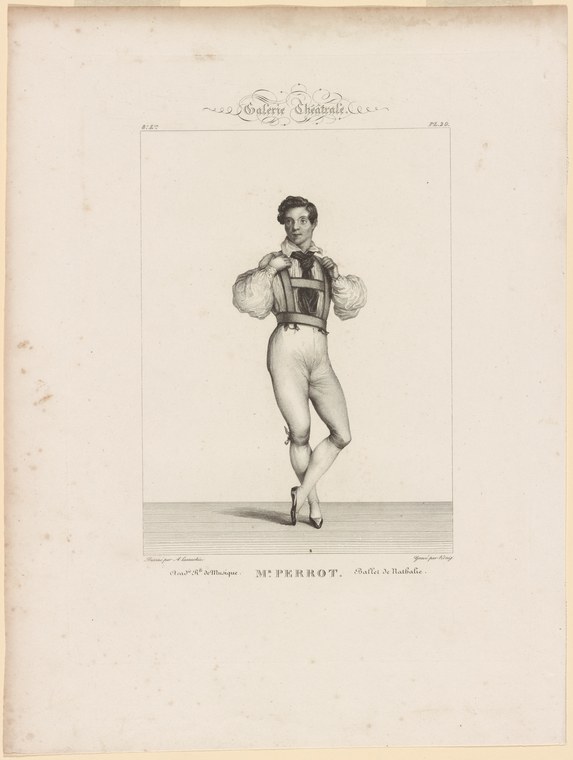
Mr. Perrot. Acad[ém]ie R[oya]le de Musique. Ballet de Nathalie
Unknown artist
- Collection:
- Prints depicting dance
- Source:
- New York Public Library
- Rights:
- Public domain — free to use, share and adapt.
- Recorded as:
- Public Domain
Jules Perrot is a pivotal figure in ballet history, yet images of male dancers of his era are far scarcer than images of women. This print is rare documentary evidence of how a male virtuoso of the Romantic era was presented to the public, in what costume, and with what physical bearing. It challenges the modern assumption that pointe work was exclusively female and shows that Romantic-era male dancers were expected to achieve and display virtuosic technical control.
What you are looking at
A single male dancer stands alone on a bare stage floor against a plain background, facing the viewer in a three-quarter pose. He wears a dark corseted tunic or bodice with a decorative front panel, light-colored tights, and pointe shoes. His arms are raised to shoulder height with the elbows bent, the upper arms slightly back and the forearms forward, creating a soft, rounded frame. His posture is upright and elongated, with his weight forward on one leg. The composition is centered and formal, suggesting a portrait of a specific dancer in a characteristic pose. The print bears a decorative banner at the top reading "Galerie Théâtrale" and text at the bottom identifying the subject as "Mr. Perrot" and noting "Acad[émie] R[oya]le de Musique. Ballet de Nathalie."
The dancing
The dancer stands in a frontal pose with weight slightly shifted, arms held in a soft, controlled position characteristic of classical ballet port de bras. The raised arms are rounded rather than extended, elbows moderately bent, suggesting a moment of calm poise rather than dynamic movement. The posture is completely upright with the spine elongated. A single figure dominates the composition entirely, isolated against blank space. The feet appear to be in a turnout position on the stage floor, supporting the impression of formal classical technique.
The dance depicted
This is a portrait of Jules Perrot (1803–1894), one of the most celebrated male dancers and choreographers of the Romantic ballet era. The costume, pointe work, and formal pose identify this as classical ballet of the mid-nineteenth century. The text specifies this is from the Académie Royale de Musique (the Paris Opera) and a ballet called "Nathalie." Perrot was renowned as a virtuoso performer and creator of innovative ballets, and this image appears to document his appearance and technique in a specific role, likely from the 1830s–1840s when he was at the height of his fame in Paris.
How it was made
This is an engraving or etching, likely hand-colored, from a theatrical documentation series called "Galerie Théâtrale" (Theatre Gallery). The fine parallel lines visible in the background and on the costume are consistent with engraving technique. This medium allowed for relatively quick reproduction and distribution to a theater-going public interested in performers and choreography. The formal composition and presentation style indicate this was a commercial print, part of a series documenting major artists of the Parisian stage.
About this work
This engraved portrait documents Jules Perrot, one of the nineteenth century's greatest male dancers, in performance costume from a Paris Opera production. It is a record of how a celebrated artist presented himself on stage and how contemporary printmakers chose to represent male ballet technique. The image belongs in a dance gallery because it demonstrates the physical and aesthetic ideals of Romantic-era classical ballet, the role of pointe work in men's performance, and the commercial circulation of dance imagery in nineteenth-century Europe. Perrot's legacy is substantial—he created some of the period's most influential ballets and mentored numerous dancers—and this print is material evidence of his public presence and status.
How to look at it
Look at the dancer's arm position and overall posture: this is not a moment of athletic exertion but of composed, controlled elegance. The rounded arms and upright spine embody the aesthetic of Romantic classicism—restraint and refinement rather than spectacle. The fact that he is shown on pointe is significant: contemporary viewers would have recognized this as a marker of technical mastery. The isolated figure against blank space is deliberate, allowing nothing to distract from the dancer's line and presence. This is how Perrot wished to be remembered and how his public knew him.
The period
This print dates from the golden age of the Paris Opera ballet, roughly 1830–1850, when Perrot was in his prime. The Romantic ballet period privileged ethereal, technically demanding female dancers in roles such as Giselle and La Sylphide, yet the greatest male dancers of the era, including Perrot and Lucien Petipa, were celebrated as virtuosi and choreographers. The popularity of theatrical prints in the Galerie Théâtrale format reflects a booming print market in Paris, where ballet was one of the city's premier cultural attractions and dancers were celebrities whose images were collected and traded. The convention of presenting a dancer in a composed studio portrait, isolated against blank space, reflects both portraiture traditions and the theatrical practice of demonstrating a dancer's technique and carriage outside of narrative context.
Where it lives
This is a print from the New York Public Library's collection of prints depicting dance. It is part of the Galerie Théâtrale, a nineteenth-century series of theatrical prints documenting performers of the Paris stage.
Dance in this work
Questions about this work
Why is a male dancer on pointe?
Pointe work was not exclusively female in the Romantic era. Virtuoso male dancers like Perrot were trained in pointework and expected to demonstrate technical mastery. The gendering of pointe as female is largely a later development, crystallized in early twentieth-century Russian Imperial Ballet practice.
Who was Jules Perrot?
Jules Perrot (1803–1894) was a French ballet dancer, choreographer, and master. He performed throughout Europe and created major ballets including Giselle (with Jean Coralli), Ondine, and Esmeralda. He was celebrated for his technical skill, his ability to work with the greatest ballerinas of the era, and his innovative choreography that balanced virtuosity with poetic expression.
What does the text at the bottom mean?
It identifies the subject as "Mr. Perrot" and notes that this is from the Académie Royale de Musique (the Paris Opera) and a ballet titled "Nathalie." This allows the print to function as both a portrait and a theatrical document, preserving information about a specific role or appearance.
What is the Galerie Théâtrale?
The Galerie Théâtrale was a popular commercial print series documenting performers and scenes from Parisian theater and ballet in the nineteenth century. These prints were collected by theater enthusiasts and provide a visual record of how major artists presented themselves on stage.
More dance artwork





