49 works in this view — arrow keys or swipe to move between them.
Dance in Art
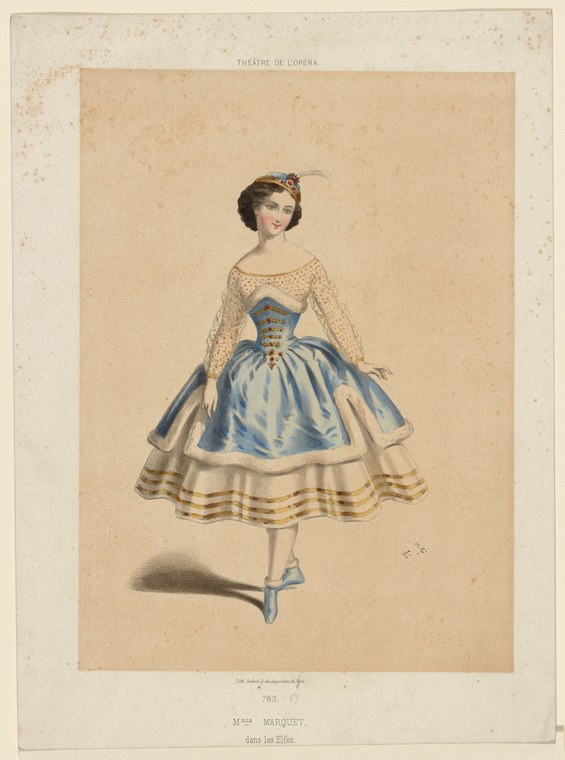
Melle. Marquet, dans Les elfes, Théâtre de l'Opéra
Unknown artist
- Collection:
- Prints depicting dance
- Source:
- New York Public Library
- Rights:
- Public domain — free to use, share and adapt.
- Recorded as:
- Public Domain
This print is a rare named documentation of a specific dancer in a specific historical ballet, providing visual evidence of Romantic ballet costuming and character work at a moment when ballet was centered on ethereal, otherworldly female roles. For historians of 19th-century French dance and costume, Marquet's image in *Les Elfes* is concrete evidence of how these ballets looked and how dancers embodied them. The work demonstrates the commercial infrastructure of mid-century ballet promotion and the importance of the Paris Opéra as a site of both artistic innovation and public spectacle.
What you are looking at
A young woman in mid-19th-century ballet costume stands in a frontal pose against a pale background, her weight poised on her left leg. She wears a white tulle skirt with horizontal gold or bronze striping at the hem, over which a deeper blue silk skirt is draped and gathered—a silhouette characteristic of the Romantic period. A fitted blue corset bodice with ornate lace sleeves completes the ensemble. Her dark hair is styled in a smooth, gathered knot decorated with a feathered ornament. Her right leg extends slightly to the side in a gentle développé or extension, and her arms hang naturally with one hand placed delicately on her skirt. The pose is that of a moment of repose rather than dynamic action—a portrait of the dancer in character. The figure is rendered with soft modeling and subtle shadow, emphasizing the three-dimensionality of the costume's layered fabrics.
The dancing
A single female dancer is portrayed, captured in a standing position with asymmetrical weight distribution and a gentle counterbalance. Her posture is upright but relaxed, with the supporting leg straight and the working leg extended into a low, controlled développé. The arm position is naturalistic rather than strictly balletic—suggesting the moment between steps rather than a formal pose de danse. The overall frame is elongated and graceful, with emphasis on the extension of line through the torso and the elegant fall of the costume.
The dance depicted
This is a Romantic-era ballet dancer, almost certainly depicted in a role from one of the fairy or supernatural ballets that dominated the 1830s–1850s. The catalogued title identifies her as Melle. Marquet performing in *Les Elfes*, a ballet by Jean-Baptiste Aumer first staged at the Paris Opéra in 1836. The costume—particularly the blue silk overdress, lace sleeves, and feathered headdress—aligns with the sylph and fairy aesthetic of Romantic ballet. The poised, ethereal quality of the pose, combined with the delicacy of the gesture, reinforces the supernatural or otherworldly character typical of such roles. The image documents not the dynamic mechanics of a jump or turn, but the visual character and costuming that defined these performances.
How it was made
This is a hand-colored engraving or lithograph of the mid-19th century, executed with fine detail and subtle color application. The base image appears to be a line engraving, with watercolor or tinted wash applied to create the flesh tones, the blue of the costume, and the gold striping of the skirt. The technique allowed for mass production and wide circulation—prints like this were sold as souvenirs and publicity for the Paris Opéra, making them important documents of how specific dancers and roles were marketed and remembered. The quality of the rendering and the refinement of the color work suggest this was a commercial product of some prestige.
About this work
This is a mid-19th-century hand-colored engraving documenting a specific moment in the history of French ballet—the performance of Melle. Marquet in *Les Elfes* at the Paris Opéra. It sits at the intersection of theater documentation and fashion print, capturing both the dancer and the costume as inseparable elements of the performance. The work is a primary record of Romantic ballet costuming and the visual presentation of supernatural feminine roles that defined the period. It belongs in a dance archive because it documents not what the dancer could do dynamically, but how she was seen, dressed, and circulated as a public figure—a crucial dimension of dance history often overlooked in favor of technique and choreography.
How to look at it
Look at the moment captured: this is not a leap, a turn, or a moment of maximum effort, but a pause—a moment of poise that allows the full costume to be visible and appreciated. The artist has chosen an angle and position that lets the viewer see the structure of the skirt, the decoration of the bodice, and the headdress without obscuring any element. Notice how the weight is clearly settled on the supporting leg and how the extended leg reads as effortless extension rather than strenuous achievement. This is how Romantic ballet was marketed and understood in the 19th century—as visual elegance and supernatural grace, captured in repose.
The period
This print was created during the height of Romantic ballet in France, when supernatural and fairy-tale narratives dominated the repertory and the ethereal, weightless quality of female dancers became central to the art form's identity and ideology. The 1830s–1850s saw an explosion of ballet imagery in commercial print form: souvenirs, publicity, and fashion documentation combined. The Paris Opéra was the center of European ballet innovation, and performances there generated prints that circulated widely and shaped public understanding of what ballet was and looked like. The soft, graceful pose and the emphasis on costume reflect the Romantic era's investment in the visual spectacle of the female body as delicate, otherworldly, and fundamentally beautiful rather than athletically skilled.
Where it lives
This work is held in the New York Public Library's collection of prints depicting dance, a resource assembled as part of broader documentation of performance history. The print is a commercial theatrical souvenir from the Paris Opéra, produced for public consumption during or shortly after the premiere of *Les Elfes*.
Dance in this work
Questions about this work
Who was Melle. Marquet?
Very little is known of Marquet beyond her appearance in *Les Elfes* and other Paris Opéra ballets of the 1830s–1840s. She was a working dancer in the corps and minor roles at the Opéra during the Romantic period. The survival of this print is one of the primary records of her career.
What was *Les Elfes*?
*Les Elfes* was a ballet choreographed by Jean-Baptiste Aumer and first performed at the Paris Opéra in 1836. It belongs to the wave of supernatural and fairy-tale ballets that included *La Sylphide* (1832) and *Giselle* (1841). These works formed the core repertory of Romantic ballet.
Why is the pose so static compared to modern ballet?
This print documents a moment of stillness by intention. The artist chose a pose that displays the costume and character clearly rather than capturing dynamic movement. Romantic ballet *did* include jumps and turns, but commercial prints prioritized elegant, readable poses that could be understood at a glance and that showcased the visual spectacle of the performance.
What do the blue skirt and lace sleeves tell us about the role?
The costume signals a supernatural or fairy character—blue was commonly used for elemental or otherworldly figures in Romantic ballet, and lace sleeves added delicacy and lightness. The feathered headdress reinforces this otherworldly quality. These visual codes would have been immediately legible to contemporary audiences.
More dance artwork





