49 works in this view — arrow keys or swipe to move between them.
Dance in Art
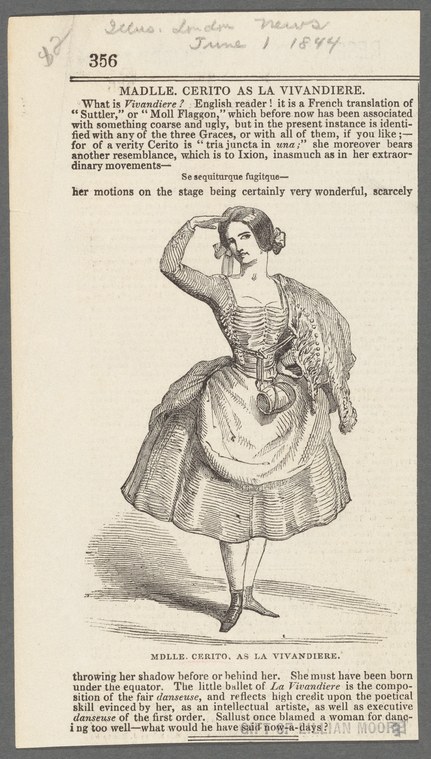
Mdlle. Cerito, as la Vivandiere [with accompanying article]
Unknown artist
- Collection:
- Prints depicting dance
- Source:
- New York Public Library
- Rights:
- Public domain — free to use, share and adapt.
- Recorded as:
- Public Domain
Cerito was one of the major ballet dancers of the mid-nineteenth century, and her success in character roles like the Vivandière reveals a dimension of Romantic ballet often overshadowed by the image of the ethereal sylph. The accompanying article's emphasis on her 'intellectual' artistry and 'extraordinary movements' provides rare contemporary testimony to what made a performer celebrated beyond classical technique. This image is a primary document of how nineteenth-century dance was marketed, reviewed, and celebrated in print.
What you are looking at
A three-quarter-length portrait engraving of a young woman in mid-nineteenth-century theatrical costume, posed in a moment of animated movement against a plain background. She wears a fitted bodice with horizontal ribbing across the chest, a full skirt ending just below the knee, and a short cape or shawl draped asymmetrically across her shoulders. Her left arm is raised to her head in a gesture suggesting surprise, coquetry, or dramatic revelation—the pose is emphatic and stagey. Her posture is upright but dynamic, with her weight appearing to shift, and her gaze directed outward toward the audience. The engraving is accompanied by a printed article identifying her as Mademoiselle Cerito in the role of la Vivandière (the Vivandière, or sutler's daughter), a character role in Romantic-era ballet. The text emphasizes her skill as an 'intellectual artiste' and notes the character's 'extraordinary movements,' suggesting a performance known for technical or narrative vivacity rather than classical restraint.
The dancing
The single figure occupies the frame with authority. Her raised left arm and slightly twisted torso suggest a moment caught mid-turn or mid-gesture rather than a static pose. The arm position—elbow bent, hand near the head—is expressive rather than balletic in the classical sense; it reads as character acting or pantomime. Her legs are straight and her stance appears light, though the engraving's linear style does not permit clear detail of the feet or weight distribution. The overall frame suggests a performer trained in mime and dramatic movement as much as in dance technique.
The dance depicted
La Vivandière was a popular character role in mid-nineteenth-century Romantic ballet, often danced as a divertissement (a solo or group number inserted for entertainment) within larger narrative ballets. Cerito was celebrated for this role, which required a different skill set from classical ballet vocabulary: the vivandière was a camp follower, a woman of the people, and her dance was characterized by playfulness, flirtation, and naturalistic gesture rather than turn-out and ethereal weightlessness. The accompanying text praises her 'extraordinary movements' and describes the character as 'lexicon, inanimate as in her extraordinary movements,' suggesting a performance that prized personality and dramatic presence. This was character or demi-caractère ballet rather than classical ballet proper, and Cerito's reputation in this role was substantial enough to warrant a printed portrait and explanatory article.
How it was made
This is a wood engraving or steel engraving, likely a reproduction print published in the 1840s for circulation in illustrated theatrical journals or collected theatrical portraits. The fine linear hatching, the clarity of the dress details, and the supplementary printed text (title, article, catalogue number) indicate this is a commercial print product designed for a literate, theatre-going audience. The technique allowed for rapid reproduction and distribution, making this image a form of mid-century celebrity marketing—the equivalent of a modern photograph or poster. Engraving was the primary method for theatrical portraiture before photography became dominant in the 1860s.
About this work
This is a portrait engraving of the celebrated Italian-Swedish dancer Fanny Cerito in the character role of the Vivandière, a popular demi-caractère ballet role of the Romantic era. The print dates to the 1840s and carries both an image and a short critical article praising Cerito's artistry and the role's demands. It documents a specific moment in Romantic ballet history—the height of character-dance popularity, when roles like the Vivandière offered opportunities for personality, mime, and naturalistic movement that contrasted with the ethereal classicism of roles like Giselle. The work belongs in a dance gallery because it preserves both the visual appearance of a celebrated dancer and the contemporary critical language used to discuss her skill.
How to look at it
Attend to the raised arm and twisted torso: this is the pose the artist chose as the signature gesture of the Vivandière character. It is neither the classical carriage of a ballerina in fifth position nor the turned-out extension of an arabesque, but rather a moment of dramatic address—a performer reaching toward an audience with personality and intention. The costume details are precise: the striped bodice, the full skirt, the military-style shawl. These costume choices signal 'character' rather than 'classical' and were instantly legible to a contemporary viewer. The artist has captured not a moment of abstract movement but a moment of theatrical presence.
The artist
The engraver is not identified in the catalogue record. The print appears to be a commercial theatrical portrait from a London or Paris publisher, produced as part of the illustrated theatrical press that flourished in the 1840s. Such prints were often unsigned or credited only to the publisher. The style and execution suggest a competent reproductive engraver working from a drawing or painting, likely made for quick circulation among theatre audiences.
The period
The 1840s were the height of Romantic ballet in Europe. While the 'classical' image of Romantic ballet centers on ethereal, supernatural roles danced en pointe—Giselle, Sylphide—the era also produced a robust parallel tradition of character and national dances: Spanish, Italian, Polish, and camp-follower roles like the Vivandière. These roles required different training and offered different pleasures. Cerito was a virtuoso of this repertoire, and her fame rivaled that of Marie Taglioni, the quintessential classical Romantic dancer. The theatrical print market was booming, with illustrated journals and collected theatrical portraits serving an expanding middle-class audience hungry for images of performers and information about current productions.
Where it lives
The work is part of the New York Public Library's collection of prints depicting dance, catalogued as item 356. It is a commercial theatrical print, likely from a London or continental publisher active in the 1840s. The presence of a printed catalogue number and article text indicates this was one page or image in a larger published collection or serial.
Dance in this work
Questions about this work
Who was Fanny Cerito?
Cerito (1817–1909) was an Italian-Swedish dancer who was one of the major ballet stars of the Romantic era, celebrated for both classical roles and character dances. She trained in Naples and performed across Europe, retiring from the stage in the 1850s to teach. She was known for her technical brilliance and her dramatic personality.
What was the Vivandière?
The Vivandière was a character role—a camp follower or sutler's daughter—that appeared in several mid-nineteenth-century ballets. It was danced as a divertissement and required mime, character acting, and a style of movement closer to national dance or folk idiom than to classical ballet vocabulary. The role offered dancers a chance to display personality and technical flair in a different mode.
How is this different from classical ballet?
Classical Romantic ballet (Giselle, Swan Lake, Sleeping Beauty) emphasizes line, turn-out, ethereality, and pointe work. Character ballet like the Vivandière uses naturalistic gesture, mime, and a less formal carriage. Both coexisted in the nineteenth century; this print documents the character-dance tradition, which is often overlooked in favor of the classical image.
Why is this a print rather than a painting?
Engraved prints were the primary method for distributing theatrical images to a wide audience in the 1840s. A single engraved plate could be printed hundreds of times, making it affordable and accessible. This was the nineteenth-century equivalent of a photograph or a modern poster.
More dance artwork





