49 works in this view — arrow keys or swipe to move between them.
Dance in Art
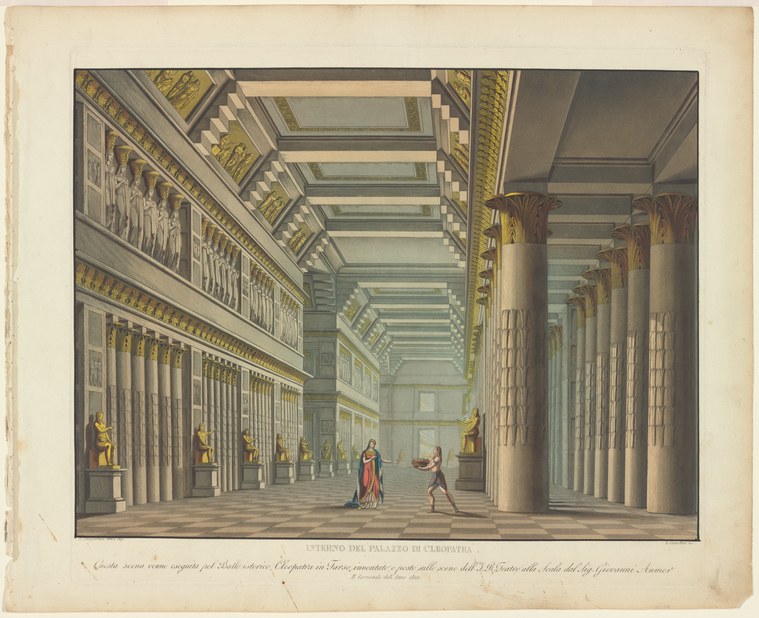
Interno del Palazzo Cleopatra: Questa scena eseguita pel ballo istorico, Cleopatra in Tarso, inventato, e posto sulle scene dell' I. R. Teatro alla Scala dal Sig. Giovanni Aumer, il carnevale dell'anno 1822
Unknown artist
- Collection:
- Prints depicting dance
- Source:
- New York Public Library
- Rights:
- Public domain — free to use, share and adapt.
- Recorded as:
- Public Domain
Aumer was one of the choreographers who created the modern language of narrative ballet, moving away from divertissement toward psychological drama and character development. This print is evidence of how thoroughly that innovation penetrated theatrical practice and how carefully such productions were documented and promoted across Europe. For anyone studying the origins of Romantic ballet and its debt to pantomime and theatrical spectacle, this work is primary material.
What you are looking at
A vast columned hall opens before us in rigid linear perspective, its coffered ceiling receding to a distant vanishing point. Monumental Corinthian columns with ornate capitals line both sides, their shafts painted in cream and gold. The floor is checkered in light and shadow. Two figures occupy the cavernous space: at center-left, a woman in a long red robe gestures with one arm raised; at right, a male figure in tan or flesh-colored garments strikes an athletic pose with one leg extended and torso tilted. The scale of the architecture dwarfs the dancers. The light is cool and even, rendered in subtle gradations of blue-gray and ochre. This is a theatrical set design rendered in perspective, with no audience visible—we are seeing the stage itself, empty except for these two figures.
The dancing
The male dancer's pose is the more forceful: legs in a wide stride or lunge, torso leaning forward in a dynamic diagonal, one arm extended. The female figure maintains a more upright, stationary stance with one arm raised. Neither figure displays the turned-out positions or pointed feet of ballet technique; their postures read as naturalistic rather than formalized. The distance between them suggests a narrative moment—perhaps a confrontation or recognition scene—rather than a symmetrical dance formation.
The dance depicted
This is a scene design for a pantomime-ballet, specifically for Giovanni Aumer's 1822 production *Cleopatra in Tarso* at La Scala, Milan. The image captures an interior scene of Cleopatra's palace in Tarsus. This was a major work in the history of *ballet d'action*—narrative ballet where plot and character emotion were conveyed through mime and gesture as much as dance. Aumer was a central figure in this movement, and the print's title credits him as the inventor and stage director. The two figures represent moments of pantomimic drama rather than a dance step proper; the theatrical spectacle lay as much in the architectural setting and the narrative unfolding as in virtuosic footwork.
How it was made
This is an engraving or stipple-engraving with hand color—a technique that allowed precise architectural rendering and subtle tonal gradations. The print is Italian, from the Milan theatrical world. The colored surface suggests this was a special edition, possibly produced for promotion or record-keeping by the theater or for wealthy patrons. The technique allowed the artist to show both the intricate perspective of the stage set and the small scale of human figures within it, emphasizing the grandeur of theatrical design. Such prints circulated among theatrical professionals and educated audiences as documents of significant productions.
About this work
This is a stage design document for a celebrated work of Romantic-era narrative ballet. Aumer's *Cleopatra in Tarso* was a landmark in *ballet d'action*, a form that prioritized storytelling and mime-gesture over technical virtuosity. The print records both the specific narrative moment—two figures in a palace interior—and the neoclassical architectural language that framed theatrical spectacle in early 19th-century Italy. The work belongs in a dance gallery not because it shows dancers executing technical steps, but because it documents how drama and emotion were staged in this period, and because Aumer's innovations in theatrical dance and choreographic structure made works like this foundational to modern ballet.
How to look at it
Observe how small the dancers are within the architectural frame. The space itself—the columned hall, the receding perspective, the neoclassical ornament—is as much the subject as the figures. Notice that the dancers are posed in naturalistic attitudes rather than balletic ones; they are in mid-gesture, mid-narrative, not mid-step. The print captures a frozen moment of drama, not a moment of technique. The female figure's raised arm and the male's dynamic lunge read as emotional and narrative expression. This reflects the aesthetics of *ballet d'action*: the story and the feeling matter more than the step.
The artist
The print is not individually attributed in the catalog, but it was produced in Milan in the early 1820s by the theater's publishing or design workshop, likely supervised by the production designer. Such prints were often collaborative works, with architectural perspective by one hand and figures by another. The style is consistent with Milanese theatrical prints of the period.
The period
The early 1820s were a pivotal moment in dance history. The Romantic movement was beginning to transform ballet from court entertainment and technical showcase into narrative theater. Aumer, working at La Scala—one of Europe's most sophisticated opera and ballet houses—was a key innovator in this shift. *Ballet d'action* prioritized gesture, mime, and story over display; La Scala's resources and reputation allowed such ambitious productions to be realized. Theater design and visual documentation (prints, drawings, painted scenery studies) became more sophisticated as productions grew more elaborate. This print testifies to that investment in both artistry and record-keeping.
Where it lives
The print is held in the New York Public Library's collection of prints depicting dance, which documents theatrical spectacle and dance history through visual sources. It is a hand-colored theatrical print, likely from a limited run produced to document or promote the production.
Dance in this work
Questions about this work
Who was Giovanni Aumer?
Aumer (1774–1833) was a Swiss choreographer and dancer based primarily in Milan and Vienna. He was one of the pioneers of *ballet d'action*—narrative ballet that used mime, gesture, and dramatic structure to tell stories rather than merely displaying technical virtuosity. His works at La Scala and other major European houses were influential in shaping Romantic ballet.
What is *ballet d'action*?
*Ballet d'action* (or ballet of action) prioritized narrative and character development over technical display. Dancers used mime, pantomime, and naturalistic gesture to convey emotion and story, while dance steps provided emphasis and transition. This was a major shift from the 18th-century emphasis on steps and spectacle. Gasparo Angiolini and Jean-Georges Noverre were early theorists; Aumer and his contemporaries realized the form on stage.
Why is this architecture so prominent?
The neoclassical palace interior was both historically evocative (Cleopatra's Egypt) and fashionable in early 19th-century taste. Theater design was lavish and sophisticated; La Scala could command the best designers. The architecture frames the dramatic action and establishes the historical and social setting. For a theater audience, the visual spectacle—the set, the costumes, the lighting—was as central to the experience as the choreography.
Is this a documentary or a stylized image?
It is stylized in the manner of theater prints of the period—the perspective is exaggerated for clarity, the light is idealized. However, it likely represents the actual scene as it appeared on stage, or at least the designer's intention. Theater prints were promotional and documentary; they needed to convey the spectacle convincingly while celebrating its grandeur.
More dance artwork





