49 works in this view — arrow keys or swipe to move between them.
Dance in Art
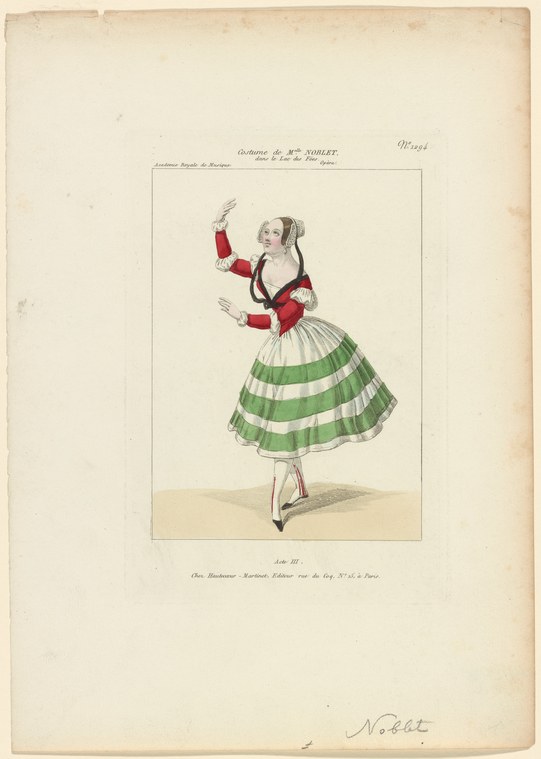
Costume de Melle. Noblet dans Le lac des fées, opéra, Académie royale de musique
Unknown artist
- Collection:
- Prints depicting dance
- Source:
- New York Public Library
- Rights:
- Public domain — free to use, share and adapt.
- Recorded as:
- Public Domain
This work documents the visual language of Romantic ballet at the height of its popularity, showing how costume, pose, and the idealized body of the dancer were constructed and circulated. As a theatrical souvenir, it reveals the mechanisms by which dancers achieved celebrity and how their images entered public circulation. For scholars of dance history, it is a primary document of Romantic-era aesthetic ideals and performance practice.
What you are looking at
A young female dancer is depicted in a three-quarter-length portrait, posed in a moment of animated performance. She wears a striking red silk bodice with short puffed sleeves, paired with a full skirt of white silk decorated with three broad horizontal stripes in green. The skirt is voluminous and captured mid-movement, creating a sense of lightness and buoyancy. Her dark hair is styled and adorned with what appears to be a decorative headpiece or headdress typical of Romantic-era theatrical costume. She stands on a single leg with her weight lifted, suggesting a moment of elevation or a brisk traveling step, while her arms are raised in a graceful gesture—the upper arm lifted and the forearm extended. Her face is delicately rendered with a composed, professional expression. The figure is set against a plain background with a light wash at the base suggesting ground or shadow, and the composition is framed within a thin rectangular border. The print bears a handwritten signature or inscription at the bottom.
The dancing
The dancer stands in a lifted, unweighted position with one leg extended and the other bearing minimal weight, suggesting the lightness characteristic of ballet technique. Both arms are raised in an expressive frame—one higher and more extended, the other bent at the elbow—creating an elegant line from shoulder through fingertip. The posture is upright and graceful, with the torso aligned vertically despite the animated arm positions. The positioning suggests a trained professional with the turned-out alignment and the sense of defying gravity that defines theatrical dance of the period.
The dance depicted
This is a costume portrait of a professional Romantic ballet dancer, most likely from the 1830s–1840s based on the style of dress and performance conventions. The inscription identifies the subject as Mlle. Noblet performing in Le Lac des fées (The Lake of the Fairies), a Romantic-era ballet at the Académie royale de musique (Paris Opera). The costume—the fitted bodice, voluminous striped skirt, and the specific headpiece—is characteristic of a fairy or sylph role in Romantic ballet. The light, lifted quality of the pose and the emphasis on the upper body and arm movement reflect the vocabulary of Romantic ballet as it was danced in Paris, where the style emphasized otherworldly grace and the illusion of weightlessness.
How it was made
This is a hand-colored engraving or aquatint, a technique well-suited to the mass production and distribution of theatrical imagery in the 19th century. The delicate linework defines the figure, while watercolor or gouache in red, green, and flesh tones has been applied by hand to each impression. This production method—engraving with hand coloring—was the standard way theatrical souvenir prints were created and circulated to audiences and collectors in Paris and beyond. Such prints were affordable mementos of famous dancers and performances, reaching a far wider audience than tickets to the theater itself, and served both as records of costume and as vehicles for the celebrity of the dancer.
About this work
This is a portrait of Mlle. Noblet, a professional dancer at the Paris Opera, captured in costume as a fairy in the ballet Le Lac des fées. The image is a hand-colored theatrical print, a form that became enormously popular during the Romantic era (1830s–1840s) as a way to commemorate famous dancers and roles. It documents not only the appearance of a specific costume but also the ideals of Romantic ballet—the emphasis on ethereal, weightless movement, the use of magical and fantastical themes, and the celebration of individual dancers as stars worthy of public commemoration. The print preserves a moment in the history of how dance was seen, sold, and remembered in early 19th-century Paris.
How to look at it
Attend first to the position of the dancer's weight—she is lifted, with almost no pressure apparent in the standing leg. This is the visual signature of Romantic ballet technique: the illusion that the dancer is barely touching the ground. Notice next the arm position and the particular arc of the raised arm: this is a moment of elegant extension and expression, not a preparation for a jump or a turn. The costume—particularly the horizontal stripes in the skirt—creates a sense of lightness and movement even in a static pose. Finally, look at the face and the overall composition: this is a souvenir portrait, a moment meant to be memorable and flattering, not a candid glimpse into an actual performance, but rather an idealized image of the dancer in her most celebrated role.
The artist
The artist is not recorded in the catalogue. However, such theatrical costume prints were produced by a large class of engravers and hand-colorists working in Paris during the 1830s–1840s, often unsigned or signed only with initials. The image follows the conventions established by famous print producers of the period, such as those working for the publisher Martinet or similar theatrical print houses. The quality of the engraving and hand-coloring suggests a professional workshop rather than an amateur effort.
The period
This print dates to the height of the Romantic ballet era in Paris, when the Opéra was the center of European theatrical dance. The 1830s–1840s saw the rise of the ballerina as a celebrity figure and the dominance of supernatural and fairy-tale themes in ballet narratives. Dancers like Marie Taglioni, Carlotta Grisi, and others were celebrated through lithographs, engravings, and prints that made their images available to a broad public. These images were often more widely seen than the performances themselves, and they shaped public imagination about what ballet was and how it should look. The Romantic aesthetic emphasized otherworldliness, grace, and the illusion of weightlessness—ideals that this portrait of Mlle. Noblet exemplifies. The striped skirt and the particular cut and proportion of the costume are characteristic of Parisian Romantic ballet and differ from the costumes of other European ballet centers.
Where it lives
This is a hand-colored theatrical print from the collection of prints depicting dance held by the New York Public Library. Such prints were produced in Paris and circulated widely in the 19th century as affordable mementos of famous dancers and roles. The collection includes many similar costume portraits of dancers from the Romantic era.
Dance in this work
Questions about this work
Who was Mlle. Noblet?
Mlle. Noblet was a professional dancer at the Paris Opéra during the Romantic era. The inscription on this print identifies her as performing in Le Lac des fées, a fairy-tale ballet typical of the 1830s–1840s. She was prominent enough to be memorialized in this hand-colored print, which suggests she was a celebrated performer of her time, though detailed biographical records of 19th-century dancers are often sparse.
What is Le Lac des fées?
Le Lac des fées (The Lake of the Fairies) is a Romantic-era ballet, a work now lost but documented through prints like this one and through archival records. It exemplifies the taste of the 1830s–1840s for supernatural and magical themes in ballet, which contrasted with earlier 18th-century taste for pantomime and courtly scenarios.
How do I identify this as Romantic ballet?
Several visual cues mark this as Romantic ballet: the emphasis on lightness and weightlessness in the pose, the ethereal quality conveyed by the costume and the delicate rendering, the supernatural subject matter (a fairy), and the idealized, almost dreamlike quality of the image. The costume—with its fitted bodice and voluminous skirt—is characteristic of Romantic-era ballet as danced in Paris, distinct from both earlier and later styles.
Why was this print made and who bought it?
Theatrical costume prints like this were made to commemorate famous dancers and performances and to be sold to audiences and collectors as affordable mementos. They served as advertising for the dancer and the theater, and they circulated the image of the dancer much more widely than actual theater attendance could. A middle-class person in Paris, London, or beyond could own a portrait of a famous dancer.
More dance artwork





