49 works in this view — arrow keys or swipe to move between them.
Dance in Art
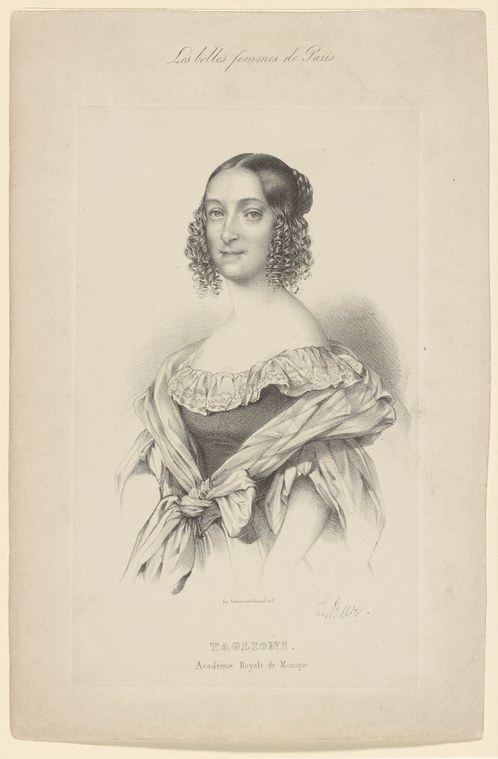
Taglioni, Académie royale de musique
Unknown artist
- Collection:
- Prints depicting dance
- Source:
- New York Public Library
- Rights:
- Public domain — free to use, share and adapt.
- Recorded as:
- Public Domain
Taglioni was arguably the most famous dancer of the nineteenth century and a revolutionary figure whose technique and artistry reshaped ballet. This portrait print circulated among audiences and served as both commemoration and advertisement, demonstrating how elite dancers leveraged portraiture to consolidate their professional status and public image. For historians of dance and visual culture, such prints reveal how nineteenth-century audiences understood and consumed the dancer's body and persona.
What you are looking at
A three-quarter-length portrait of a young woman in mid-nineteenth-century dress, shown against a plain background. She wears a dark, off-shoulder bodice with a white ruffle at the neckline and a sheer white wrap or shawl draped loosely across her lower arms and torso. Her hair is arranged in long, carefully defined ringlets that frame her face and fall to her shoulders—a hallmark of Romantic-era styling. The pose is contemplative and turned slightly away from the viewer, her gaze directed downward and to the side. The composition and costume suggest this is a formal portrait of a professional dancer, likely meant for theatrical promotion or artistic documentation. The print is executed in fine lithographic or engraved line work with subtle tonal shading that emphasizes the delicacy of the fabrics and the refinement of the sitter's features.
The dancing
The figure is stationary and posed rather than captured mid-movement. Her posture is upright but relaxed, with weight evenly distributed as she stands in a three-quarter turn. The arms hang naturally, one across the torso and one at the side, cradling the white wrap. The head is tilted slightly downward in a pose of quiet grace typical of Romantic-era portraiture. There is no visible evidence of active dancing—no extension, turnout, or weight shift—though the overall carriage and presentation of the body convey trained deportment and theatrical presence.
The dance depicted
This is a portrait print of Marie Taglioni, the Swedish-Italian prima ballerina who became the defining dancer of the Romantic ballet era in the 1830s–1840s. The title identifies her by name and notes her position at the Académie royale de musique (the Paris Opéra). The image does not depict her dancing but rather presents her as a celebrity and professional artist in street or reception dress. Taglioni's fame rested on her revolutionary technique in works like *La Sylphide* (1832), where she perfected the illusion of weightlessness and ethereal movement that came to define Romantic ballet. The portrait itself is a form of dance documentation and promotion—the kind of image circulated to audiences and collected as theatrical memorabilia.
How it was made
This is a lithograph or fine engraving, likely produced in Paris in the 1840s or early 1850s. The technique is that of a commercial portrait print, with careful attention to linear definition and tonal subtlety to render the textures of fabric and the modelling of the face. The print's refinement and finish suggest it was intended for a cultivated audience—collectors of theatrical portraits and devotees of Parisian ballet culture. The medium allowed for relatively quick production and wide distribution, making Taglioni's image available to admirers across Europe and beyond.
About this work
This is a celebrity portrait print of Marie Taglioni, a central figure in the history of Western theatre dance. It documents not a moment of performance but the dancer herself as a public persona—a professional ballerina of international renown whose likeness was marketable and collectable. The image belongs in a dance gallery because it captures the intersection of Romantic ballet aesthetics, theatrical celebrity culture, and the visual conventions through which dancers were promoted and remembered in the nineteenth century. It testifies to the power of the individual dancer to define an era and a style, and to the role of reproductive prints in creating and sustaining that cultural presence.
How to look at it
The portrait should be read as a statement of Taglioni's status and artistic identity rather than a document of her technique. Observe the care taken in rendering her hair, the drape of her wrap, and the refinement of her posture—these details communicate elegance, training, and professional authority. The downward gaze and three-quarter turn create an effect of introspection and mystery in keeping with Romantic ideals of femininity and artistic sensibility. The print's finish and circulation within a series of theatrical portraits (as suggested by the title framing) places this image within a system of celebrity promotion specific to nineteenth-century theatre.
The artist
The artist is not recorded in the catalogue. However, this is clearly the work of a professional theatrical portraitist working within the Parisian lithographic trade of the mid-nineteenth century. Such prints were typically produced by specialized workshops that collaborated with dancers and impresarios to create marketable images for distribution to patrons and the public.
The period
This portrait dates to the height of the Romantic ballet movement, when ballet had shifted from the virtuosic, acrobatic idiom of the eighteenth century toward an emphasis on ethereal, weightless movement and fantastical narrative. Taglioni epitomized this aesthetic and became the first truly international ballet superstar, touring Europe and America with unprecedented success. The 1830s–1840s saw an explosion in the production and circulation of theatrical portraits in lithographic form, reflecting both advances in printing technology and a new culture of celebrity around individual performers. Such portraits served as merchandise, souvenirs, and proof of artistic legitimacy.
Where it lives
This is part of a collection of prints depicting dance, held by the New York Public Library. It appears to be a commercial portrait print, likely one of many produced and distributed in Paris and elsewhere during Taglioni's performing career and afterward.
Dance in this work
Questions about this work
Who was Marie Taglioni?
Taglioni (1804–1884) was a Swedish-Italian ballerina and the defining figure of Romantic ballet. She created the role of the Sylphide in the 1832 premiere of *La Sylphide* at the Paris Opéra and became the first truly international ballet superstar, touring Europe and America. She was known for her weightless technique, delicate artistry, and her ability to convey otherworldly grace. She retired from dancing in 1847 but remained a cultural icon.
Is she dancing in this portrait?
No. This is a standing portrait in street or reception dress, not a performance image. It documents Taglioni as a public figure and celebrity rather than capturing her in motion. Such portraits were common forms of theatrical merchandise and fan souvenirs in the nineteenth century.
What does 'Académie royale de musique' mean?
The Académie royale de musique was the official name of the Paris Opéra, the primary venue for ballet and opera in Paris. Taglioni's position there as a principal dancer was the highest professional honor available to a nineteenth-century ballerina and consolidated her international reputation.
Why are there so many prints of Taglioni?
Taglioni's fame generated enormous demand for her portrait. Lithographic prints allowed these images to be produced and distributed relatively cheaply, making them affordable to middle-class collectors and theatre-goers. Such prints served as souvenirs, celebrity merchandise, and artistic documentation—a precursor to modern celebrity photography and fan culture.
More dance artwork





