49 works in this view — arrow keys or swipe to move between them.
Dance in Art
Overture to Masaniello
Unknown artist
- Collection:
- Prints depicting dance
- Source:
- New York Public Library
- Rights:
- Public domain — free to use, share and adapt.
- Recorded as:
- Public Domain
This engraving documents the visual and physical reality of Romantic-era operatic ballet—not a stylized or retrospective interpretation, but contemporary material culture from the period itself. For historians of dance technique, costume, and stagecraft, it provides concrete evidence of how the body was posed and moved in the 1820s–1840s, at a moment when ballet was redefining itself around weightlessness and fantasy. The survival of such works alongside their musical scores shows how intimately dance was bound to opera and musical production in this era.
What you are looking at
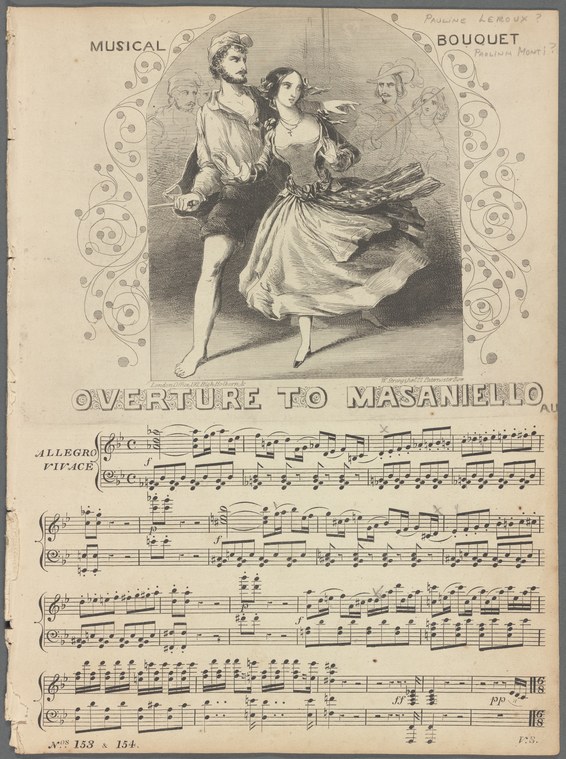
This is a printed score for a musical overture accompanied by an engraved illustration of a theatrical dance scene. The image depicts two figures in Romantic-era dress: a man in dark breeches and a woman in a pale, billowing skirt caught mid-motion. The woman's skirt swirls dramatically around her legs, suggesting rapid turning or spinning movement, while the man stands in an attentive pose beside her. In the background, smaller figures are visible, suggesting a theatrical ensemble or crowd scene. The illustration is framed by an ornate decorative border of circular baroque scrollwork. Below the engraving, four systems of musical notation in treble and bass clef present the orchestral score, marked "Allegro Vivace" at the opening. The overall composition presents the work as a theatrical or operatic piece—a complete artistic object bridging music and visual dance narrative.
The dancing
The principal female dancer is captured in a moment of rotation, her weight appearing to transfer through her body as her skirt billows outward from the momentum. Her partner stands in a supportive pose, one arm extended toward her in a gesture of attentiveness or encouragement typical of partnered Romantic-era dance. The woman's posture is upright and the line of her body is extended, suggesting trained technique rather than folk movement. The secondary figures in the background appear to be watching or participating in a larger theatrical tableau, though they are rendered in smaller scale and less detail.
The dance depicted
The work is identified in the title as an "Overture to Masaniello," which refers to the 1828 opera *La muette de Portici* (The Mute Girl of Portici) by Daniel Auber, which uses the Masaniello revolt as its subject. The operatic works of this period customarily incorporated substantial dance sequences, and the Romantic-era costume and technique evident in the engraving—the lifted, ethereal quality of the woman's skirt, the upright posture, the theatrical partnering—point to theatrical ballet of the 1820s–1840s. This is likely a representation of a divertissement or dance scene from the opera's performance, depicting the balletic vocabulary of Romantic ballet as it would have appeared on the operatic stage.
How it was made
This is an engraving (established from the image; the catalogue record does not specify medium). The technique of steel or copper engraving allowed for fine linear detail and the delicate rendering of fabric and movement visible here. The combination of engraved image with printed musical score on a single sheet suggests this was published as promotional or instructional material, circulating among theater-goers, musicians, and dance practitioners in the nineteenth century. The decorative border and careful composition indicate this was a commercially produced item of some refinement, likely sold as sheet music or a theatrical souvenir.
About this work
This is a published engraving with orchestral score documenting a dance scene from Auber's opera *La muette de Portici*, one of the defining works of the operatic Romanticism. The image captures the aesthetics and technique of Romantic ballet—the weightlessness, the upright carriage, the elaborate skirts—at the precise moment when ballet was becoming the primary form of spectacle in European opera houses. The work exists at the intersection of music, theater, and dance, serving both as a visual record of performance practice and as sheet music for musicians and choreographers. Its place in a gallery of dance art is earned not merely by the dancing figures it depicts, but by its role as an artifact of how Romantic ballet was circulated, consumed, and understood in its own time.
How to look at it
Attend to the moment of the skirt and the woman's posture: the artist has captured the instant of maximum rotation, when the laws of physics make the fabric fly outward. The woman's upright carriage and the height of her center of gravity suggest she is en pointe or on the balls of her feet—a technique that was revolutionary in this period. Notice the man's attentive pose and the asymmetry of the composition: he is secondary to her movement, a supporter rather than an equal partner. The ornate frame and theatrical setting signal that this is not folk dance or social dance, but an art form produced for a paying audience in a formal theater.
The artist
The artist is not recorded in the catalogue. However, the quality of the engraving and the style of the decorative border suggest this was produced by a professional theatrical engraver working in Paris or another major European publishing center during the mid-nineteenth century. Such works were commonly created after performances by artists employed by music publishers, who would commission engravings from performances to serve as cover art, advertisements, and instructional aids.
The period
The 1820s–1840s were the height of Romantic ballet in Europe. *La muette de Portici*, first performed in 1828, was itself a landmark work in operatic spectacle, and the substantial dance sequences it contained were among the most celebrated aspects of its productions across Europe. This was the era of Marie Taglioni, La Sylphide, and the rise of the ballerina as the visual center of operatic and theatrical performance. Ballet was moving away from the geometric, courtly vocabulary of the eighteenth century toward an aesthetic of apparent weightlessness and supernatural grace—what contemporaries called the *terre-à-terre* and *elevation* technique. The publication and circulation of engravings like this one served to disseminate these new aesthetic ideals across Europe and to create a visual archive of performance for audiences who could not attend the theater.
Where it lives
The work is held in the New York Public Library in its collection of prints depicting dance. It is catalogued without artist attribution, date, or medium specification, though the engraving technique and style are consistent with mid-nineteenth-century theatrical publications.
Dance in this work
Questions about this work
What is Masaniello?
Masaniello refers to the historical revolt of 1647 in Naples; the "Overture to Masaniello" is from Auber's 1828 opera *La muette de Portici*, which dramatizes this event. The opera was a sensation across Europe and helped establish the aesthetic of Romantic ballet within operatic performance.
What technique is the dancer using?
The upright posture, lifted quality, and ethereal skirt are hallmarks of early Romantic ballet technique, which emphasized apparent weightlessness and vertical lift. The woman's pose suggests she is dancing *en pointe* or at least on the balls of her feet, a technique that was relatively new and controversial in this period.
Why is there music printed on this page?
This is a published score—sheet music with an engraved illustration. Such works were sold to concert musicians, ballroom dancers, and opera enthusiasts as both instructional material and souvenirs of celebrated performances. The music and image together conveyed the complete theatrical experience.
How do we know this is from an opera and not a ballroom dance?
The costume (the elaborate Romantic skirt), the posed partnering, the theatrical setting, and the identification in the title all indicate this is staged theatrical ballet. The engraved border and professional publication format further distinguish it from social dance material of the period.
More dance artwork





