49 works in this view — arrow keys or swipe to move between them.
Dance in Art
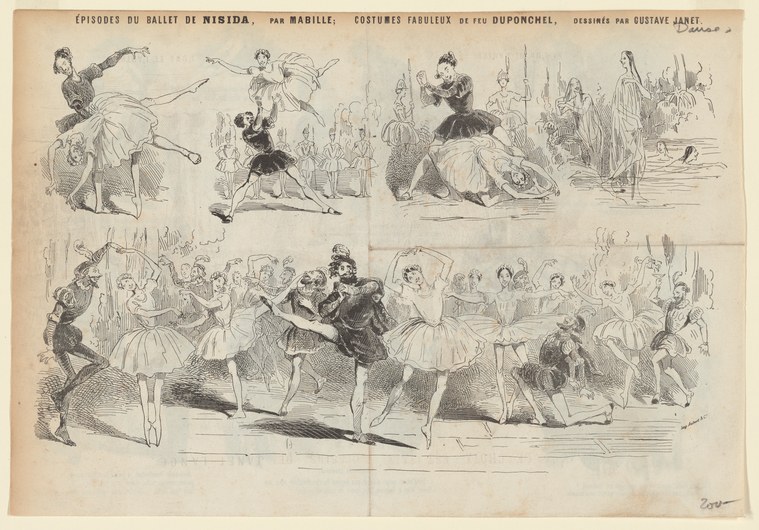
Episodes du ballet de Nisida, par Mabille; costumes fabuleux de feu Duponchel
Unknown artist
- Collection:
- Prints depicting dance
- Source:
- New York Public Library
- Rights:
- Public domain — free to use, share and adapt.
- Recorded as:
- Public Domain
For dance historians, this is evidence of how Romantic ballet looked in performance—the silhouettes, the male-female dynamics in supported work, the use of ensemble as both narrative chorus and visual mass. For costume historians, Duponchel's palette and construction are visible in detail. The work also documents the now-forgotten choreography of Louis Mabille, a significant if overshadowed figure in mid-century Paris ballet, and helps recover what was danced and how it appeared to contemporary spectators.
What you are looking at
This is a composite illustration divided into two tiers, depicting episodes from a ballet titled *Nisida*. The upper register shows four separate vignette scenes: at far left, a solo female dancer in a pale tutu strikes an arabesque or similar attitude, her partner visible behind; second from left, another ballerina executes a high jump or petit allégro, limbs extended; center-right, a female dancer bends deeply backward in a dramatic arch, supported by a male dancer; at far right, a figure stands at the water's edge of what appears to be a coastal landscape. The lower register is a continuous ensemble scene showing a large corps of ballerinas in pale tutus executing synchronized movements, interspersed with male dancers in darker costumes. The corps members are arranged in loose lines and clusters across a landscape setting with stylized rocky or architectural forms in the distance. The drawing style is economical but precise line work typical of mid-nineteenth-century theatrical illustration—the bodies are rendered in pen or pencil with minimal shading, capturing the silhouette and gesture rather than modeling form.
The dancing
The dancers throughout display the vertical carriage, turned-out legs, and lifted torso fundamental to classical ballet technique. In the upper scenes, the principal dancers—particularly the female soloist—show the elongated line and extension characteristic of Romantic ballet, with arms held in soft, rounded positions. The supported back bend shows the male dancer as stabilizing anchor while the female achieves dramatic line. The ensemble dancers in the lower tier maintain upright posture and coordinate their movements, many with arms raised or extended to the sides. Footwork is not minutely detailed at this scale, but the overall body alignment and the clarity of single-leg stands indicate the artist understood turned-out ballet carriage.
The dance depicted
This is theatrical ballet, almost certainly Romantic ballet from the mid-nineteenth century based on the tutu silhouette, the narrative episodes, and the presence of a male corps. *Nisida* (also known as *La Nymphéa* or *The Island*) was a ballet produced in the 1840s–1850s; this appears to document key moments from the plot—presumably a scene of shipwreck or coastal drama involving a nymph or supernatural female character, given the water setting visible in the right-hand vignette and the isolated, mystical tone of the composition. The costumes are attributed to the celebrated designer Duponchel (1795–1868), who designed for the Paris Opéra and was known for elaborate, historically informed designs. The narrative structure and the mixing of solo display, supported pas, and ensemble work reflects standard mid-century ballet dramaturgy.
How it was made
This is a pen-and-ink illustration, likely a wood engraving or lithographic print given its linear clarity and uniform medium tone. The technique allowed rapid circulation as a theatrical souvenir or press image—such prints were pasted into theatrical almanacs, reviews, or sold as stand-alone ephemera to promote a new production or document a famous dancer's performance. The economical linework and composite layout suggest this was created for a newspaper or journal rather than as a fine-art engraving; the title inscription and artist/designer credits are printed above. The medium's speed and reproducibility made it the primary vehicle for theatrical documentation before photography became standard.
About this work
This is a mid-nineteenth-century theatrical illustration documenting moments from the ballet *Nisida*, showing principal dancers in Romantic-era tutus executing canonical poses—arabesque, a supported back bend, elevated steps—and a coordinated ensemble in a coastal setting. The image is attributed to the designer Duponchel and was drawn or adapted by Gustave Janet, as indicated by the printed credit. It is a rare documentary record of a now-obscure Romantic ballet, and one of the few surviving visual records of how Mabille (the choreographer) staged his narrative ballets. The work exemplifies the theatrical print as advertisement and record: designed for wide circulation to promote the production to Paris theater-goers, it captured the costume design, the plot's scenic moments, and the dancers' bodily technique in a single composite image.
How to look at it
Read the upper vignettes as a sequential narrative—the scenes follow the plot from left to right, each freezing a moment of maximum dramatic or technical interest: the graceful solo, the thrilling elevation, the submission and supported intimacy of the pas de deux. The lower ensemble scene contextualizes these moments within the full spectacle, showing how the principals' actions are echoed and supported by the corps. Notice how the artist uses blank space and the outline of the body as the primary graphic elements—there is almost no interior shading or detail, which makes the silhouette and the line of the limbs carry all the meaning. This was an economical choice but also an aesthetic one: it emphasizes the purity of the ballet line, the clarity of the pose, which was central to how Romantic ballet imagined itself.
The artist
The inscription credits Gustave Janet as the illustrator (*dessiné par Gustave Janet*). Janet was a prolific theatrical and portrait draftsman working in Paris in the mid-nineteenth century; he specialized in rapid documentary sketches of opera and ballet performances for publication in theatrical almanacs and periodicals. His work is characterized by fluent, economical line and an eye for capturing characteristic poses and costume silhouettes rather than anatomical detail. Duponchel, credited for the costumes, was the chief designer at the Paris Opéra and one of the most influential costume and set designers of the era, known for scholarly historical research and lavish execution.
The period
This work dates to the height of Romantic ballet in France, the 1840s–1850s. The era saw the dominance of narrative ballets set in exotic or supernatural locales—*La Sylphide* (1832), *Giselle* (1841), *La Péri* (1843). The female dancer in the ethereal, pale tutu had become the standard image of ballet; the male dancer was present but subordinate, typically cast as the hapless mortal caught between the real and magical worlds. Choreography emphasized elevation, turning, and the illusion of weightlessness. Theater prints like this one were a primary medium for promoting new works and fixing iconic moments in the public memory before photographs could be mass-produced. The mid-nineteenth-century theatrical print industry was at its zenith, with journals like *L'Illustration* and specialist theatrical papers creating vast markets for such documentation.
Where it lives
This print is held in the New York Public Library's collection of theatrical and dance-related prints and ephemera. It is a theatrical souvenir or press illustration from the mid-nineteenth-century Parisian stage, the kind of object that would have been sold at the theater or published in a contemporary arts journal. Its preservation in an institutional collection reflects its value as documentation of theater history and design.
Dance in this work
Questions about this work
What is the ballet *Nisida* and who made it?
*Nisida* was a Romantic-era ballet choreographed by Louis Mabille, a mid-nineteenth-century French choreographer. Little is known about the plot or its subsequent performance history, and no complete choreographic notation survives. This print is one of the primary visual documents of the work. Mabille was active in Paris in the 1840s–1850s but is now largely forgotten, overshadowed by Adolphe Adam, Jules Perrot, and other more celebrated choreographers of the era.
Who was Duponchel and why does he get credit?
Duponchel (1795–1868) was the chief costume and set designer at the Paris Opéra and one of the most influential theatrical designers of the nineteenth century. He designed elaborate costumes informed by historical research and contemporary fashion. In theatrical prints, the designer was often credited as prominently as the choreographer because the visual spectacle—the costume, the decor—was a major draw for audiences. Dancers performed in Duponchel's designs, and audiences came partly to see his work.
How do we know this is actually from the ballet and not invented by the artist?
We can't be certain. Theatrical prints were sometimes based on actual performances witnessed or sketched, and sometimes were promotional images created from descriptions or choreographers' instructions. The specificity of the title, credits, and the different episodes suggests this was made in connection with an actual production, but without archival records—playbills, reviews, a company notebook—we cannot confirm that these exact moments were performed in this exact sequence.
What is Romantic ballet and why does it matter?
Romantic ballet (roughly 1830–1860) was defined by ethereal female dancers in pale tutus, magical or exotic plots, and an aesthetic of illusion and transcendence. It created the visual and technical vocabulary of classical ballet as it survives today: pointe work, turned-out positions, the ethereal corps de ballet, the male dancer as support. This print is an artifact of that revolutionary shift in what ballet was and how it looked.
More dance artwork





