49 works in this view — arrow keys or swipe to move between them.
Dance in Art
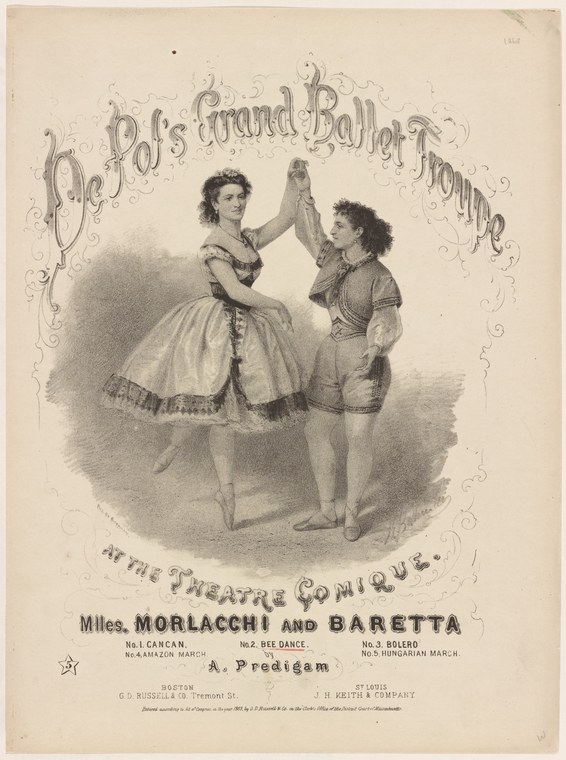
De Pol's Grand Ballet Troupe at the Theatre Comique, Mlles. Morlacchi and Baretta
Unknown artist
- Collection:
- Prints depicting dance
- Source:
- New York Public Library
- Rights:
- Public domain — free to use, share and adapt.
- Recorded as:
- Public Domain
Morlacchi and Baretta were major figures in the international romantic ballet of the 1840s-50s; this lithograph is evidence of their continued performance careers and of the elaborate advertising apparatus surrounding theatrical dance in this period. The image also documents the visual conventions of mid-century ballet promotion—the emphasis on elegant dress, formal posture, and theatrical presentation rather than the specific technique of the dance itself.
What you are looking at
A lithographic title page for a theatrical production presents two figures in a moment of social dance or theatrical gesture. The composition is centered and symmetrical, framed by elaborate decorative scrollwork in the upper portion bearing the title "De Pol's Grand Ballet Troupe" and lower text identifying the venue and performers. The female dancer stands at left wearing a mid-nineteenth-century ball gown with a fitted corseted bodice, short off-shoulder sleeves, and a full skirt with a deep ruched or pleated hem. Her dark curled hair is styled in the fashion of the 1840s-50s. The male dancer stands to her right in fitted breeches or tights and what appears to be a short jacket or tunic, also with dark curled hair. The two figures face each other with their arms raised and joined above, in a gesture suggesting either the conclusion of a dance movement or a formal theatrical pose. The background is rendered in soft wash tones that suggest stage lighting or an atmospheric interior, with no other figures or furnishings visible. The overall tone is formal and promotional.
The dancing
Both figures are upright and frontal, with arms lifted to meet above their heads in a joined or nearly-joined hand position. This elevated arm carriage and the symmetrical spacing suggest a formal theatrical moment rather than an active ballroom hold. The woman's weight appears centered, her posture upright and dignified; the man stands in a similar aligned posture. Neither figure is shown mid-stride or in the flowing, continuous motion typical of social dancing—instead, the pose reads as a discrete, held moment, consistent with a theatrical tableau or a stylized greeting.
The dance depicted
The image is a promotional lithograph for a theatrical ballet production, not a documentary image of dance in progress. The title credits Miles. Morlacchi and Baretta as the principal dancers; both were celebrated performers in mid-nineteenth-century European and American theaters, known for romantic ballet and theatrical spectacle. The gesture—elevated arms meeting above the head—is more consistent with theatrical ballet conventions of the period than with social ballroom dance. The formal, symmetrical composition and the ball gown suggest either a formal social scene within a ballet narrative or a posed curtain-call or title-page image meant to advertise the production rather than capture an actual dance movement.
How it was made
This is a hand-tinted or printed lithograph, a medium that allowed for wide circulation of theatrical advertising and imagery in the nineteenth century. Lithography's capacity for fine detail and gradation of tone is evident in the rendering of the figures' hair, the pleating of the skirt, and the atmospheric background wash. The decorative scrollwork framing the title is characteristic of mid-nineteenth-century commercial printing, and the overall composition suggests this is a title page or cover for a theatrical libretto or playbill—an object made for mass distribution to theaters and to the public.
About this work
This is a promotional lithograph announcing a performance of "De Pol's Grand Ballet Troupe" at the Théâtre Comique, featuring the celebrated dancers Morlacchi and Baretta. Rather than documenting an actual dance step or movement, it presents a formal theatrical tableau—two elegantly dressed figures in a symmetrical, posed gesture that signaled sophistication and romantic spectacle to contemporary audiences. The work belongs in a gallery of dance imagery because it records how nineteenth-century theatrical ballet was marketed and imagined, and because it preserves the names and visual presentation of two historically significant performers whose work shaped European and American dance in the mid-1800s.
How to look at it
The artist has chosen a moment of stillness and symmetry rather than motion—the raised, joined arms and frontal stance create a formal, almost hieratic effect that emphasizes the dancers' status and elegance rather than their technical skill. This reflected a mid-nineteenth-century convention in which theatrical imagery of dancers often prioritized visual refinement and romantic allure over kinetic realism. The decorative frame and careful attention to dress and hair signal that this is a promotional image meant to appeal to taste and social aspiration, not a technical or documentary record.
The artist
The lithograph is unsigned; the printer is identified only as "G. Schlösser & Co., Tremoni St." (likely referring to Turin, Italy) and "J. H. Keith & Company" in St. Louis. This suggests the image was printed and distributed in North America, possibly for touring productions. The style and execution are consistent with commercial theatrical printing of the period, made by skilled lithographic workshops rather than by the dancers or choreographers themselves.
The period
This lithograph dates to the mid-nineteenth-century international ballet scene, when romantic ballet—characterized by ethereal female dancers, pointe work, and narratives of love and magic—dominated European and American stages. The 1840s-50s saw the height of the Romantic era in ballet, with works like La Sylphide, Giselle, and La Peri establishing conventions of spectacle and feminized grace. Theatrical promotion through lithographed playbills and portraits was a major form of publicity, and dancers' names and images were commodities in a growing commercial entertainment industry.
Where it lives
The New York Public Library holds this as part of its collection of prints depicting dance, indicating it was part of the Library's acquisitions of theatrical ephemera and visual records of performance history.
Dance in this work
Questions about this work
Who were Morlacchi and Baretta?
Morlacchi and Baretta were celebrated international ballet dancers of the mid-nineteenth century, known for their performances in romantic ballet throughout Europe and America. Morlacchi, an Italian dancer, was particularly renowned for her starring roles in major productions of the era. This lithograph documents their names and their appearance, though much of their detailed performance history remains to be recovered from archival sources.
Is this showing an actual dance movement?
No. This is a posed, promotional image created as a title page or playbill cover. The raised-arm gesture and formal stance are theatrical conventions designed to convey elegance and romantic appeal to potential theatergoers, not a documentary record of a specific dance step or choreography.
What does 'Théâtre Comique' refer to?
Théâtre Comique was a theatrical venue, likely in a European city. The print was produced by a printer in Turin and distributed by a St. Louis company, suggesting the production toured or was advertised internationally. The venue name appears on the print as part of the production credits.
More dance artwork





