49 works in this view — arrow keys or swipe to move between them.
Dance in Art
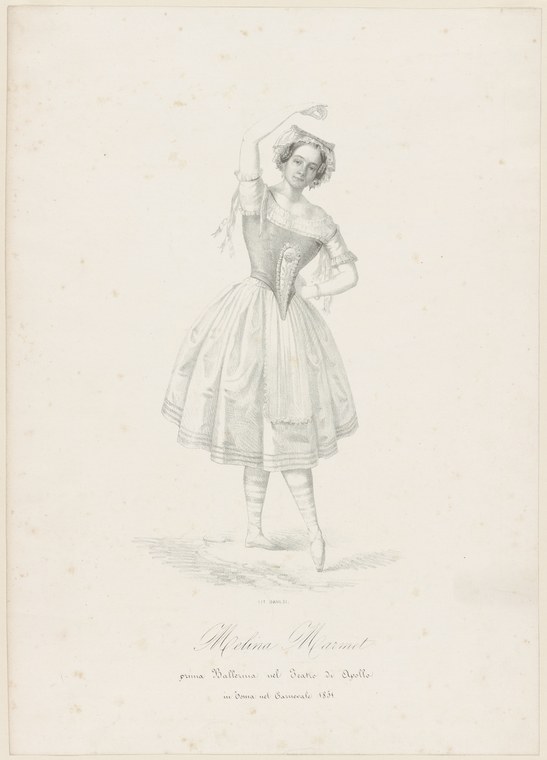
Melina Marmet prima ballerina nel Teatro de Apollo in Roma nel carnevale 1851
Unknown artist
- Collection:
- Prints depicting dance
- Source:
- New York Public Library
- Rights:
- Public domain — free to use, share and adapt.
- Recorded as:
- Public Domain
This is a named working dancer, not a generic figure—it documents a real person's professional identity in a specific place and time. For historians of nineteenth-century ballet, such portraits are primary evidence of how dancers actually looked, how they were costumed, and how the profession was mediated and marketed through visual culture. The inscription grounds the image in historical fact rather than romantic fiction, allowing researchers to trace individual dancers and their careers across European theatres.
What you are looking at
A single female dancer stands in a three-quarter pose against a plain background, her weight lifted onto her right leg in a balletic stance. Her left leg extends slightly behind, the foot pointed. She wears a short white ballet skirt with horizontal pleating that falls just below the knee, a fitted bodice with short sleeves, and what appears to be a decorative headdress or tiara. Her right arm is raised and curved overhead in a classical position, while her left arm rests at her side. Her posture is upright and formal, characteristic of mid-nineteenth-century ballet. The drawing is executed in fine pencil with delicate shading, and the figure is rendered with anatomical precision typical of professional dance documentation from this period.
The dancing
The dancer presents a classical ballet frame: the supporting leg is straight and turned out, the free leg extended with a pointed foot, the torso held in vertical alignment. The raised arm curves gracefully overhead in what would be fifth position in ballet terminology. The head turns slightly toward the raised arm, following the line of the gesture. The overall impression is one of controlled elevation and formal dignity rather than dynamic movement—this is the dancer posed for documentation rather than captured mid-leap or turn.
The dance depicted
This is romantic-era ballet, almost certainly a formal portrait of a working prima ballerina. The costume—the short tutu, the pointe work implied by the pointed feet and upright carriage, the classical arm positions—all indicate classical ballet as practiced in European theatres around mid-century. Melina Marmet was a professional ballerina performing at the Teatro Apollo in Rome during Carnival 1851. The image serves as a professional record of her appearance and technique, likely published as a print for circulation to theatre patrons and other dancers. The pose suggests a moment of rest or display rather than narrative dance action.
How it was made
This is a fine pencil drawing, possibly a finished study or a reproduction print. The delicate, consistent linework and fine hatching suggest either a skilled hand-drawn original or a high-quality engraving or lithograph made after a drawing. The formal presentation and inscription indicate this was made for professional distribution—it belongs to the genre of theatrical portraiture that documented celebrated dancers for the public record. The technique allowed for the precise rendering of the dancer's proportions, costume detail, and formal pose that such documentation required.
About this work
This is a professional portrait print of a named ballet dancer, Melina Marmet, documented at a specific moment and place: performing as prima ballerina at the Teatro Apollo in Rome during Carnival 1851. It represents the intersection of theatrical practice and visual record-making in the romantic era of ballet. Such prints circulated among theatre-goers, patrons, and other dancers, serving both as publicity and as documentation of working professionals. The work sits squarely within the tradition of European dance portraiture that emerged in the eighteenth century and flourished in the nineteenth, when the dancer's image became a commodity and a form of professional identity.
How to look at it
This is not an action image; it is a formal portrait, akin to a photograph. What matters is what the artist chose to document: the dancer's actual build and proportions, her costume, the exact carriage of her body, the formal positions that defined her as a trained classical dancer. The pose is a rest position—the kind a dancer would hold for a portrait sitting—but it displays the turned-out legs, lifted spine, and controlled arm positions that were the mark of a competent ballerina. Look at the relationship between the supporting leg and the spine: this is the alignment that ballet training produces, and it is drawn with anatomical precision.
The period
This print belongs to the romantic era of ballet, roughly 1830–1860, when ballet was dominated by female dancers in ethereal tutus performing fairy and supernatural roles. This was also the era in which dancers' portraits became mass-produced commodities—lithographed prints sold to theatre patrons as souvenirs and collectibles. The mid-nineteenth century saw the professionalization of dance in European capital cities and the emergence of the international celebrity dancer who performed across multiple seasons in different theatres. Rome's Teatro Apollo was one of many regional theatres that hosted touring stars and employed resident companies. The formal pose and classical technique shown here reflect the codified vocabulary that had emerged from the schools of ballet across Europe.
Where it lives
This work is held in the New York Public Library's collection of prints depicting dance. The inscription provides the only known information about its creation: it names the subject, dates her performance, and locates it geographically.
Dance in this work
Questions about this work
Who was Melina Marmet?
Melina Marmet was an Italian or European-trained ballerina who performed as prima ballerina at Rome's Teatro Apollo during Carnival 1851. Beyond this inscription, little is documented about her career. Like many dancers of the era, she was a working professional whose livelihood depended on her technical skill and popularity, not on preservation in historical record. This print is one of the few traces of her professional identity.
What does 'prima ballerina' mean in this context?
In nineteenth-century theatre, 'prima ballerina' meant the leading female dancer of a company or production, typically the dancer assigned the most substantial roles and the final solo or featured moment in a performance. It was a professional rank, not a lifetime title as the term later became. Marmet held this position at the Teatro Apollo during the 1851 Carnival season.
Why was she drawn in this formal pose?
This is a professional portrait made for circulation—either as a souvenir for theatre patrons or as a document for other theatres and companies considering hiring her. The formal pose displays her training and physique clearly. Such prints were the primary way dancers' images were disseminated before photography became common, and they served as both publicity and professional credential.
Is this a lithograph or an engraving?
The record does not specify the printing technique, but the fine, consistent linework and the formal presentation suggest either a high-quality engraving or lithograph made after a drawing. The precision and the light touch indicate professional printmaking rather than a hand-drawn original, though this cannot be confirmed from the image alone.
More dance artwork





