49 works in this view — arrow keys or swipe to move between them.
Dance in Art
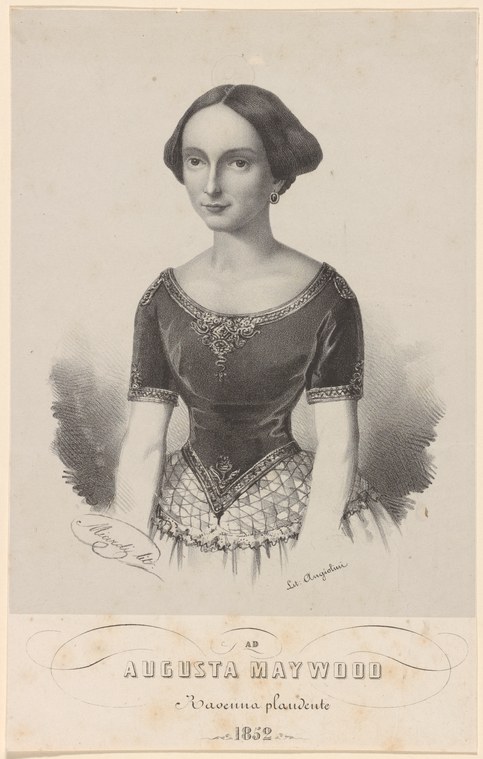
Ad Augusta Maywood Ravenna plaudente, 1852
Unknown artist
- Collection:
- Prints depicting dance
- Source:
- New York Public Library
- Rights:
- Public domain — free to use, share and adapt.
- Recorded as:
- Public Domain
Augusta Maywood was one of the first American-born dancers to achieve international stardom in ballet, and this engraving is documentary evidence of her celebrity and the visual culture surrounding her performances. For scholars of 19th-century American dance and of Romantic ballet costume, the detailed rendering of the skirt decoration and overall silhouette provides concrete information about theatrical dress in the 1850s.
What you are looking at
A half-length portrait of a woman in early 19th-century dress, presented in a three-quarter view against a plain background. She wears a dark silk or velvet dress with short puffed sleeves trimmed in ornamental braid or embroidery; the neckline is similarly decorated. Her dark hair is parted in the center and swept back in the fashionable style of the 1820s–1850s, with volume at the sides. Most striking is the lower portion of her garment: a skirt or overskirt of sheer fabric—possibly net or tulle—with deep scalloped or fringed edges, decorated with geometric or floral patterning. This elaboration of the lower garment, combined with the formal presentation and the engraved technique, suggests this is a theatrical or celebrity portrait. She is presented frontally with a composed, direct gaze.
The dancing
The figure is stationary and posed rather than captured mid-movement. She stands with shoulders relaxed and turned slightly, her posture upright but not rigid. Both arms hang naturally at her sides. There is no partnering, no partner visible, and no indication of active dance movement—the pose is that of a formal portrait subject. The emphasis is entirely on her costume, particularly the decorative lower garment.
The dance depicted
The inscription identifies this as depicting Augusta Maywood in the role of 'Ravenna plaudente' (literally 'Ravenna applauding'), dated 1852. Maywood was a celebrated American ballet dancer of the Romantic era. The costume—particularly the decorated skirt and the theatrical styling—indicates this is a portrait of her in a specific ballet role rather than a record of an actual dance moment. The term 'plaudente' suggests a character or dramatic moment in a narrative ballet, most likely from the Romantic ballet tradition. However, the static pose provides no evidence of specific technique, movement vocabulary, or partnership that would distinguish one Romantic ballet idiom from another.
How it was made
This is an engraving, rendered in the classical technique of line engraving or possibly steel engraving—a process that allowed for fine detail, subtle modeling of the face through parallel lines, and wide circulation through printing. The technique was well-suited to theatrical portraiture and allowed publishers to produce and distribute images of celebrated performers to a broad audience. The signature visible in the lower left corner suggests this was made by an identified artist (though not recorded in the catalogue). The quality and finish suggest this was a professional, published work rather than a sketch or preliminary study.
About this work
This is a formal theatrical portrait engraving of the American Romantic-era ballet dancer Augusta Maywood, made in 1852 and documenting her in a named stage role. The work belongs to the substantial 19th-century print tradition of celebrity ballet portraiture—a form that celebrated star dancers and made images of them available to the growing middle-class audience for theatrical entertainment. The portrait captures not a moment of dance but rather the visual spectacle of Romantic ballet costuming: the ornate skirt with fringed edges and decorative patterning exemplifies the theatrical silhouette of the period. The work is valuable as a record of a major American dancer's fame and of how Romantic ballet spectacle was visually marketed in the mid-19th century.
How to look at it
Attend to the costume rather than the pose: the scalloped or fringed skirt overlay, the ornamental sleeve trim, and the overall silhouette are the real subject here. The engraver has lavished detail on the lower garment, using fine parallel lines to suggest texture and shadow. This is a costume portrait, not a dance action portrait—the frozen moment is not the peak of a movement but the presentation of a famous performer in a glamorous role. The formal frontality and the direct gaze establish the authority of the celebrity subject.
The artist
The artist's name is not recorded in the catalogue, though a signature is visible in the engraving. The quality of execution and the professional presentation suggest a mid-level or established print shop rather than a major artist—such celebrity theatrical portraits were produced as commercial prints by multiple hands. The work sits within the broad practice of theatrical and operatic portraiture engraving that flourished in Europe and America through the 19th century.
The period
This engraving was made during the height of the Romantic ballet era, when the cult of the ballerina was at its peak in Europe and America. Maywood was performing in the 1840s–1860s, a period when ballet was dominated by the aesthetics of Romantic ballet—ethereal heroines, fantastical scenarios, elaborate costume, and the international fame of individual dancers. The tradition of celebrity dance portraiture engraving was well-established by 1852; publishers issued thousands of such prints for popular consumption. The inscription in Latin ('Ravenna plaudente') suggests the work was intended for educated viewers familiar with literary and theatrical allusion.
Where it lives
The work is held in the New York Public Library's collection of prints depicting dance. It is part of the broad documentary record of 19th-century theatrical celebrity and dance imagery. The engraving was produced for public circulation, likely as a souvenir of Maywood's performances or as a commercial theatrical print sold alongside playbills and lithographs of other performers.
Dance in this work
Questions about this work
Who was Augusta Maywood?
Augusta Maywood (1821–1876) was an American ballet dancer and one of the first native-born American dancers to achieve major international fame during the Romantic ballet era. She performed in leading roles throughout Europe and America and was celebrated for her technique and dramatic presence. This engraving documents her fame and her role in expanding the presence of American dancers in European ballet.
What does 'Ravenna plaudente' mean?
The phrase means 'Ravenna applauding' in Latin. It indicates that Maywood is portrayed in a named character or dramatic moment from a ballet, though the specific ballet is not identified in the catalogue record. The Latin suggests the work was created for an educated audience and marketed to readers of literary sophistication.
What era of ballet does this represent?
This is from the Romantic ballet era (roughly 1830–1870), characterized by ethereal heroines, supernatural and fantastical scenarios, pointe work, elaborate tutus and decorated skirts, and the international fame of individual ballerinas. Maywood was a star of this period, and the costume shown here is typical of Romantic ballet spectacle.
Why is the skirt so decorated?
The ornate skirt with fringed or scalloped edges and decorative patterning was typical of theatrical costume in Romantic ballet. These elaborations were part of the visual spectacle that made ballet a popular entertainment, and they served to catch light and emphasize the movement of the lower body during performance. The detailed rendering suggests the engraver understood the visual importance of this element of the costume.
More dance artwork





