49 works in this view — arrow keys or swipe to move between them.
Dance in Art
The three Graces
Unknown artist
- Collection:
- Prints depicting dance
- Source:
- New York Public Library
- Rights:
- Public domain — free to use, share and adapt.
- Recorded as:
- Public Domain
This work reveals how dance—or the classical ideal of grace expressed through the moving body—was marketed and understood in early 19th-century visual culture. It shows that dance subjects sold as popular prints, and that the female body in motion was a desirable, acceptable subject for framing and display. For students of Romantic ballet and the visual construction of femininity, it documents the costume, posture, and aesthetic values of the period outside the formal ballet theater.
What you are looking at
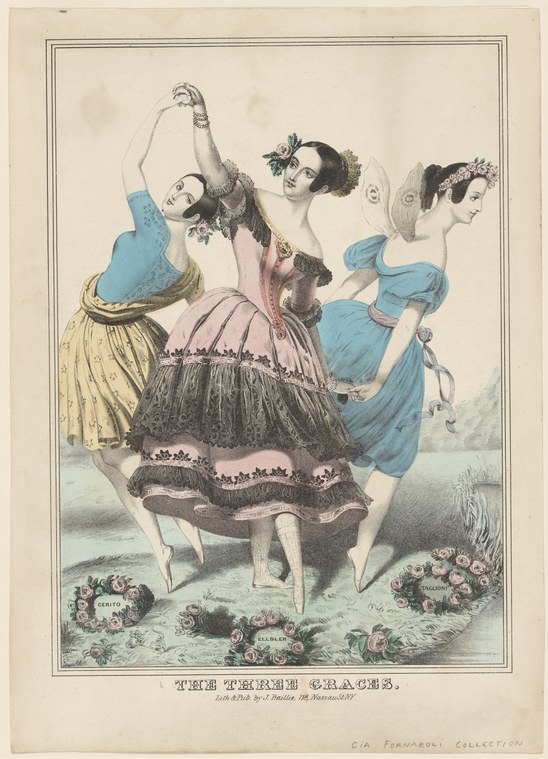
Three young women in early 19th-century dress dance together in an energetic, playful composition. The central figure leans back with one arm raised high, her head tilted upward in an attitude of uninhibited joy, while the other two women flank her—the figure on the left in a yellow skirt and blue jacket, the one on the right in blue. All three wear their hair crowned with flowers or wreaths. Their skirts are voluminous, caught mid-swirl to reveal the movement and lightness of the dance; the layered hems and decorative trim are rendered in fine detail. The ground beneath them is scattered with garlands and floral wreaths, reinforcing a theme of spring, youth, and celebration. The background is minimal and atmospheric, allowing the figures to dominate. The whole scene radiates a spirit of abandon and classical grace—a modern reading of an ancient allegory.
The dancing
The three dancers are arranged in a loose triangular composition, their bodies angled toward and around each other rather than in formal alignment. The central figure's backward lean with raised arm creates the visual apex; her companions lean inward as though caught in the same moment of exuberance. The women's arms are bare or lightly covered; their posture is upright but free, not constrained by the formal posture codes of rigid court dance. The skirts and their movement are central to the visual effect—the artist has captured the swirl and lift of fabric with particular care, showing how the layered hems catch and fall. Weight appears distributed lightly, suggesting dancers on their toes or in an athletic pose rather than a processional one.
The dance depicted
This is a representation of the Three Graces, a classical subject from mythology, reinterpreted through the lens of early 19th-century theatrical dance and popular culture. The Graces were traditionally depicted as ideals of beauty and grace; here they are shown as living, dancing figures in a contemporary moment. The dance itself appears to be a joyful, unstructured celebration rather than a codified ballet technique—more akin to the Romantic era's fascination with natural, spontaneous movement and the idealization of female youth and beauty. The floral setting and the linked, intimate grouping suggest a private or pastoral moment rather than a staged theatrical performance, though the refinement of dress and the careful composition indicate this is a theatrical or literary fantasy rather than documentary.
How it was made
This is a hand-colored engraving or lithograph, as evidenced by the fine linear work in the figures and the subtle gradation in the background wash. The coloring has been applied selectively—bright blues and yellows in the clothing, delicate pink tones in the flesh, soft greens and browns in the scattered garlands—creating a luminous, jewel-like effect typical of early 19th-century color prints. The technique allowed for wide circulation as a popular print; this was affordable wall art or a collectible for the middle class, and the subject's appeal (classical, romantic, celebratory) made it commercially viable. The signature and publication information at the base would have been visible to the original owner or buyer.
About this work
The Three Graces is a neo-classical subject rendered as a Romantic dance image: three idealized young women in high-waisted Regency dress, crowned with flowers, caught in a moment of spontaneous, joyful movement. It belongs to a rich tradition of prints depicting dance as an expression of beauty, grace, and youthful joy—subjects that appealed to the early 19th-century appetite for both classical allusion and contemporary fashion. The work sits at the intersection of theatrical allegory, Romantic aesthetics, and popular commercial printmaking. For dance history, it documents how the ideals of movement and the female dancing body were visualized and consumed in the Regency and early Victorian periods—not as technical performers but as embodied ideals of beauty and grace.
How to look at it
Note the artist's choice to freeze the moment of maximum exuberance—the central figure's head thrown back, the arms raised, the skirts caught mid-spin. This is not a pose held for the camera but a peak of movement. The composition uses the scattered flowers and the close grouping of the three figures to create intimacy and suggest a private, joyful moment. The careful rendering of the fabric and the play of light on the women's bare skin and raised arms emphasize the lightness and freedom of their movement. Pay attention to how the artist has used the upward lift of the skirts and the raised arms to create the illusion of weightlessness and elevation—a visual vocabulary that would become central to Romantic ballet aesthetics.
The period
The early 19th century saw an explosion of theatrical and popular dance subjects in engravings and lithographs, particularly after the success of Romantic ballet in the 1830s. The idealization of the female dancer as ethereal, youthful, and graceful—a visual ideal rather than a skilled performer—was pervasive in prints and periodicals. Classical subjects, including the Three Graces, were frequently reinterpreted through contemporary fashion and dance aesthetics. The Regency era (c. 1811–1820) was marked by high-waisted dresses, bare arms, and a Neo-classical aesthetic in visual culture; this print reflects those fashions and the period's fascination with combining classical mythology with modern life and contemporary female beauty.
Where it lives
This print is held in the New York Public Library's collection of prints depicting dance, a collection focused on documenting how dance has been visualized in graphic media from the 18th century onward.
Dance in this work
Questions about this work
Who are the Three Graces?
In classical mythology, the Three Graces (Aglaia, Euphrosyne, and Thalia) are goddesses of beauty, charm, and joy. They appear frequently in art as idealized female figures, often linked or dancing together. By the 19th century, they had become a stock allegorical subject, readily adapted to contemporary fashion and popular media.
Is this a scene from a real ballet?
There is no evidence in the image itself that this depicts a specific staged ballet. It appears instead to be an idealized, allegorical image—a literary or artistic fantasy of the Three Graces imagined as contemporary young women in a timeless, pastoral moment. It may have been inspired by theatrical dance without being a direct documentary of a performance.
Why are these prints colored by hand?
Hand coloring of engravings and early lithographs was the standard method before color printing technology became reliable and affordable. Each print was colored individually or in small batches, making hand-colored prints more expensive and desirable than uncolored ones. This one's vibrant blues and yellows suggest it was made for a middle-class buyer who valued the finished, jewel-like effect.
What does the floral imagery mean?
Flowers connote spring, youth, fertility, and natural beauty—all associations with the Graces themselves. The scattered garlands and wreaths frame the dancers as ideals of beauty emerging from or surrounded by nature. This imagery was conventional for allegorical and romantic subjects in the period.
More dance artwork





