49 works in this view — arrow keys or swipe to move between them.
Dance in Art
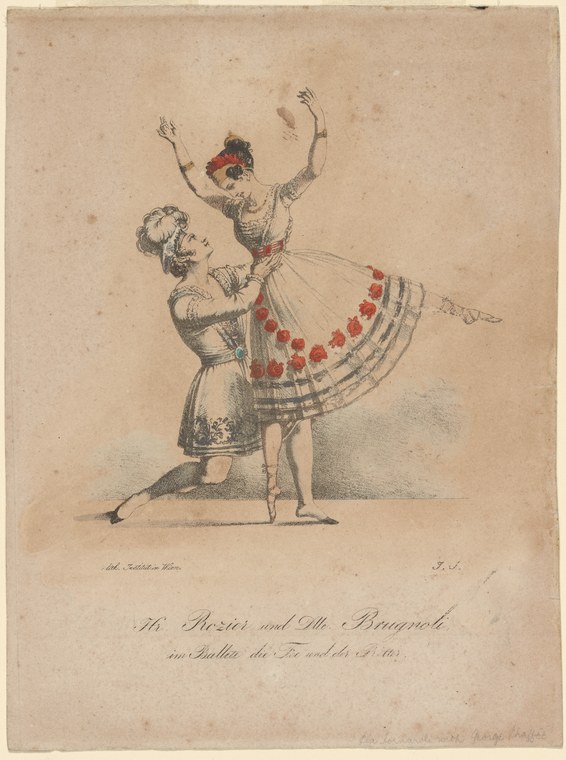
Hr. Rozier und Dlle. Brugnoli im Ballete die Fee und der Ritter
Unknown artist
- Collection:
- Prints depicting dance
- Source:
- New York Public Library
- Rights:
- Public domain — free to use, share and adapt.
- Recorded as:
- Public Domain
This print preserves a record of how Romantic-era dancers actually moved and partnered, and documents the career of Brugnoli, a significant performer of her time. The image is evidence of the technical possibilities and aesthetic ideals of early 19th-century ballet—the emphasis on weightless, arched extensions supported by a male partner—that shaped the development of classical ballet technique.
What you are looking at
A man in dark coat and breeches supports a woman in an elaborate tiered skirt decorated with red pompoms or rosettes, her arms raised expressively overhead. The woman's upper body leans back in a dramatic arch while the man maintains an upright, supporting posture. The composition is set against a plain background with a simple ground line suggested by shadow. The woman wears what appears to be a fitted bodice with puffed sleeves and a striking skirt composed of multiple horizontal bands trimmed with red circular ornaments. Both figures are rendered in a style suggesting a print from the early 19th century, with fine line work defining the forms and selective hand-coloring applied to the woman's face and the skirt decoration. The moment captured is one of theatrical lift and extension—a dramatic partnered movement rather than a static pose.
The dancing
The male dancer stands in a grounded, supporting position with one arm raised to steady the woman, who is arched backward in a dramatic extension with both arms lifted above her head. Her weight is supported by his frame, and her body forms a pronounced backward curve from knee through torso. The man's posture is vertical and stable, demonstrating the classical partnering technique of the period where the male dancer provides a secure base for the female's extension. The spatial relationship between the two figures—close contact, his grounded position contrasting with her suspended, airborne quality—is central to the image.
The dance depicted
This appears to be a scene from early 19th-century theatrical ballet, most likely from a Romantic-era ballet given the costuming and the technical partnering displayed. The title references Mr. Rozier and Mademoiselle Brugnoli in *La Fée et le Chevalier* (The Fairy and the Knight), identifying this as a scene from a specific ballet performance. The movement shown—a supported arch or suspension with the male partner providing lift and stability—was a signature feature of Romantic ballet technique, where ethereal, weightless extensions of the female dancer were prized. The woman's upraised arms and arched back suggest a moment of magical transformation or romantic suspension, typical of fairy or supernatural characters in ballets of this era.
How it was made
This is an engraving with hand-coloring, a common format for theatrical prints of the early 19th century. The fine line work of the engraved base layer defines form and anatomy with precision, while selective coloring—particularly in the woman's face and her skirt's red pompom trim—draws the eye to key focal points. This technique allowed for affordable mass production and wide circulation among theatergoers and dance enthusiasts, making such prints important documents of actual stage performances and the celebrity of dancers. The hand-coloring indicates this is a higher-quality or specialized version, possibly intended for collectors or as a gift, rather than a simple theatrical advertisement.
About this work
This is a documentary print of a moment from an early 19th-century ballet, capturing the partnership technique and costume style of the Romantic era. It records a specific performance by named dancers—Rozier and Brugnoli—in a ballet with a supernatural theme. The work sits at the intersection of theater history, dance history, and printmaking practice, serving as both an artwork and a historical record of how partnering was executed and presented to audiences during the height of Romantic ballet. Such prints were the photographs and posters of their day, making the spectacle of live performance available to those who could not attend the theater.
How to look at it
Attend to the moment the artist chose: not a moment of effort or struggle, but one of apparent weightlessness and ease on the woman's part, despite the complexity of the lift. Notice how the man's vertical posture and steady gaze contrast with the woman's arching, suspended body—this contrast was the aesthetic ideal of the Romantic era. The hand-coloring of the red pompoms draws attention to the elaborate costume, which would have been one of the spectacular elements of the live performance. The positioning of both dancers' arms contributes to the sense of drama and expression typical of theatrical gesture of the period.
The artist
The artist is not recorded in the available catalogue information. The style and execution suggest a professional theater print maker working in the early 19th century, likely in a European printing center. Such prints were often produced by workshops rather than individual artists, and attribution has frequently been lost.
The period
This print dates to the height of Romantic ballet, the period roughly 1830–1850 when ethereal, otherworldly ballets featuring supernatural heroines became the dominant form. Marie Taglioni and other celebrated dancers of the era were celebrated for their ability to appear weightless and gravity-defying, aided by the newly perfected technique of dancing en pointe. The partnership between male and female dancers intensified during this period, with the male dancer's role shifting from soloist to support—a dynamic clearly evident in this image. Theatrical prints became increasingly sophisticated and widely distributed, serving as marketing, documentation, and souvenirs for a growing middle-class theatergoing public.
Where it lives
This work is held in the Prints Collection of the New York Public Library, part of a broader holdings of theatrical and dance prints from the 19th century. Such prints were typically sold in the lobbies of theaters or through print sellers, and they often bear inscriptions identifying the dancers, the ballet, and sometimes the performance date.
Dance in this work
Questions about this work
Who were Rozier and Brugnoli?
The print identifies them as dancers in this specific ballet performance, but further biographical details are not recorded in the available catalogue information. They were performers in the professional ballet theaters of early 19th-century Europe, during the Romantic era when such prints were actively produced to celebrate star dancers.
What is the ballet *La Fée et le Chevalier* about?
Based on the title alone, it concerns a fairy and a knight, suggesting a romantic or supernatural narrative typical of Romantic-era ballets. The image shows a moment of magical suspension or transformation, consistent with such themes.
Why do theatrical prints like this matter to dance history?
They are primary documents showing how dancers moved, how they partnered, what they wore, and which performances were celebrated. Before photography, prints like this were the main way dance was recorded and circulated, making them invaluable evidence of technique, aesthetic values, and the fame of individual dancers.
How do I know this is an engraving, not a lithograph or another print?
The fine, parallel line work visible in the background and the precision of the linear detail are characteristic of engraving technique. Lithography would show softer transitions; woodcut would show bolder, more angular marks. The hand-coloring was added after the engraved base layer was printed.
More dance artwork





