49 works in this view — arrow keys or swipe to move between them.
Dance in Art
Maria Medina Vigano
Unknown artist
- Collection:
- Prints depicting dance
- Source:
- New York Public Library
- Rights:
- Public domain — free to use, share and adapt.
- Recorded as:
- Public Domain
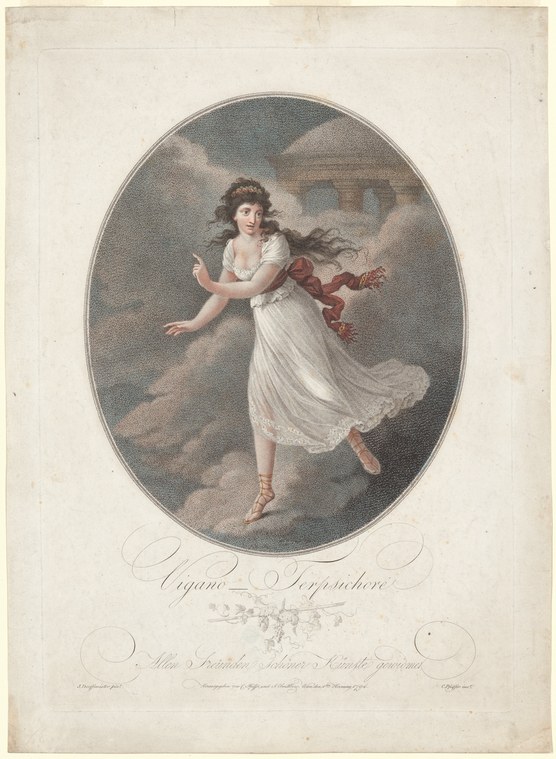
This print is a rare survival of a specific performance tradition—the souvenir dance image that constituted much of the visual record of 19th-century theater before photography. For historians and dancers alike, it documents how Romantic ballet dancers held their bodies, what they wore, and which moments of movement were considered worth preserving. It is evidence of which dances were famous enough to be mass-produced, and thus which performers and works shaped the era's dance culture.
What you are looking at
A young woman in classical dress performs a solo dance against a dark, atmospheric background. She wears a white muslin empire-waist gown with short sleeves, the skirt caught mid-motion and billowing around her legs. A crimson ribbon or sash trails dramatically behind her from the waist. She stands in a graceful contrapposto, one leg bearing weight while the other extends lightly, her arms held in an open, expressive frame—the near arm raised and bent, the far arm extended to balance the composition. The setting is indistinct but suggests an interior space, with what may be architectural elements (possibly a pavilion or portico) dimly visible in the background. The print is hand-colored, with careful attention to the flesh tones, the luminous white of the dress, and the deep blue-grey atmospheric background that creates theatrical depth. The composition is framed within an oval vignette, a common format for dance imagery of the Regency era. Below the image, elegant cursive script reads "Cyprienne" and additional text in smaller type, though the full inscription is not entirely legible in reproduction.
The dancing
The dancer's weight is poised lightly on one leg with a fully extended supporting posture; the other leg is raised and bent in a lyrical, open position. Both arms are held away from the body in a soft, expressive frame without rigidity—the raised arm curves gracefully, and the extended arm stretches laterally with control but ease. The carriage is upright and elegant, with the head held high and turned slightly toward the raised arm, following a classical principle of épaulement. The entire figure communicates buoyancy and lift; there is no sense of grounded, earthbound movement. The posture suggests the kind of ethereal, weightless quality valued in early Romantic dance.
The dance depicted
This appears to be a souvenir or promotional image of a famous dancer performing a signature solo in the Romantic ballet tradition, circa 1820s–1840s. The title "Cyprienne" (likely referring to a character or national dance of Cyprus) and the name attached suggest a specific performed piece that was celebrated enough to be commemorated in print. The dance style is clearly theatrical rather than social—the technical sophistication, the theatrical costume, the lifted carriage, and the expressive arm vocabulary all point to professional ballet training of the Romantic era. The work captures a single moment of apparent weightlessness and grace, typical of how artists froze the most ethereal instant of a dancer's movement for popular consumption.
How it was made
This is a hand-colored engraving or possibly an aquatint, a reproductive print technique that allowed such images to circulate widely and affordably. The oval vignette format and the careful modeling of form through stippling and line are consistent with early 19th-century dance prints produced for the public market. Such images were sold as memorabilia of celebrated stage performances and famous dancers, allowing audiences to own a image of a performer they had seen—or hoped to see—in the theater. The hand-coloring distinguishes this from cheaper mass-produced versions and suggests it was aimed at a relatively affluent collector market.
About this work
This is a commemorative print of a Romantic-era dancer performing a solo known as "Cyprienne." The subject is unknown (the artist is unrecorded), but the print itself is a primary document of early 19th-century theatrical dance and its visual culture. The image captures not merely a moment of movement but an ideal—the ethereal, weightless, emotionally expressive dancer that defined the Romantic ballet aesthetic. It belongs in a dance collection because it is both a record of how celebrated dancers were marketed and remembered, and evidence of how engravers understood and rendered the technical and emotional vocabulary of professional dance.
The print is a window into the economics and fandom of early Romantic ballet. Dancers built their reputations through published images; audiences bought prints to commemorate favorite performances; and engravers developed visual conventions to convey elegance, lift, and the sense of supernatural grace that audiences craved. The work sits at the intersection of performance, visual culture, and the birth of modern celebrity.
How to look at it
Attend to the moment captured: the artist has frozen the instant of apparent weightlessness, with the dancer's supporting leg so lightly engaged that the whole figure seems to float. This was a deliberate choice—a more earthbound moment would have conveyed different meaning. Notice too the coordination of the arms and the direction of the gaze: they work together to extend the line of the body and create a sense of yearning or elevation, rather than mere athletic display. The oval frame and the atmospheric background are not decorative but theatrical—they situate the dancer in a stage world, set apart from ordinary space. The white dress and the dark background create maximum visual contrast, making every line of the body readable; this is a print designed to be legible at a distance, like a theater seen from the back of the house.
The period
This print dates to the height of Romantic ballet, when theatrical dance had become a fashionable entertainment for urban middle and upper-class audiences across Europe and beyond. The ethereal, weightless aesthetic it captures—the sense of a dancer barely touching the ground, lit from within by emotion—was the dominant ideal of the era, exemplified by dancers like Marie Taglioni, who became international celebrities. The print technology (engraving with hand-coloring) was the primary means by which performances were documented and circulated; photography of dance did not become practical until the late 19th century. Solo dances by famous dancers, often keyed to a particular character (Spanish, Polish, Scottish, or—as here—Cypriot), were star vehicles and audience favorites. Such images were produced in quantity and sold in theater lobbies and print shops, making them a significant part of how dance culture was consumed and remembered.
Where it lives
The print is held at the New York Public Library in their collection of prints depicting dance, part of a larger archive of theatrical imagery from the 19th century. Such prints are typically untitled beyond the name of the dance and dancer, and attributions to engravers are often lost; this one carries no recorded artist name.
Dance in this work
Questions about this work
Who was the dancer?
The print does not record the performer's name in the title or inscription readable here. The cataloguer has noted the name "Maria Medina Vigano" in the record, but it is unclear whether this refers to the dancer, a composer, or a choreographer associated with the piece. Without a clear inscription visible in the image itself, the identity of the performer cannot be confirmed from the print alone.
What is a Cyprienne and why does the dancer's costume not look Cypriot?
In the Romantic era, a "Cyprienne" or similar character dance was often a fantasy or stylized evocation of a place rather than an ethnographic accuracy. The white muslin gown with its high waist is the standard costume for Romantic ballet heroines and soloists; it signals elegance and ethereality rather than regional authenticity. The character name would have been understood as a romantic or poetic reference—a mood or character type—rather than a requirement for historically accurate dress.
Why is the image so atmospheric and dark?
The dark background is a deliberate theatrical effect, both in how the dance was staged and in how the print reproduces it. A dark background makes the dancer's body and the white dress maximally visible and emphasizes the sense of the performer standing apart, in a spotlight, on an imaginary stage. It is also technically consistent with hand-colored engravings of the period, which often used warm or cool atmospheric tones to create depth and mood.
Is this a photograph?
No. This is an engraving (or possibly aquatint), a hand-colored print. Photographers could not reliably capture moving dancers until the very late 19th century, and color photography came much later still. This image was created by an engraver working from a drawing or sketch, probably based on a live performance or a detailed description by someone who had seen it.
More dance artwork





