49 works in this view — arrow keys or swipe to move between them.
Dance in Art
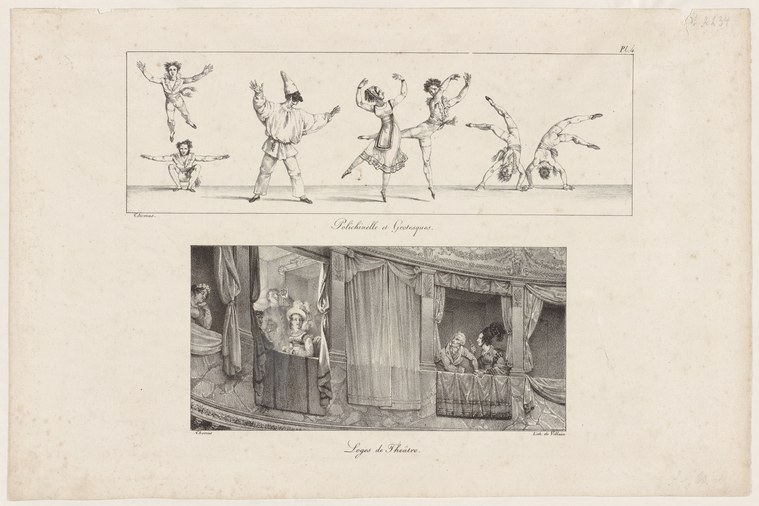
Polichinelle et grotesques.
Unknown artist
- Collection:
- Prints depicting dance
- Source:
- New York Public Library
- Rights:
- Public domain — free to use, share and adapt.
- Recorded as:
- Public Domain
Commedia dell'arte represents a lineage of physical comedy and acrobatic training that predates modern dance and influenced subsequent theatrical forms, yet its movement vocabulary survives primarily through images like this. For dancers and historians, this engraving is evidence of how professional performers in the 16th–18th centuries trained their bodies to extremes of flexibility and inversion that were coded as entertainment precisely because they defied courtly decorum and anatomical expectation.
What you are looking at
This composite print shows two distinct theatrical scenes of Commedia dell'arte performance. The upper strip presents a series of five acrobatic figures in rapid succession, rendered as sketch-like line drawings: a winged cherub or spirit figure with arms raised, a character in tall costume with exaggerated pose, two figures performing inverted or contorted movements, and additional acrobatic positions. The lower, larger engraved scene depicts an indoor theatrical setting with draped fabrics and architectural framing. Multiple figures in period costume are arranged across a stage or performance space: some observe from within doorways or behind curtains (stage left), while others perform or prepare in the main acting area. The lighting is created through fine cross-hatching, giving depth to the interior and silhouetting the figures against fabric backgrounds. The costumes suggest 17th or 18th century dress, with visible breeches, vests, and period hats.
The dancing
The upper register shows individual dancers in extreme positions: arched backs, inverted body lines, splits, and sprawled attitudes that suggest acrobatic virtuosity rather than courtly restraint. The lower scene presents ensemble figures in varied postures—some vertical and posed, others bent or in mid-gesture, suggesting narrative action unfolding across the stage space. No closed partner holds are visible; instead figures occupy distinct spatial zones within the theatrical interior. The proportions and musculature suggest mature, trained performers executing intentional physical feats.
The dance depicted
This appears to document Commedia dell'arte performance, specifically the acrobatic and physical comedy traditions associated with the form. The title 'Polichinelle et grotesques' identifies Pulcinella (Polichinello), the stock character of Commedia known for physical buffoonery, exaggeration, and acrobatic skill. The upper frieze of contorted figures illustrates the 'grotesque' physicality—inversions, extreme flexibility, and comic body positions—that were signature to Commedia performance. The lower scene shows the theatrical setting and ensemble arrangement typical of Commedia staging, where masked or costumed stock characters interacted in rapid, physical comedy. These performances were improvisational, audience-directed, and deliberately anti-courtly in their excess and bodily license.
How it was made
This is an engraving, composed of two separate scenes on one plate. The upper strip uses light line-work suited to rapidly conveying pose and movement; the lower scene employs dense cross-hatching to model form and create atmospheric interior space. Engraving allowed wide circulation of performance imagery to audiences who could not attend theaters, making this a document of performance practice intended for study, collection, and distribution beyond the immediate theatrical venue. The contrast between sketchy upper register and finished lower scene suggests this may record both quick studies of movement and a composed theatrical narrative.
About this work
This engraving preserves evidence of Commedia dell'arte as a physical, acrobatic performance tradition centered on the character of Pulcinella. Commedia troupes were among the most widely traveled and imitated theatrical forms of the early modern period, and this print documents both the characteristic 'grotesque' body positions and the stage arrangements through which these performances reached audiences. The work sits at the intersection of theater history, physical comedy, and dance practice—recording a tradition in which trained physical virtuosity, improvisation, and audience engagement were paramount. The dual register (sketch studies above, composed scene below) shows how performers' bodies were studied and circulated as technical models.
How to look at it
Attend to the progression of body positions in the upper frieze: each pose freezes a moment of extreme physical distortion or acrobatic transition, inviting the viewer to imaginatively animate the sequence. In the lower scene, notice how the artist uses the architectural frame (doorways, curtains, proscenium-like arrangement) to stage multiple simultaneous actions and spatial depths—typical of Commedia's episodic, ensemble-driven narrative. The density of cross-hatching in shadows and fabric creates a sense of crowded, kinetic interior space quite unlike the clarity of contemporary court ballet imagery.
The period
Commedia dell'arte emerged in mid-16th-century Italy as a professional, traveling theatrical form and dominated European performance through the 18th century. Unlike court ballet, which was developing formal technique and aristocratic decorum, Commedia prized physical excess, improvisation, and direct audience address. The form was particularly popular in France from the late 16th century onward, and this image likely documents French staging or a Franco-Italian performance context. By the 17th century, when this print appears to have been made, Commedia was experiencing both celebration as a virtuosic art and condemnation as vulgar; this engraving records it as a respected form worthy of study and circulation.
Where it lives
This engraving is held in the New York Public Library as part of a collection of prints depicting dance. It represents a significant category of performance documentation from the early modern period: widely circulated engravings that brought knowledge of theatrical practice to patrons, artists, and performers across Europe.
Dance in this work
Questions about this work
What is Commedia dell'arte and why does it matter to dance history?
Commedia dell'arte was a professional, improvisational theater tradition that dominated Europe from the 16th to 18th centuries. Unlike court ballet, it prized physical excess, acrobatic virtuosity, and direct audience engagement over formal technique. It influenced subsequent theatrical forms and represents a distinct lineage of trained physical performance that valued flexibility, inversion, and comic distortion—skills that were deliberately anti-courtly and audience-facing.
Who was Polichinelle and what did he do?
Polichinelle (Pulcinella) was a stock character of Commedia dell'arte, typically depicted as a hook-nosed servant or buffoon character known for physical buffoonery, acrobatic skill, and exaggerated gesture. He was one of the most recognizable and widely imitated Commedia types, and his performances centered on physical comedy, rapid movement, and audience interaction rather than narrative coherence.
Why are the figures in the upper part so contorted?
The upper frieze shows acrobatic positions and 'grotesque' body attitudes that were characteristic of Commedia performance. These extreme inversions, splits, and distorted postures were intentional displays of trained physical virtuosity, designed to amaze and amuse audiences by defying normal bodily decorum. They illustrate the physical vocabulary of the form and were studied and imitated by performers across Europe.
How do we know this is a theatrical performance?
The lower scene shows a clearly defined interior theatrical space with architectural framing (doorways, curtains, proscenium-like elements), costumed figures in period dress, and spatial arrangement typical of stage staging. The upper frieze functions as a study of movement types, and the title explicitly identifies the characters and form, confirming this as a document of professional theater rather than social dance.
More dance artwork





