49 works in this view — arrow keys or swipe to move between them.
Dance in Art
La guinguette
Unknown artist
- Collection:
- Prints depicting dance
- Source:
- New York Public Library
- Rights:
- Public domain — free to use, share and adapt.
- Recorded as:
- Public Domain
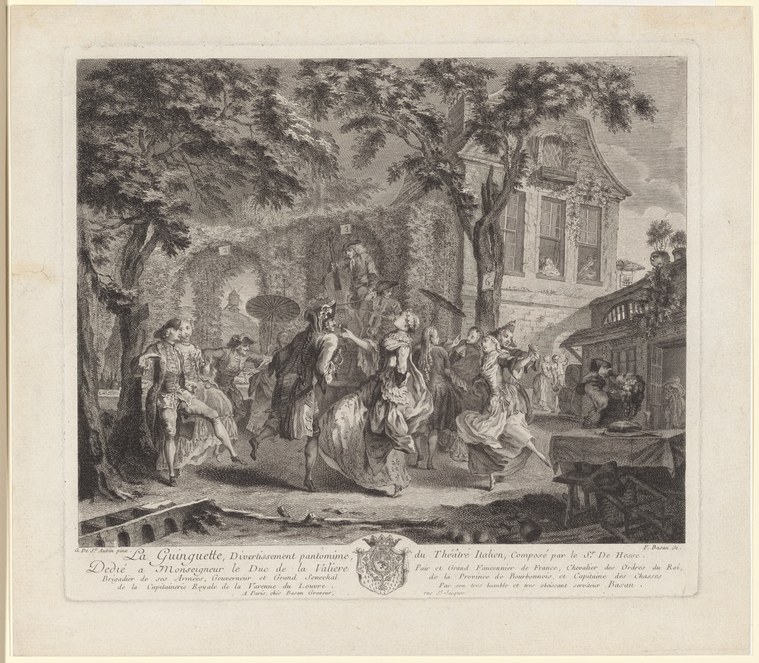
The guinguette represents a crucial moment in European social history when dance moved from the court and the aristocratic salon into semi-public, commercialised spaces accessible to a broader social spectrum. This engraving is one of the few visual documents that records the actual appearance and ethos of these venues, the dress of their participants, and the integration of dancing within a larger social performance. For students of 18th-century urban culture, fashion, and the democratisation of entertainment, the image is invaluable.
What you are looking at
A lively outdoor gathering in an aristocratic or upper-class setting, likely 18th century. The scene is dominated by a large tree in the foreground left, its dense foliage casting dappled shade across the ensemble. To the right stands a substantial building with classical architectural details—tall windows, balustrade, and a mansard-style roof. The ground slopes gently, and numerous figures in formal dress populate the entire composition: men in coats and breeches, women in full skirts with panniers and fitted bodices, many wearing hats. The central action is social and mobile rather than formally staged—couples appear to be dancing or promenading, some standing in conversation, others moving through the space. The mood is festive but ordered, the dress expensive and fashionable. The light is natural and diffuse, consistent with a spring or summer afternoon. The whole composition suggests a garden party or open-air entertainment at a country estate.
The dancing
The bodies are held upright and composed, with the formality of courtly deportment. Several pairs are clearly coupled, moving together through the space without visible tight holds; their arms are gesturing and engaging rather than grasping. The women's skirts dominate the visual space, their volume and movement central to the image's rhythm. Footwork is not legible in the engraving's detail, but the overall posture and positioning of the feet suggest the controlled, turned-out stance of aristocratic dancing. One figure near the center appears to be mounted or riding, introducing a moment of elevated status or ceremony. Across the scene, individuals are oriented toward one another, creating the impression of a coordinated social activity.
The dance depicted
This depicts a guinguette—a term for an outdoor entertainment venue, typically in a garden or rural setting near Paris, where the middle and upper classes would gather for dancing, music, and socializing in the 18th century. The guinguette tradition involved country dances, cotillions, and quadrilles performed in open air, often with a rural or rustic aesthetic despite the refinement of the participants' dress. The image captures the informal yet ritualised nature of these gatherings: the dancing is embedded within a broader social performance of promenade, conversation, and display. The presence of trees, the sprawling composition, and the mix of activities (some dancing, some socializing, some standing in groups) all accord with contemporary accounts of how guinguettes functioned as spaces of social mobility and entertainment.
How it was made
This is an engraving, as evidenced by the fine parallel line work (hatching and cross-hatching) that models form, shadow, and texture throughout the composition. The technique allows for precise detail in the architecture, the folds of fabric, and the varied poses of the figures, while the scale of the work suggests it was intended for circulation as a print—suitable for framing in a collector's cabinet or for bound inclusion in a book of social scenes or garden designs. The quality of the line work and the complexity of the composition indicate professional execution, likely by a skilled reproductive engraver working from a drawing or painting. Engravings of this type reached educated audiences across Europe and were important documents of contemporary life and fashion.
About this work
This engraving documents a guinguette, the 18th-century tradition of open-air social dancing and entertainment that flourished in the suburbs and gardens of Paris and other European cities. The work captures the ritual and aesthetic of these gatherings: the formal dress, the outdoor setting with its mixture of cultivation (the building) and nature (the trees), and the simultaneous engagement with dance and with social display. The scene is one of ordered pleasure, where aristocratic and bourgeois bodies perform both the steps of dance and the choreography of polite society. For historians of dance, the image is valuable not for precise technical detail—the engraver's hand does not preserve exact footwork—but for its testimony to where and how social dancing took place, who participated, and how it was understood as a form of public and semi-public leisure.
How to look at it
Attend first to the composition's division of space: the vertical division created by the tree and building frames the dancing and socializing figures as actors within a theatre-like setting. Look at how the engraver has rendered the movement of skirts and the positions of the couples—the informality of their positioning, the lack of rigid formation, marks this as a moment of social dancing rather than formal court ceremony. Notice the background figures and the way the scene recedes into depth; the engraver has created a coherent social world rather than isolating individual dancers. The inscribed title and text below the image (visible but requiring translation) would have directed 18th-century viewers to understand this as a fashionable gathering and probably offered commentary on the morality or social significance of the guinguette itself.
The period
The guinguette emerged as a distinct phenomenon in the mid-18th century, particularly around Paris, as urban growth and the rise of a prosperous merchant and professional class created demand for entertainment outside the court and formal aristocratic circles. These venues were celebrated in literature and art as sites of both pleasure and moral anxiety—they represented freedom, informality, and social mixing, yet they were sometimes criticised as spaces of excess or impropriety. The 18th century saw a broader shift in European dance practice: the codification of court dances (minuets, cotillions, quadrilles) reached their peak, while simultaneously the boundaries of who could dance and where became more permeable. Engravings of guinguettes and other scenes of popular amusement were part of a growing market for images of contemporary life, a category that included fêtes galantes, carnival scenes, and pastoral entertainments.
Where it lives
This engraving is held in the New York Public Library's collection of prints depicting dance. The inscription below the image, in French, identifies the subject and likely credits the artist and engraver, though the record provided does not preserve this information. As a print from a collection of dance imagery, it would have been valued as both a document of social custom and a work of visual interest.
Dance in this work
Questions about this work
What is a guinguette and why were these venues important?
A guinguette was an outdoor entertainment venue, typically in gardens or rural areas near 18th-century Paris, where the emerging middle classes and educated bourgeoisie gathered for social dancing, music, and conversation. These venues were significant because they represented a shift in European social life: dancing and entertainment were no longer confined to aristocratic courts and formal salons, but became commercialised, semi-public activities accessible to a broader social spectrum. Guinguettes became symbols of urban leisure and social mixing, celebrated in art and literature as spaces of pleasure and modernity.
What dances would have been performed at a guinguette?
The main dances were cotillions, quadrilles, and country dances—all courtly forms that had been standardised and codified by the 18th century. These dances were accessible to educated dancers without formal court training, which is one reason they became popular in semi-public venues. Unlike the solo or paired improvisational dancing of earlier court entertainments, these were structured group dances with clear formations and steps that could be learned and executed by amateurs.
How do we know this is actually a guinguette and not some other gathering?
The inscription beneath the engraving identifies it as such, and the visual elements accord with contemporary descriptions and other images of guinguettes: the outdoor garden setting, the mixture of formal dress with a semi-rural environment, the presence of a pavilion or refreshment house, and the mix of dancing couples with onlookers and strolling figures. The image shows the characteristic fusion of cultivation (the building, the dressed figures) and informality (the trees, the dispersed composition) that defined the guinguette aesthetic.
More dance artwork





