49 works in this view — arrow keys or swipe to move between them.
Dance in Art
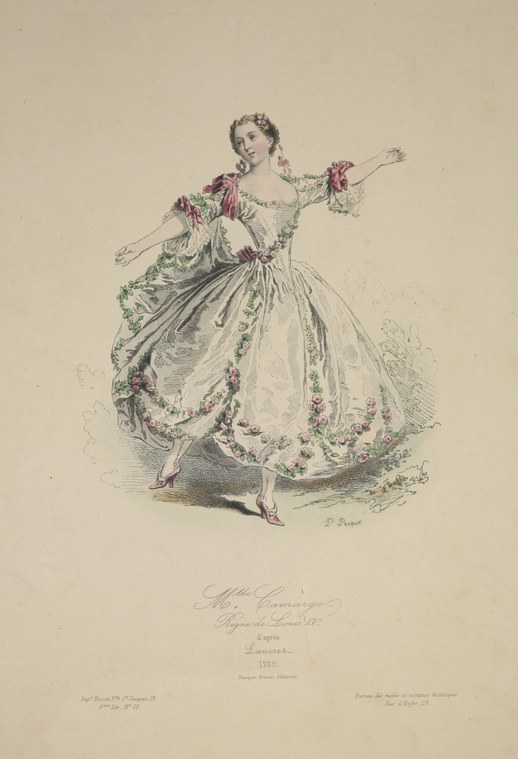
Mlle. Camargo, règne de Louis XV, d'après Lancret 1730.
Unknown artist
- Collection:
- Prints depicting dance
- Source:
- New York Public Library
- Rights:
- Public domain — free to use, share and adapt.
- Recorded as:
- Public Domain
Camargo was a revolutionary figure in dance history, celebrated for introducing new technical possibilities and for her fame as a performer. This image is direct evidence of how she was presented and consumed—not as an abstract dancer but as a glamorous, aristocratic figure whose costume and appearance were central to her appeal. It also documents the practice of circulating images of celebrated performers, a precursor to the star system of later centuries.
What you are looking at
A single female dancer is depicted in a three-quarter view, captured mid-performance in an attitude of theatrical grace. She wears an elaborately decorated gown characteristic of early 18th-century court dress: a low-necked bodice in pale silk with short puffed sleeves trimmed in deep rose or burgundy, and a voluminous skirt gathered with swags and garlands of flowers or floral ornament in shades of pink, green, and gold. The skirt extends to the ankles, revealing heeled slippers beneath. Her posture is elegant and composed—one arm extends outward in an open gesture while the other remains at her side, her body held upright with the formal poise expected of a court performer. The background is minimal, rendered in light washes that do not distract from the figure. The overall effect is that of a theatrical portrait or costume study rather than a narrative scene.
The dancing
A single dancer is shown in an upright, balletic frame with the weight carried lightly. The extended arm suggests an open, presentational quality typical of court dance, where the dancer addresses an audience directly rather than engaging with a partner. The carriage is aristocratic and restrained—there is no suggestion of vigorous movement or complex footwork. The costume dominates the composition as much as the body; the elaborate skirt with its flower garlands suggests the dancer is performing a formal, decorative role in which costume and appearance are as important as technique.
The dance depicted
This is a portrait of Mademoiselle Camargo, one of the most celebrated dancers of the early 18th century, shown in her characteristic role as a performer at the court of Louis XV. The inscription confirms this identification and dates the original source to 1730. Camargo was famous for her technical innovations—particularly her introduction of higher jumps and a lighter, faster style—and for her stage presence as a celebrated beauty. The formal, still pose here does not capture movement but rather documents her appearance and status as a court performer, as she would have been understood by the aristocratic audience who knew her work.
How it was made
This is a hand-colored engraving or aquatint, executed with fine lines for the bodice and face and broader washes of color for the skirt and background. The inscription at the base indicates it is made 'd'après Lancret 1730'—that is, after a painting by Nicolas Lancret from that year. The technique of colored engraving allowed for wide distribution among an educated audience interested in court fashion and theatrical celebrities. The refinement of line and subtlety of color suggest this is a high-quality work intended for collectors and those with an interest in dance and fashion history.
About this work
This is a theatrical portrait of Mademoiselle Camargo, one of the most celebrated dancers of the early 18th century, shown in the formal court dress and elegant posture that defined her public image. It is a hand-colored engraving made after a painting by Nicolas Lancret, created during the height of Camargo's fame in the 1730s. The work documents not a specific dance or movement but rather the visual image and status of a star performer—her costume, her bearing, her role in the cultural life of the court of Louis XV. For historians of dance and theater, it is a crucial record of how a celebrated performer was understood and marketed to her audience.
How to look at it
The artist has chosen a moment of stillness rather than movement—the dancer pauses, facing the viewer in a pose of composed elegance. This is not meant to convey the actual movement of her dance but rather to present her as a visual icon: her costume, her beauty, her aristocratic bearing. Notice the extreme care with which the artist has rendered the flower garlands and the texture of the silk; these details are as important to the image as the dancer's body, reflecting the 18th-century understanding that theater was a visual spectacle in which costume and appearance were paramount. The hand-coloring adds a precious, precious-object quality, suggesting this print was intended for a cultivated collector.
The artist
The inscription attributes the source to Nicolas Lancret (1690–1743), a major French Rococo painter specializing in fêtes galantes and theatrical scenes. Lancret was particularly associated with depicting the court and aristocratic leisure, and he painted several portraits of celebrated performers of his time, including Camargo. The engraver who made this version is not identified in the record, which was typical practice; reproductive engravings were often treated as collaborative works, with the original painter credited but the printmaker's name omitted.
The period
The 1730s were the height of the Rococo period in France, characterized by an aesthetics of elegance, grace, and theatrical presentation. This was also a moment of significant innovation in dance: Camargo was among the first dancers to introduce higher jumps, faster footwork, and a lighter technique that challenged the more formal, stately style of earlier court dance. Her fame coincided with the rise of a new kind of public interest in theatrical celebrities, enabled by prints like this one. Lancret's painting would have reached a much wider audience through hand-colored reproductive prints distributed among collectors and the educated public.
Where it lives
This work is held in the New York Public Library's Prints collection, which holds extensive sets of 18th- and 19th-century theatrical and costume prints. It is catalogued as a reproduction of a Lancret painting from 1730, though the date of the print itself is not recorded. Such prints were mass-produced for the educated market and widely collected by those interested in theater, fashion, and visual culture.
Dance in this work
Questions about this work
Who was Mademoiselle Camargo?
Camargo (1710–1770) was one of the most celebrated dancers of the early 18th century and a major innovator in ballet technique. She was famous for introducing higher jumps, faster footwork, and a lighter style that moved dance away from the formal, measured movements of earlier court dance. She also notably shortened her skirt to show her feet and footwork—radical for the time—and became a celebrated public figure whose image was circulated through prints like this one.
What does 'd'après Lancret 1730' mean?
It means this print is made after (d'après) a painting by Nicolas Lancret from 1730. Lancret was a celebrated Rococo painter who specialized in theatrical and aristocratic scenes. Reproductive prints like this allowed his paintings to reach a much wider audience than the original could. The print was likely made some years after the painting, but the artist's name and date of the print itself are not recorded.
Why is she standing still rather than dancing?
This is a theatrical portrait, not a depiction of a specific dance or movement. The artist is presenting Camargo as she would be understood by her audience: as a glamorous, aristocratic figure whose costume, appearance, and public persona were central to her fame. The formal pose and elaborate dress emphasize her status and beauty rather than her technical abilities, reflecting 18th-century values in which theatrical performance was understood as a visual spectacle.
What is this print and how was it used?
This is a hand-colored engraving made for distribution among collectors and the educated public interested in theater, fashion, and contemporary celebrities. Such prints were affordable enough to circulate widely but fine enough to appeal to cultivated taste. They served as records of celebrated performers and as fashion documentation, and they are among the earliest examples of the celebrity image industry.
More dance artwork





