49 works in this view — arrow keys or swipe to move between them.
Dance in Art
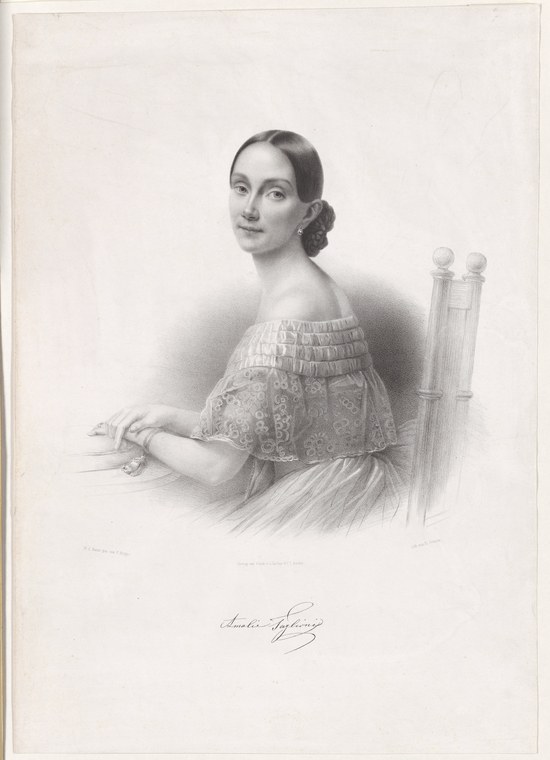
Amalie Taglioni [facsimile signature]
Unknown artist
- Collection:
- Prints depicting dance
- Source:
- New York Public Library
- Rights:
- Public domain — free to use, share and adapt.
- Recorded as:
- Public Domain
This portrait documents how a professional dancer of the early Romantic era was marketed and presented to the public; the clothing, posture, and presentation reveal the aesthetic values and class status associated with ballet at the height of its popularity in the 19th century. The work is a primary historical source for understanding the visual culture surrounding Romantic ballet and the celebrity status of the Taglioni family.
What you are looking at
A young woman is depicted from the waist up, seated and turned three-quarters toward the viewer's left. She wears a white or cream off-shoulder dress with a deep décolletage and a fitted bodice; the neckline is finished with layered horizontal ruffles or fluting. The sleeves are short and puffed. Her dark hair is parted in the center and gathered into a low chignon at the nape of her neck. Her right arm rests across her body, the hand rendered with careful attention to pose and gesture; her left arm is not visible. She gazes toward the upper left with a composed, slightly distant expression. The figure is rendered as a bust-length lithographic portrait against a plain white ground, with soft modeling in the face and shoulders and subtle shading to suggest volume and presence. A wooden chair back is barely sketched in behind her on the right. The work is signed in script at the lower margin with the subject's name: Amalie Taglioni.
The dancing
The sitter is composed and still, seated rather than in active movement. Her posture is upright and graceful, with the visible arm relaxed but deliberately posed—the hand positioned delicately, suggesting the balletic propriety expected of a professional dancer in formal portraiture. The clothing and grooming emphasize elegance and refinement; the off-shoulder dress exposes the neck and shoulders in the manner of Romantic-era theatrical costume. The overall bearing—the carriage of the head, the gentle turn of the shoulders, the careful positioning of the hand—conveys the trained physicality of a dancer even at rest.
The dance depicted
This is a formal theatrical portrait of Amalie Taglioni, a dancer of the Romantic ballet era. Taglioni was a member of the famous dancing family and performed in the early-to-mid 19th century, when ballet was entering its Romantic phase. The dress and styling are consistent with the costume and presentation of a prima ballerina of the 1830s–1840s. The off-shoulder neckline and short puffed sleeves are typical of Romantic ballet costume, designed to expose the line of the arm and shoulder for the ethereal, weightless movement the style prized. The portrait itself—a lithograph capturing the dancer at rest—does not depict her dancing, but rather presents her as a fashionable professional and celebrated performer for an audience that would have recognized her name.
How it was made
This is a lithographic print, a reproductive medium that allowed wide circulation of theatrical and celebrity portraits in the 19th century. The technique permitted soft tonal gradations and a refined linear quality, visible here in the delicate modeling of the face and the fine detail of the dress. The signature and the subject's name inscribed below indicate this was a commercial portrait intended for public sale and distribution. Lithography was the dominant medium for theatrical portraiture and celebrity imagery in the 1830s–1850s, enabling dancers and actors to reach audiences far beyond those who attended live performance.
About this work
This is a formal portrait lithograph of Amalie Taglioni, a professional dancer of the early Romantic ballet period. The work belongs to a substantial genre of 19th-century theatrical portraiture that served both as souvenirs for theater-goers and as records of celebrated performers. The image is significant not as documentation of dance in action, but as evidence of how dancers were presented to the public: fashionable, refined, physically distinguished by their training, and worthy of collection and display. The Taglioni family—particularly the more famous Marie—dominated European ballet in the 1830s–1840s, and theatrical portraits of family members were widely distributed and collected. This print is part of that historical and commercial context.
How to look at it
Attend to the carefully chosen dress and presentation: the off-shoulder neckline, the short puffed sleeves, and the fine material all announce this as a woman of theatrical refinement and professional standing. The pose—seated, composed, the hand delicately positioned—conveys trained grace without requiring movement. Notice how the lithographer has rendered the soft modeling of the face and the fine texture of the fabric, creating an image designed to flatter the subject and appeal to an audience who knew her from the stage. The inscribed name at the bottom signals this is a commercial portrait intended for sale and collection.
The artist
The artist is not recorded in the catalogue. The work is a commercial lithographic portrait, likely produced in Paris or another major European theatrical center in the 1830s–1840s, during the height of the Taglioni family's fame. Such portraits were often created by specialist print makers working from drawings or sketches; the quality and finish suggest a professional theatrical portraiture workshop rather than a major fine artist.
The period
This portrait dates to the Romantic ballet era, roughly 1830–1860, when ballet was transformed by the introduction of pointe work, ethereal costuming, and the emphasis on weightlessness and otherworldliness. The aesthetic of Romanticism—which prized the delicate, the ethereal, and the feminine—dominated theatrical dance. The Taglioni family, particularly Marie Taglioni, became international celebrities, and their images were circulated as lithographic prints throughout Europe and beyond. Theatrical portraiture became a major commercial enterprise in the 19th century, with prints sold to theater audiences, collected by enthusiasts, and distributed through print dealers. This portrait belongs to that thriving market.
Where it lives
The work is held in the New York Public Library's collection of prints depicting dance. It is a lithographic print of commercial theatrical portraiture, part of the broader corpus of 19th-century celebrity and performer imagery that documented the Romantic era of European theater and dance.
Dance in this work
Questions about this work
Who was Amalie Taglioni?
Amalie Taglioni was a dancer in the early-to-mid 19th century and a member of the famous Taglioni family, which dominated European ballet during the Romantic era. While less celebrated than her relative Marie Taglioni, she performed as a professional dancer and was prominent enough to have her portrait circulated in lithographic form. The family's name became synonymous with the highest standards of ballet technique and artistry.
Why was her dress rendered this way?
The off-shoulder neckline and short puffed sleeves are characteristic of Romantic ballet costume, designed to expose the arm and shoulder for movement and to create a graceful, ethereal line. Even in a portrait where she is not dancing, the costume communicates her profession and the aesthetic values of Romantic ballet—elegance, refinement, and the illusion of weightlessness.
What is a lithographic portrait and why were they popular?
Lithography was a printmaking technique that allowed mass production of high-quality portraits at relatively low cost. In the 19th century, theatrical portraits were major commercial products, sold to theater-goers as souvenirs and collected by admirers. They served as the equivalent of modern celebrity photographs, circulating widely and building the fame and marketability of dancers and actors.
More dance artwork





