49 works in this view — arrow keys or swipe to move between them.
Dance in Art
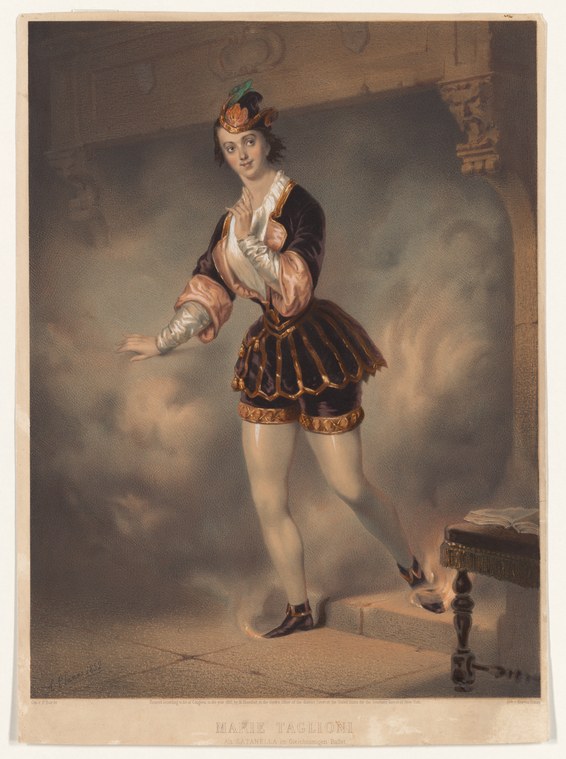
Marie Taglioni als Satanella im gleichnamigen Ballet
Unknown artist
- Collection:
- Prints depicting dance
- Source:
- New York Public Library
- Rights:
- Public domain — free to use, share and adapt.
- Recorded as:
- Public Domain
Marie Taglioni was the defining ballerina of the Romantic era, and this print documents her embodiment of a central Romantic type—the ethereal, supernatural, or morally ambiguous female dancer. For historians of ballet technique, costume, and theatrical practice, this image is primary evidence of how Romantic heroines were costumed, posed, and presented to spectators.
What you are looking at
A young woman in Romantic-era theatrical costume stands alone in a dramatic interior lit by strong, raking light that casts deep shadows across the background. She wears a dark velvet jacket with white lace cuffs and a prominent white lace jabot, paired with a short pleated skirt in earth tones and pale stockings. Her reddish-blonde hair is crowned with what appears to be a jeweled circlet or tiara. Her posture is alert and poised, one arm extended with fingers delicately splayed, the other held closer to her body. She gazes toward the viewer with an expression of theatrical intensity. Behind her, a neoclassical column and drapery suggest a palace or grand interior. In the lower right corner sits a small decorative object—possibly a lute or musical instrument—and what may be a goblet. The overall composition emphasizes her isolation and dramatic presence, with the lighting and shadow creating an almost supernatural atmosphere.
The dancing
The dancer occupies a clear, frontal stance with her weight distributed on both feet in a position ready for movement. Her extended right arm traces an elegant line with articulate fingers, the gesture suggesting simultaneity of strength and grace. Her torso is upright but with a subtle forward inclination. The costume—particularly the fitted jacket and short, structured skirt—allows visibility of the legs and permits the kind of quick, precise footwork associated with early Romantic ballet. The single figure and open stage space emphasize the soloist tradition of the era.
The dance depicted
This is almost certainly Marie Taglioni as the character Satanella from the ballet of that name, choreographed in the 1850s and famous for Taglioni's virtuosity. The image captures her in character as a supernatural or infernal female spirit—a type of role that suited the Romantic ballet's fascination with otherworldly femininity. The costume and pose suggest the moment before or during a scene of seduction or supernatural intervention. Taglioni was the most celebrated ballerina of the Romantic period, and her interpretations of such dramatic roles were legendary for their combination of technical precision and theatrical intensity.
How it was made
This is a hand-colored lithograph or color print, a medium that allowed wide circulation of theatrical imagery in the 19th century. The technique permits both delicate detail in the facial features and costume and the atmospheric rendering of shadow and light that creates the dramatic, almost ominous mood of the image. The color separation and registration are skillfully executed, with subtle gradations in the background and careful definition of the figure. This type of print was a primary means of documenting and promoting celebrated dancers and roles to audiences throughout Europe.
About this work
This is a theatrical portrait print documenting Marie Taglioni in one of her celebrated roles during the height of the Romantic ballet period. It preserves a specific performance tradition—the supernatural or infernal female character in ballet—and the particular style of costume, gesture, and stagecraft associated with Taglioni's artistry. The print is both a work of theatrical documentation and an artwork in its own right, using the resources of color lithography to capture the drama and technical refinement that made Taglioni famous. It belongs in the history of dance because it shows how a paramount historical figure was presented to the public and because it reveals the aesthetic values of Romantic ballet performance.
How to look at it
Note how the artist has chosen a moment of stillness and readiness rather than mid-leap—this emphasizes character and presence over virtuosity, though the poised, articulate arm position and upright carriage suggest the physical training behind the role. Observe the use of light and shadow to create an almost spectral quality appropriate to Satanella's supernatural nature. The costume details—the dark jacket, the pleated skirt, the precise accessories—show how nineteenth-century ballet was a thoroughly costumed form in which the dancer's body and the character's identity were inseparable. The downward gaze and posture suggest a moment of theatrical intensity before action rather than the apex of a technical feat.
The artist
The artist is not recorded in the catalogue. However, the work is typical of the theatrical print production that flourished in Paris and London in the 1850s-60s, when major dancers were routinely documented by print makers working for publishing houses that specialized in theatrical and operatic imagery. Such prints were often executed by artists in the workshops of lithographic publishers rather than by independent painters; the style and finish suggest a competent professional hand trained in the conventions of theatrical portraiture.
The period
This print dates to the height of the Romantic ballet period, when the female dancer had become the primary attraction of ballet and when roles emphasizing ethereality, mystery, and supernatural agency were at the center of the repertory. Taglioni's career (1822–1884) spanned this entire period and defined its aesthetic. Satanella (choreographed by Joseph Mazilier, 1858) was one of the great roles of the late Romantic era, part of a category that included Giselle, La Sylphide, and other works in which female characters operated in a realm between human and supernatural. The 1850s-60s were the period of maximum theatrical print production and circulation in Europe; such images were affordable souvenirs and promotional materials that shaped how dancers and roles were remembered.
Where it lives
The print is held in the New York Public Library's collection of prints depicting dance. It is a hand-colored lithograph, a popular and widely circulated format, indicating this documented a famous performance familiar to European audiences.
Dance in this work
Questions about this work
Who was Marie Taglioni?
Taglioni (1804–1884) was the most celebrated ballet dancer of the 19th century and the defining artist of Romantic ballet. She was famous for her technical virtuosity, her ethereal presence, and her creation of iconic roles. She also danced on pointe (en pointé), a technique that became standard in ballet, and was one of the first to perfect it extensively.
What was the ballet Satanella?
Satanella, or The Devil's Bride, was choreographed by Joseph Mazilier and premiered in 1858 at the Opéra in Paris, with Taglioni in the title role. It was a fantastical drama in which Satanella, a demonic or supernatural figure, intervenes in a human drama. The role was a vehicle for virtuosity and dramatic character work, combining technical display with theatrical presence.
How can I tell this is a lithograph?
The method is visible in the smooth gradations of color, the characteristic slight texture of the printing process, and the way light and shadow are built up through color separation and hand-coloring. The image has the clarity and definition possible only with lithography, and the fact that it survives in good condition suggests it was made in quantity and carefully printed.
Why do historical dancers wear costumes like this?
In Romantic ballet, costume was central to meaning. The dark jacket, tiara, and short skirt signified a character who was regal, supernatural, or morally complex—not a classical sylph or nymph. The silhouette, with its close-fitting bodice and short skirt, allowed the dancer to display both virtuosity and the precise footwork and leg position that demonstrated technical training.
More dance artwork





