49 works in this view — arrow keys or swipe to move between them.
Dance in Art
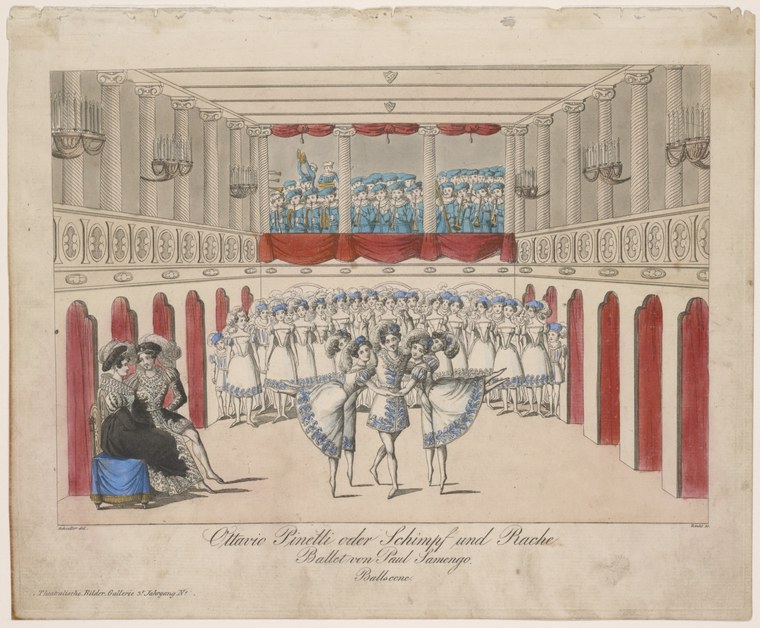
Ottavio Pinelli oder Schimpf und Rache, Ballet von Paul Samengo, Ballscene
Unknown artist
- Collection:
- Prints depicting dance
- Source:
- New York Public Library
- Rights:
- Public domain — free to use, share and adapt.
- Recorded as:
- Public Domain
This image is crucial evidence for understanding how Romantic-era ballets were structured, staged, and experienced. It shows the scale of the corps de ballet, the formality of classical positions, and the integration of narrative pantomime with dance—essential information for reconstructing lost choreographies. For historians of theater and visual culture, it documents the conventions of theatrical printmaking and the commercial circulation of ballet imagery in the 19th century.
What you are looking at
A grand theater interior staged for a ballet performance, shown in cross-section to reveal both the stage and auditorium. The stage is framed by a proscenium arch with red velvet curtains and decorated with a red-and-gilt border. Rows of male and female dancers in classical ballet dress—women in pale tutus and pointe shoes, men in tights and fitted jackets—stand in geometric formations across the stage, creating a symmetrical tableau. The auditorium is filled with spectators in formal dress: women in elaborate gowns with plumed headdresses, men in dark coats and breeches. In the foreground at stage left, an elderly woman in black with a blue underskirt and ornamental staff sits as an observer or perhaps a character in the narrative. Two male figures in the foreground engage in what appears to be a dramatic exchange. The architecture is neoclassical with fluted columns, sconces, and an ornate ceiling. The entire scene is rendered in hand-colored engraving with careful attention to perspective and detail, from the gilt decoration of the boxes to the individual faces in the crowd.
The dancing
The dancers on stage stand in vertical alignment, bodies erect and arranged in parallel lines—the typical formation of corps de ballet in the early 19th century. The women's arms are raised or held at waist in classical fifth position; the men stand in formal counterpose. In the foreground, two male figures appear to be in dramatic gesture, possibly mid-dialogue or combat, with one reaching toward the other. The elderly woman at stage left holds a staff or wand, suggesting an authoritative or magical role. The precision of pose and the uniformity of the corps suggests a formal, hierarchical choreography rather than loose or naturalistic movement.
The dance depicted
This depicts a scene from a theatrical ballet performance in the early 19th-century European tradition. The title references *Ottavio Pinelli* and a revenge narrative (*Schimpf und Rache*—insult and revenge)—likely a romantic or dramatic ballet with plot complications. The scale of the corps de ballet, the geometric formations, and the formal stage setting are consistent with Romantic-era ballet spectacle. The presence of a character in black with a staff and the dramatic confrontation in the foreground suggest a narrative ballet in which magical or supernatural elements and human conflict interact. The style of dress and composition indicates this is a ballet in the tradition established by figures like Paul Taglioni or other mid-19th-century ballet masters, though the specific choreographer Paul Samengo is not otherwise documented in standard histories.
How it was made
This is a hand-colored engraving or aquatint, identifiable by the fine parallel line-work visible in the architectural detail and the distinct application of color in separate zones—pale for the tutus, pink and red for flesh and fabric, grey-blue for shadows. The technique allowed for both architectural precision and narrative detail; the cross-sectional view of the theater was a convention in 18th and 19th-century theatrical prints, enabling the viewer to see stage and audience simultaneously. Such prints were produced for distribution to the public as souvenirs or promotional images, circulated among theater patrons and collectors of theatrical imagery. The hand-coloring indicates this was a luxury production, more expensive than uncolored impressions.
About this work
This is a record of a specific ballet performance—*Ottavio Pinelli, oder Schimpf und Rache*—staged in a major European theater in the 19th century. It captures the spectacle and social ritual of Romantic-era ballet: the formal architecture of the proscenium stage, the large ensemble of trained dancers in classical dress, the narrative incident frozen in a single dramatic moment, and the theatrical audience as witnesses. The image documents not only the choreography but the entire theatrical apparatus—stage machinery, costume, décor, and the social composition of the audience. It belongs in a gallery about dance because it shows how ballet was created, displayed, and consumed as public entertainment; it reveals the hierarchy and formations that define classical ballet technique; and it captures a moment in which dance, narrative, and architectural spectacle converge.
How to look at it
The viewer should attend to the moment captured: a dramatic pause or confrontation in the narrative, frozen while the corps de ballet remains in formal alignment on stage. This is not a moment of dynamic movement but of theatrical narrative presentation—the dramatic figures in the foreground command attention while the ensemble provides a static geometric backdrop. Notice how the artist uses the architectural frame—the proscenium, the boxes, the columns—to organize the composition and to distinguish the stage world from the social world of the audience. The contrast between the formal, posed bodies of the dancers and the varied attitudes and reactions of the audience members reveals the fundamental 19th-century understanding of ballet as a spectacle designed for observation and admiration rather than participation.
The artist
The artist is not recorded in the catalogue. The print bears a printer's mark at lower left: 'Lith. Anstalt v. Fiedler in Gohlis n°.' indicating it was produced by a lithographic press in Gohlis (a suburb of Leipzig, Germany), suggesting a German or Central European context. The work was likely produced by a theatrical print publisher who specialized in ballet and opera imagery—a common commercial practice in the mid-19th century. Without further documentation, the designer cannot be firmly attributed, though the sophistication of the composition and hand-coloring suggest a professional theatrical illustrator.
The period
This work dates to the height of the Romantic ballet era, roughly 1830–1860, when narrative ballets with supernatural or exotic themes dominated European stages. The aesthetic values evident here—the idealization of the female corps de ballet, the geometric precision of formations, the elaborate stage spectacle, and the integration of mime-drama with dancing—are all hallmarks of Romantic choreography as practiced by choreographers like Jean-Coralli, Jules Perrot, and Auguste Bournonville. In the visual arts, theatrical prints in this period served as a primary means of circulating knowledge of ballet beyond those who could attend performances; they were affordable luxury goods that allowed middle-class collectors to own images of famous dancers and celebrated productions. The hand-coloring and architectural detail place this work in the tradition of late 18th and early 19th-century German and Austrian theatrical printmaking.
Where it lives
The work is held in the New York Public Library's Prints collection, described as part of a series of images depicting dance. It comes from a German lithographic publisher (Fiedler, Gohlis) and was likely produced as part of a series documenting celebrated ballet performances in German-speaking theaters, suggesting it had currency in Central European theatrical culture.
Dance in this work
Questions about this work
Who was Paul Samengo and what was this ballet about?
Paul Samengo is not well documented in standard ballet histories, suggesting he may have been a minor or regional choreographer. The title *Ottavio Pinelli, oder Schimpf und Rache* (Insult and Revenge) indicates a narrative ballet with dramatic content—Pinelli is likely a character, and the plot involves conflict and retribution, typical of Romantic ballet melodrama. The presence of an elderly woman with a staff suggests magical intervention or a supernatural element.
What can we learn about classical ballet technique from this image?
The dancers' formal alignment, the emphasis on symmetry and vertical posture, and the visible fifth position of the arms all document the classical ballet aesthetic of the mid-19th century. The large corps de ballet arranged in parallel lines shows how ensemble dancers were used to create visual spectacle and formal beauty rather than individual virtuosity. The separation of narrative pantomime (performed by principal dancers in the foreground) from pure dancing (performed by the corps) was a structural principle of Romantic ballet.
How were ballet performances documented and shared in the 19th century?
Since photography was not yet widely used for theater, hand-colored engravings and lithographs were the primary means of recording and circulating images of celebrated performances. These prints were sold as souvenirs and distributed through print shops to a paying public, making them a commercial product as well as historical documentation. They often celebrated famous dancers, celebrated productions, and the spectacle of the theater itself.
More dance artwork





