49 works in this view — arrow keys or swipe to move between them.
Dance in Art
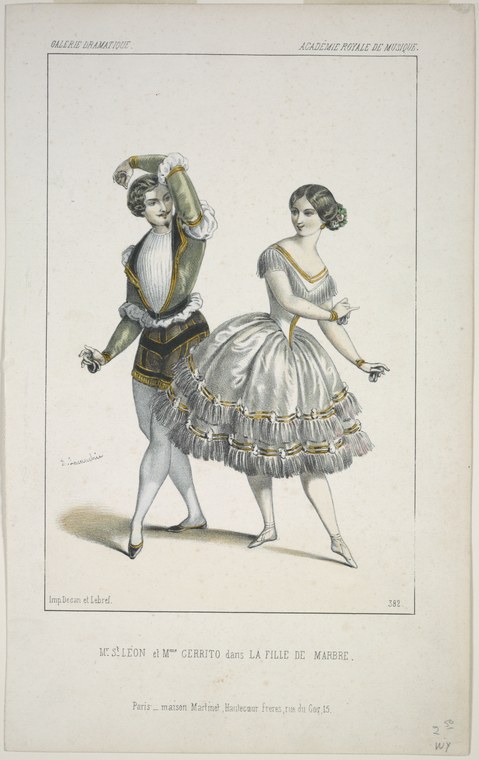
Mr St. Léon et Mme Cerrito dans La fille de marbre.
Unknown artist
- Collection:
- Prints depicting dance
- Source:
- New York Public Library
- Rights:
- Public domain — free to use, share and adapt.
- Recorded as:
- Public Domain
This work documents not just a specific performance but the dominant aesthetic and technical vocabulary of one of ballet's defining eras, and it shows how that vocabulary was circulated, remembered, and sold to the public through theatrical prints. For historians of dance, it is primary evidence of how the Romantic ballet looked on stage—not what we infer from choreographic notation or from later reconstructions, but what contemporary audiences actually saw. For dancers and teachers, it is a precise record of how the classical ballet port de bras, carriage, and costume were understood and executed in the era of Romantic ballet's maturity.
What you are looking at
A hand-colored engraving depicting two dancers in mid-performance, likely from a mid-19th-century ballet or theatrical production. On the left, a male dancer in a dark green jacket with gold trim and fitted tights strikes a dynamic pose with one arm raised above his head, the other at his side, his body angled forward in a buoyant attitude. To his right stands a female dancer in a pale silk dress with a full skirt trimmed in gold ruching and ribbon, her arms extended to either side in a graceful port de bras, her posture upright and poised. The woman's dress features the characteristic silhouette of Romantic-era ballet—a fitted bodice with a low, wide neckline and a skirt that falls to mid-calf. Both dancers wear pale stockings and perform against a plain cream background with minimal setting detail, allowing focus to remain entirely on their bodies and costumes. The print bears the hallmarks of theatrical documentation from the 1840s-1850s: bold outlines hand-colored with watercolor or gouache, precise delineation of musculature and costume detail, and a composition designed to capture a single, legible moment of the performance.
The dancing
The male dancer displays a weight-forward, energetic port de bras typical of the male vocabulary of the period: elevated arm line, controlled torso, and a sense of propulsive movement. The female dancer maintains the erect carriage and extended arm positions characteristic of classical ballet technique, with her weight centered and her frame open toward the audience. Neither dancer appears to be in actual physical contact, suggesting a moment of spatial relationship or transition within the choreography. The composition emphasizes contrast: the male dancer's dynamic, upward impulse against the female dancer's sustained, balanced classical line.
The dance depicted
This is almost certainly a scene from *La Fille de marbre* (The Marble Daughter), a mid-19th-century ballet, as stated in the title. The named dancers—St. Léon and Cerrito—were celebrated ballet stars of the 1840s-1850s. The costume styles, the pointe shoes visible on the female dancer, and the formal academic vocabulary on display are consistent with the Romantic ballet of this period. The image captures what appears to be a moment of classical duet work, likely from a principal pas or pas de deux. The specific choreography cannot be determined from a single stillframe, but the vocabulary and relationship suggest the formal, aristocratic movement vocabulary of mid-nineteenth-century ballet before the more athletic transformations of the late 19th century.
How it was made
This is a hand-colored engraving, a reproductive print that allowed wide circulation of theatrical imagery in the era before photography dominated such documentation. The technique—fine line engraving with subsequent hand application of watercolor or gouache—was standard for theatrical prints sold as souvenirs to audiences and collectors. The precision of the engraved line preserves fine detail in the dancers' musculature, costume construction, and facial features, while the hand-coloring adds immediacy and the illusion of stage lighting. Such prints were produced in series and distributed by Parisian publishers, making them a primary record of how specific performances and star dancers were documented and remembered.
About this work
This hand-colored engraving records a moment from a mid-19th-century Parisian ballet, *La Fille de marbre*, featuring two of the era's most celebrated dancers. It is a theatrical souvenir print—a form of performance documentation that preceded photography as the primary means of circulating images of dance to the public. The work captures the vocabulary, costume conventions, and aesthetic ideals of the Romantic ballet at its height: the female dancer in the characteristic long tutu with pointed shoes, the male dancer in tailored jacket and tights, both executing the vocabulary of classical ballet technique with the formality and precision that defined the period's aesthetic. As both a historical artifact and a work of visual representation, it embodies the transatlantic circulation of Parisian ballet culture in the mid-19th century and the role of the print in creating and sustaining the image of the ballet star.
How to look at it
Look first at the costume and the body's relationship to it: the male dancer wears a jacket, the female dancer a long tutu with visible pointe shoes, establishing both the gender conventions of the period and the level of technique being performed. Then observe the moment of the movement: the male dancer is captured in an upward impulse, his arm raised and his torso lifted, while the female dancer is in a moment of sustained balance and extension. Notice the precision of the line work in the engraving—it preserves muscle definition, the structure of the tutu's skirt, and the angles of the limbs with great clarity. The hand-coloring adds warmth and the impression of stage light, particularly in the pink and gold tones of the female dancer's costume. This is a work of theatrical documentation designed to be legible and memorable, not an artistic interpretation.
The artist
The artist is not identified in the catalogue record. However, the print was published by Martinet, a major Parisian theatrical publisher of the mid-19th century, and bears the signature of the engraver in the lower left corner (indistinct in reproduction). Theatrical prints of this type were produced by commercial publishing houses employing teams of engravers, colorists, and publishers rather than by named individual artists in the fine-art tradition. The work is representative of a vast production of such prints documenting Paris's leading performers and productions.
The period
This engraving dates to the mature phase of the Romantic ballet, a period roughly 1830–1860 when the aesthetic ideals of Romanticism—otherworldliness, ethereal femininity, exoticism, melancholy—dominated European ballet. By the time this print was made, the pointe shoe had become standard for female classical dancers, the tutu had assumed its characteristic silhouette, and the male dancer's role had begun its slow decline relative to the ballerina. Paris was the undisputed capital of ballet, and its stars—Taglioni, Cerrito, Grisi, and the male virtuosos who partnered them—were international celebrities. Theatrical prints were a crucial means of disseminating their images and creating lasting records of their performances. This work sits at a moment when the engraved theatrical print, though being challenged by new reproductive technologies, was still the dominant form for such documentation.
Where it lives
The print is held in the New York Public Library's collection of prints depicting dance. It is a commercial theatrical souvenir, one of many such prints produced and sold to audiences in Paris and circulated internationally. The publisher's mark identifies it as a product of Martinet's enterprise, a major publisher of such ephemeral but historically valuable documents.
Dance in this work
Questions about this work
Who were St. Léon and Cerrito?
Saint-Léon (Michel Léon) and Fanny Cerrito were among the most celebrated dancers of the mid-19th century. Cerrito was an Italian ballerina known for her virtuosity and dramatic power; Saint-Léon was a French dancer, choreographer, and violin virtuoso who became ballet master at the Imperial Theatre in St. Petersburg. Both were international stars who performed across Europe's major opera houses.
What was *La Fille de marbre*?
A now-lost ballet of the Romantic era, likely choreographed in the 1840s-1850s. Like many ballets of the period, its plot probably involved supernatural or exotic elements—the title suggests a story about a marble statue or a female figure with marble-like qualities. The work survives only through such prints and through references in dance histories.
Why were theatrical prints like this one made and sold?
These prints served as souvenirs for audience members and as promotional tools for theaters and performers. Before photography dominated, they were the primary means by which performances could be recorded and circulated. They were inexpensive to produce compared to fine-art engravings and were sold at theaters and by print publishers to create a lasting record of celebrated performances and stars.
What can this print tell us about Romantic ballet technique?
It shows the standard costume and port de bras of the period, the use of pointe shoes by female dancers, the male dancer's vocabulary of elevation and dynamic movement, and the formality and academic precision that characterized the technique. The stillness of the moment suggests classical control rather than the more athletic, turning-based vocabulary that would dominate later 19th-century ballet.
More dance artwork





