49 works in this view — arrow keys or swipe to move between them.
Dance in Art
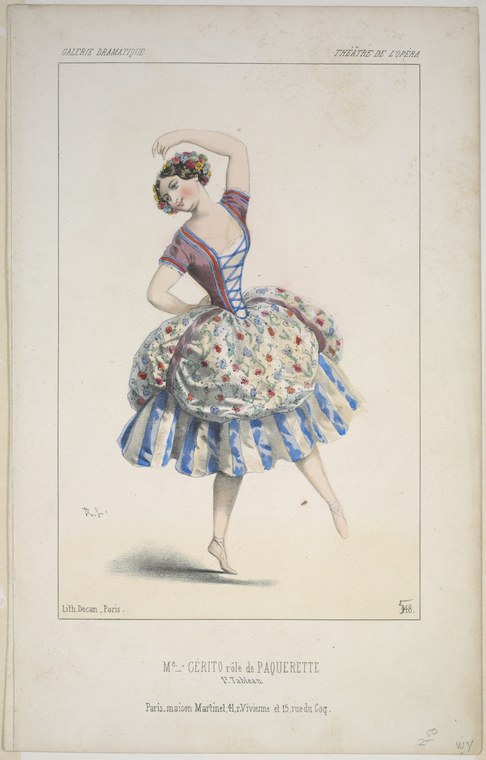
Melle. Cérito rôle de Paquerette, 1r tableau.
Unknown artist
- Collection:
- Prints depicting dance
- Source:
- New York Public Library
- Rights:
- Public domain — free to use, share and adapt.
- Recorded as:
- Public Domain
This print is crucial evidence for the visual culture of romantic ballet: it shows us exactly what Paquerette's costume looked like, how it moved, and how the dancer was expected to present herself to the public. It also demonstrates the 19th-century tradition of packaging and selling dancers' images, a practice that shaped both theatrical celebrity and the visual grammar of ballet portraiture.
What you are looking at
A single female dancer poses in a moment of suspended grace against a plain background, her body angled in a classical contrapposto. She wears a fitted bodice in purple-blue with short puffed sleeves and a voluminous skirt of pale silk decorated with a dense pattern of small floral sprigs in red, blue, and green. The skirt is caught mid-movement, its tiered ruffle hem creating a dramatic silhouette as she balances on her left leg with her right extended behind her. Her left arm is raised and bent, hand positioned near her head in a graceful line; her right arm is pulled back. Her dark hair is dressed in ringlets and crowned with a small wreath of flowers matching the skirt's decoration. The figure is rendered in delicate hand-colored lithography with soft gradations of tone, particularly in the shadowing beneath her body and the subtle modeling of her limbs. The pale cream paper grounds the composition, emphasizing the dancer as the sole focus.
The dancing
A single dancer in a sustained posed attitude rather than an arrested moment of traveling movement. Her weight is concentrated on her supporting leg, her torso angled forward from the hips, and her extended leg held high and straight behind her with apparent ease—a line suggesting both strength and effortlessness. The raised arm and tilted head create an S-curve through the body. The gesture is one of deliberate presentation: she is not dancing *for* someone, but rather being displayed *to* the viewer, a convention of theatrical portraiture that prioritizes beauty of line over action.
The dance depicted
This is a theatrical-ballet portrait, most likely documenting Amalia Ferraris or another prima ballerina of the 1840s–1850s in the romantic-era costume and pose that defined the period. The floral-sprigged skirt, the pointe-like positioning, and the classical arabesque-adjacent attitude are hallmarks of the romantic ballet aesthetic. The inscription names Mlle. Cérito in the role of Paquerette (Daisy), likely from a short, character piece or divertissement within a larger production. Eugénie de Mérode and other dancers of the era were frequently documented in such costume studies, often issued as part of collected series of performers and roles.
How it was made
This is a hand-colored lithographic print, a medium that dominated theatrical publicity in the 19th century. The soft, modulated lines and the delicate hand-application of watercolor or gouache are visible in the uneven density of the floral pattern and the subtle tonal transitions. Lithography allowed rapid, affordable production of multiple impressions for distribution to theaters, salons, and collectors, making the dancer's image widely circulated. The technique supported the romantic aesthetic of ethereal, idealized beauty: harder media such as engraving would have created harsher lines and less flattering tonality.
About this work
This is a theatrical souvenir portrait of a romantic-era ballerina in character costume, preserved in the New York Public Library's collection of dance prints. It documents both the costume conventions of 1840s–50s ballet and the commercial practice of publishing dancers' likenesses for public consumption. The work sits at the intersection of theatrical documentation, commercial portraiture, and the emerging culture of the ballerina as a publicly celebrated figure. It is simultaneously an artwork, a publicity object, and a historical record of how dancers dressed and how they understood their own image.
How to look at it
Attend to the precision of the pose: the dancer is not in motion but in a *held* position, one designed to be held and photographed. Notice how the floral pattern on the skirt is rendered as individual flowers rather than a woven or printed repeat—this labor-intensive hand-coloring suggests a premium object. The pose is deliberately flattering: the extended leg shows off the line, the raised arm creates an unbroken curve, and the frontal-but-angled stance presents the dancer at her best angle. The wreath on her head echoes the floral pattern on the skirt, creating a visual rhyme that emphasizes the ornamental, decorative function of the dancer's body within the romantic aesthetic.
The artist
The artist is not recorded in the catalogue, which is typical for mass-produced theatrical prints of the era. The print was published by Lith. Bénard, Paris, a commercial lithographic house that produced numerous dance and theatrical portraits for Parisian and international distribution. Such prints were often credited to the publisher rather than the artist, and individual lithographers' names were frequently omitted from the plate. The style is consistent with the work of mid-19th-century Paris theatrical printmakers, whose practice was to render performers in idealized but recognizable costume and attitude.
The period
This print belongs to the high era of romantic ballet, roughly 1830–1860, when the ballerina became the central figure of European theatrical culture and dance imagery flooded the popular market. The costume—the fitted bodice, the knee-length tulle skirt, the floral crown—is the canonical romantic silhouette, designed to emphasize weightlessness and ethereal grace. The pose reflects the classical training and aesthetic values of the Cecchetti and Vaganova methods, which were systematizing ballet technique across Europe. The floral skirt pattern and character-dance naming (Paquerette = Daisy) suggest a lighter, more playful piece within the era's broader tragic narratives like *Giselle* and *La Sylphide*, indicating the importance of variety within a night's performance.
Where it lives
This print is part of the New York Public Library's Prints depicting Dance collection, a broad assemblage of theatrical and dance imagery spanning centuries and media. The collection preserves theatrical publicity materials, costume studies, and performance documentation that would otherwise have scattered across dealers and private collectors. As a mass-produced item, this print would have been affordable and widely distributed, making its survival in institutional holdings typical for its type.
Dance in this work
Questions about this work
Was Mlle. Cérito a real dancer?
Yes. Fanny Cerrito (sometimes spelled Cérito) was an Italian-born ballerina who danced extensively in Paris, London, and across Europe during the 1840s and 1850s. She was a major figure of the romantic era and a favorite of audiences and critics. Roles like Paquerette were characteristic of the lighter, character-dance pieces that dancers of her rank performed in addition to the grand tragic ballets.
What does '1r tableau' mean in the title?
'1r tableau' means 'first tableau' or 'first scene'—an indication that this was Paquerette's entrance or opening appearance in whatever work she appeared in. Theatrical programs and published costume studies often noted the act or tableau, both to aid identification and to suggest the narrative moment being depicted.
Why is the skirt so full if this is ballet?
The romantic-era ballet tutu was designed to enhance the illusion of weightlessness and to make the dancer's legs and feet visible. The layered, gathered skirt created volume without weight and allowed the thin silk to move fluidly with the dancer's motion. The knee-length hem also became iconic: earlier classical tutus had been longer, and later 20th-century tutus became much shorter, but this mid-thigh length defined the romantic era.
How much would a print like this have cost?
Theatrical prints ranged from inexpensive one or two francs for simple black-and-white lithographs to significantly more for hand-colored editions like this one. An average worker's daily wage in Paris in the 1840s was 2–3 francs, so even a cheap print represented a small luxury. Hand-colored versions would have been more expensive and aimed at wealthier collectors and theater patrons.
More dance artwork





