49 works in this view — arrow keys or swipe to move between them.
Dance in Art
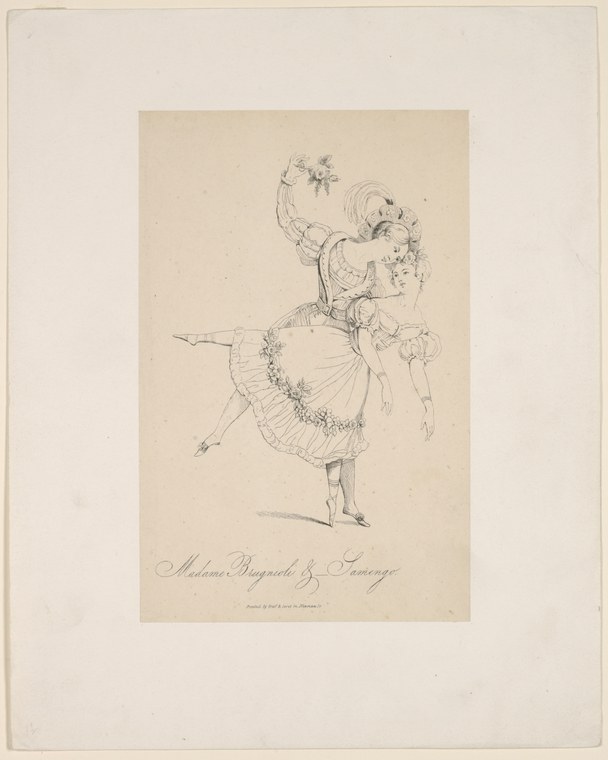
Madame Brugnioli [Brugnoli] & Samengo.
Unknown artist
- Collection:
- Prints depicting dance
- Source:
- New York Public Library
- Rights:
- Public domain — free to use, share and adapt.
- Recorded as:
- Public Domain
Amalia Brugnoli was a major figure in romantic ballet, and this image documents her actual practice and the visual language of romantic ballet as her contemporaries saw and recorded it. The work is evidence of how dancers themselves were celebrated and circulated in the pre-photography era, and of the role of rapid sketch-documentation in theatrical culture.
What you are looking at
A single female dancer dominates this delicate pen sketch, positioned in a balletic pose against a plain background. She wears a short, elaborately gathered tutu with decorative garland or floral detail at the hem, and her bodice appears fitted with puffed sleeves. Her hair is styled up and adorned with what appears to be feathers or plumage. The dancer's weight rests primarily on one leg while the other extends, and her upper body leans back slightly in a graceful arch. Her arms are raised and angled, with one hand holding what appears to be a flower or small prop. Below the figure, in flowing script, the artist has inscribed "Madame Brugnoli & Samengo," suggesting this depicts a pas de deux or perhaps the moment of a male dancer lifting or supporting a female dancer, though only the female figure is rendered in detail. The line work is fine and precise, characteristic of early theatrical portraiture, with minimal shading and a focus on silhouette and gesture.
The dancing
The dancer's pose displays the characteristic asymmetry of romantic-era ballet: her supporting leg is nearly straight but with a softness that suggests the slight knee flexibility of the period, while her free leg extends in a position somewhere between attitude and arabesque. Her torso curves gently backward in a romantic 'épaulement'—the tilting and spiraling of the upper body that was central to the aesthetic. Both arms are raised but in a relaxed, naturalistic manner rather than the more geometric arm positions of classical ballet. The single visible dancer occupies the full height of the composition, drawn with anatomical understanding of ballet's weight distribution and the subtle cant of the body that precedes a turn or traveling step.
The dance depicted
This is a theatrical ballet image from the romantic period (likely early-to-mid 19th century, based on costume and style), depicting a moment from a professional pas de deux or individual variation. The names inscribed—Madame Brugnoli (almost certainly Amalia Brugnoli, a celebrated Italian ballerina of the 1830s–1840s) and a partner surnamed Samengo—indicate this records a specific performance, probably in Italy. The costume, pose, and execution all align with the romantic ballet vocabulary of the 1830s–40s: the short tutu; the floral and feather decoration; the soft, curved épaulement; the integration of a hand-held prop (possibly a flower, suggesting a courtship or pastoral theme). The artist understood ballet's mechanics and captured the moment of suspension or preparation that defines romantic choreography.
How it was made
This is a pen-and-ink drawing, likely a working sketch or study preparatory to a published print; the inscription in flowing script is part of the original composition. The fine, uniform line work and the precision of the figure suggest the hand of a trained theatrical illustrator or a dancer-adjacent artist familiar with ballet anatomy. The technique allowed rapid documentation and wide circulation of theatrical imagery—such sketches were often engraved or lithographed for sale to audiences as souvenirs or to artists as reference material. The apparent age of the paper and the style of the inscription support dating to the 1830s–1850s.
About this work
This is a professional theatrical record of a romantic-era ballet dancer, most likely Amalia Brugnoli, one of the most celebrated Italian ballerinas of her time. The inscription names both a principal dancer and her partner, suggesting this documents a specific pas de deux or variation performed in an Italian theatre. The image is a working sketch in pen and ink, the kind of rapid, observant drawing that circulated among dancers, choreographers, and theatre practitioners of the period to preserve and disseminate a celebrated performance.
The work belongs in a dance history collection as evidence of romantic ballet's aesthetics in action: the costume vocabulary (short tutu, floral ornament), the body's curve and asymmetry, and the integration of a prop into the dance's narrative. It shows how professional dancers of the 1830s–40s understood and inhabited their roles, and it documents a specific moment in the international dissemination of romantic ballet—in this case, from France to Italy and back into circulation as a theatrical souvenir.
How to look at it
Attend to the moment the artist chose: not the apex of a jump or turn, but the preparation or recovery—the instant of suspension and curve that defines romantic ballet's aesthetic. Notice how the supporting leg is not locked but flexed, how the torso curves back and away from vertical in a way that looks effortless but required precise control. The raised arms, the hand holding a small prop, the tilt of the head—all of these are not arbitrary poses but choreographic statements. The fine line and minimal background focus all attention on the body's line and the dancer's understanding of how to present herself to an audience.
The artist
The artist is not recorded. The quality of anatomical understanding and the assured line suggest a trained artist with access to rehearsals or performances, possibly a theatre illustrator or a painter attached to an Italian opera house. The style of inscription and the period of the paper indicate a mid-19th-century Italian or European theatrical milieu.
The period
This drawing dates to the height of romantic ballet, the era of Taglioni, Elssler, and their Italian contemporaries (1820s–1850s). In Italy, the ballet d'action tradition remained strong, and Italian ballerinas like Brugnoli were celebrated across Europe for their technical brilliance and dramatic presence. The 1830s–40s were a period of intense international exchange: dancers toured, companies merged, and choreographers restaged works across borders. Theatrical portraiture—in prints, sketches, and engravings—was a major commercial and cultural practice, allowing audiences to collect images of celebrated performers and dancers to study technique and style from published records.
Where it lives
This sketch is held in the New York Public Library's collection of prints depicting dance. It is not a finished work but a preparatory or working drawing, the kind that circulated among theatrical practitioners and was sometimes engraved or lithographed for wider sale. The inscription in the artist's hand identifies the subjects and is the sole evidence of the work's context.
Dance in this work
Questions about this work
Who was Amalia Brugnoli?
Amalia Brugnoli was an Italian ballerina of the 1830s–1840s, celebrated for her technical brilliance, dramatic presence, and skill in the Italian ballet d'action tradition. She performed across Europe and was a major figure in the dissemination of romantic ballet from Paris to Italy and beyond. She was known for her strong technique and her ability to perform both dramatic and lyrical roles.
What is this drawing a record of?
This sketch documents a specific pas de deux or solo variation performed by Madame Brugnoli and her partner (surnamed Samengo) in an Italian theatre, probably in the 1830s or 1840s. The inscription and the costume details suggest this was a performance record—the kind of rapid sketch an artist would make in the theatre or from memory to capture a celebrated moment for reproduction or study.
How do we know what dance style this is?
The costume (short tutu, fitted bodice, floral ornament), the body position (asymmetrical, curved épaulement, soft weight), and the historical context (the 1830s–40s, Italy, a celebrated ballerina) all point to romantic ballet. The pose and the dancer's understanding of how to inhabit it confirm that this is ballet of the romantic era, not classical ballet or any other form.
Why was this image made?
Theatrical sketches like this served multiple purposes: as working notes for choreographers or costume designers; as records of celebrated performances for dancers studying style; and as the basis for engravings or lithographs sold to audiences as souvenirs. Before photography, such sketches were the primary way dancers and choreographers preserved and circulated images of celebrated performances.
More dance artwork





