49 works in this view — arrow keys or swipe to move between them.
Dance in Art
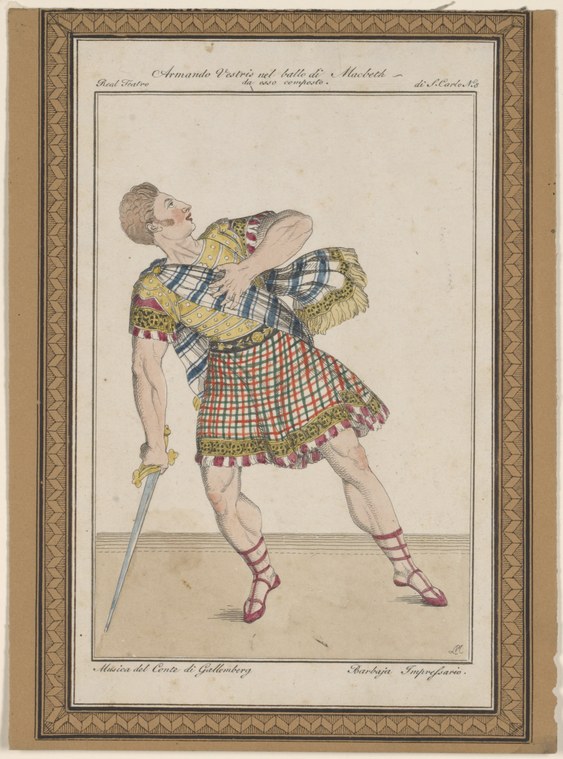
Armando Vestris nel ballo di Macbeth, da esso composto, musica del Conte di Gallemberg, Barbaja impressario.
Unknown artist
- Collection:
- Prints depicting dance
- Source:
- New York Public Library
- Rights:
- Public domain — free to use, share and adapt.
- Recorded as:
- Public Domain
This image documents one of Europe's most celebrated male dancers at the height of his fame and shows how theatrical dance of this era combined technique with dramatic acting and spectacular costume. For historians and dancers, it is evidence of what Romantic-era male dancing looked like, what dancers wore, and what kind of dramatic or narrative roles were considered appropriate for the virtuoso male dancer—a question that the 19th century would increasingly struggle with as the ballerina became the center of attention.
What you are looking at
A male dancer in theatrical costume stands in a dynamic, mid-movement pose against a plain background. He wears a richly patterned costume consisting of a short pleated skirt in red and white check with green trimmed edges, a yellow and blue plaid or striped upper garment, and what appears to be a draped yellow fabric across his chest. His legs are bare except for red and white striped stockings and red heeled shoes. He holds a sword or dagger in his right hand, angled downward, and his left arm is raised and bent. His head is tilted back, his body weight shifted onto one leg in a pose of dramatic tension. The composition is a three-quarter view against a plain cream background, framed by an ornate double-lined border typical of 18th or early 19th-century theatrical prints. The title inscribed above indicates this depicts Armando Vestris in a scene from a ballet adaptation of Macbeth.
The dancing
A single male dancer dominates the frame in a strongly asymmetrical pose. His weight is concentrated on his right leg while his left leg extends or turns; his torso twists and tilts back, creating a sense of dramatic urgency or emotional turmoil. The raised left arm and downward-angled sword suggest violent action or agitated emotion rather than the controlled line of classical ballet. The pose reads as expressive pantomime or action dance rather than the codified positions of formal ballet technique, with the emphasis on communicating a dramatic moment through the body's disposition.
The dance depicted
This is a theatrical dance from the Romantic era, specifically a scene from a ballet adaptation of Macbeth. Armando Vestris (1758–1821) was one of the most celebrated male dancers of his era, known for both technical virtuosity and dramatic power in roles that required acting as well as dancing. The inscription credits the music to Count Gallemberg and the production management to the impresario Barbaja, establishing this as a documented work from the professional stage. The pose suggests a moment of psychological crisis or violent action—appropriate to Macbeth's themes—rendered through the expressive, character-based movement that was central to theatrical dance of this period rather than pure technique display.
How it was made
This is a hand-colored engraving, a reproductive print technique that was standard for theatrical publicity and documentation in the late 18th and early 19th centuries. The precision of the line work and the delicate hand-coloring (visible in the careful registration of yellows, reds, and greens) indicate a work of professional quality intended for circulation among theater audiences and patrons. Engravings like this served both as souvenirs of famous performances and as visual records of celebrated dancers' costumes and dramatic interpretations, making them valuable documents of historical dance practice. The ornate border and inscription treatment suggest a prestigious production worthy of publication as a collectible print.
About this work
This is a theatrical print documenting a scene from a professional ballet of the early 19th century, specifically the role of Armando Vestris in a Macbeth adaptation. It is a hand-colored engraving—a medium that allowed wide circulation of images of celebrated dancers and was essential to the development of dance as a recorded and discussed art form. The work captures the expressive, character-driven dance style of the Romantic era, when male dancers were expected to embody dramatic emotion and psychological states through movement. Vestris's pose is theatrical and pantomimic, emphasizing action and emotion over the pure display of technique, and his exotic costume (a plaid skirt with draped fabrics) signals the ballet's engagement with spectacle and visual fantasy as part of its narrative.
How to look at it
Pay attention to the asymmetry and emotional charge of the pose: Vestris is captured not in a position of repose or display, but in a moment of dramatic action or psychological distress. Notice how his costume combines technical sophistication (the fitted upper garment and precisely cut skirt) with theatrical exoticism (the exotic plaid, the draped yellow fabric), designed to catch light and movement on stage. The angle of his head tilted back and his raised arm create a diagonal line of energy through the body that reads as expressive movement rather than static pose. This is the visual language of Romantic-era character dance—the body in motion and in emotion, not the body as an instrument for pure technique display.
The period
Armando Vestris was active during the transition from the 18th-century courtly ballet tradition to the Romantic ballet of the early 19th century. His career spanned the late 1700s and early 1800s, when male dancers in Europe were still expected to be virtuosic performers in their own right, executing brilliant technical passages and embodying heroic or dramatic roles. By the time this print was made (likely early 19th century, given Vestris's age and the print's style), theatrical ballet was beginning to shift toward the female dancer as the primary focus of visual and technical attention—a shift that would accelerate through the Romantic era. The adaptation of Macbeth as a ballet speaks to the era's appetite for dramatic and literary subject matter in dance, a trend that defined the period. Engravings like this were part of the machinery of theatrical publicity and celebrity culture that made famous dancers recognizable across Europe.
Where it lives
This is a hand-colored engraving held in the New York Public Library's collection of prints depicting dance. It is part of a broader tradition of theatrical publicity and documentation that made famous dancers and their roles visible to the public through reproducible print media.
Dance in this work
Questions about this work
Who was Armando Vestris?
Armando Vestris (1758–1821) was one of the most celebrated male dancers of the late 18th and early 19th centuries, known for both technical brilliance and dramatic power. He was the son of Auguste Vestris, himself a legendary dancer, and continued his father's reputation as one of the great male virtuosos of the European stage. He danced across major European cities and was known for taking on dramatic and demanding roles, including adaptations of literary works like Macbeth.
What is a hand-colored engraving and why were they made of dancers?
A hand-colored engraving is a print made from an engraved metal plate, with color added by hand afterward. These prints were made of famous dancers and theatrical scenes as a form of publicity, documentation, and collectible merchandise. They circulated among patrons and theater audiences and served as visual records of celebrated performances and iconic roles, allowing people who had not seen the performance to know what the dancer looked like and what they wore.
What was the costume of male dancers in this period?
This image shows an unusually exotic costume for a dramatic role—the plaid skirt with draped fabrics suggests a character or fantasy role rather than a classical or courtly setting. In the late 18th and early 19th centuries, male dancers wore tight-fitting upper garments, knee breeches or short skirts, stockings, and heeled shoes. For dramatic roles like Macbeth characters, costumes became more elaborate and fantastical, designed to enhance the theatrical impact of the character and to show off the dancing body through movement.
What does this print tell us about how men danced in this era?
The pose suggests movement that is expressive and character-driven rather than purely technical. The raised arm, tilted head, and dramatic stance indicate that male dancers of this period were expected to embody emotional and psychological states through their bodies, and to tell stories and convey character through dramatic action. This was before the 19th-century shift toward the female dancer as the focus of virtuosity; here, the male dancer is the center of attention and expected to demonstrate both technique and dramatic presence.
More dance artwork





