49 works in this view — arrow keys or swipe to move between them.
Dance in Art
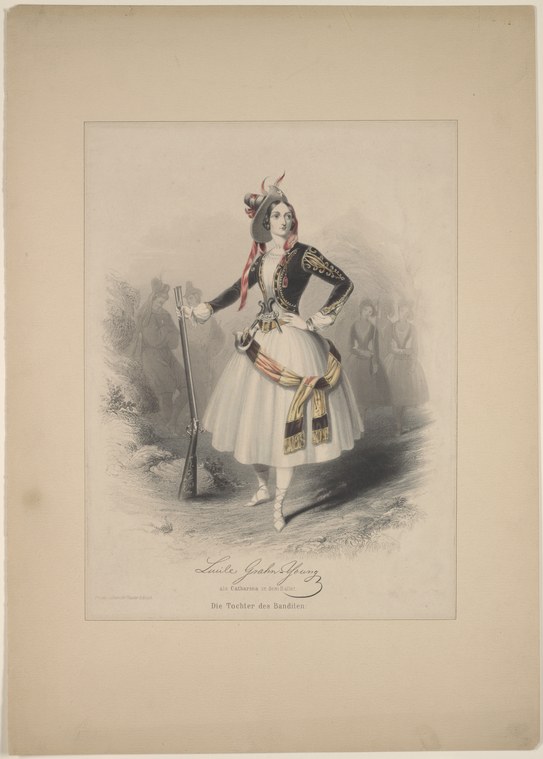
Lucile Grahn-Young (facs. sig.) als Catharina in dem Ballet Die Tochter des Banditen.
Unknown artist
- Collection:
- Prints depicting dance
- Source:
- New York Public Library
- Rights:
- Public domain — free to use, share and adapt.
- Recorded as:
- Public Domain
Lucile Grahn was one of the great ballerinas of the Romantic era, and this print documents her in a character role that challenges the stereotype of Romantic ballet as purely ethereal and decorative. The image reveals how nineteenth-century narrative ballet gave female dancers dramatic agency and physical authority—qualities that would later be suppressed in classical ballet's emphasis on weightlessness and subordination. It is a rare visual record of a specific performance and performer from an era before photography could capture theater.
What you are looking at
A solo female dancer is shown in three-quarter view against a plain background, wearing a dark velvet jacket with ornate trim and a full white skirt with a broad golden sash at the waist. She wears a small horned or pointed headdress and holds a rifle or musket in her left hand, which she brandishes at an angle across her body. Her right arm is positioned on her hip in a confident, assertive pose. The figure is rendered in hand-colored lithographic style with subtle shading that gives volume to the fabrics and depth to the composition. Behind her, faint figures suggest a scene or ensemble, though they remain deliberately obscured. The title identifies her as Lucile Grahn performing in the role of Catharina in the ballet *Die Tochter des Banditen* (The Bandit's Daughter).
The dancing
The dancer stands in a stable, grounded stance with weight evenly distributed, the body held upright and dignified despite the dramatic costume. The left arm extends forward holding the weapon; the right arm bends sharply at the elbow with hand at hip, a gesture of defiance or authority. The posture suggests the character of a woman of action or rebellion rather than the ethereal, weightless line typical of contemporary Romantic ballet. The head is held high, the gaze direct and commanding. There is no visible pointe work or the characteristic turnout of classical ballet technique in this position—the stance is sturdy and frontal.
The dance depicted
This is a Romantic-era ballet, likely from the 1840s, and *Die Tochter des Banditen* is a work with a dramatic, possibly criminal or outlaw narrative. Lucile Grahn (1819–1907) was a Danish-Italian prima ballerina of the Romantic period, celebrated for her technical brilliance and dramatic roles. The costuming and pose here—the weapon, the military jacket, the assertive stance—suggest a character role within a narrative ballet, a genre in which female dancers took on strong or exotic personas. The image does not capture the dancer in motion, but rather in a character portrait pose that suggests the dramatic intensity and narrative weight of the role, consistent with Romantic ballet's interest in powerful female characters and emotionally charged scenarios.
How it was made
This is a hand-colored lithograph, a reproductive print technique that allowed rapid and relatively inexpensive circulation of images of famous performers. The delicate stippling and tonal gradations show the lithographer's skill at rendering fabric texture and light. The hand-coloring—applied after printing—is uneven in places, which is typical of commercial theatrical prints of the period. Such prints were sold as souvenirs and publicity materials at theaters, making them important documents of how performances were marketed and how dancers' roles were visualized for the paying public.
About this work
This is a portrait print of the Romantic-era ballerina Lucile Grahn in character costume for a narrative ballet. It belongs to the tradition of theatrical portraiture that documented the stars and spectacular roles of mid-nineteenth-century dance, a tradition that used printmaking to reach audiences beyond the theater and to immortalize celebrated performances. The image captures not a moment of dancing but a dramatic persona—a woman armed and defiant, positioned outside the ethereal femininity that dominated later Romantic ballet. It is evidence of how Romantic ballet encompassed a range of female character types and how dancers' reputations were built and circulated through mass-produced imagery.
How to look at it
Look first at the pose: it is not a ballet position at all, but a theatrical stance of confidence and command, rooted to the earth rather than aspiring to weightlessness. The weapon is not decorative—it is held as if it will be used, and the body language supports that reading. Notice the contrast between the austere, military jacket and the full, soft white skirt: the image suggests a woman who moves between two worlds, or who claims both masculine authority and feminine form. The faint figures in the background suggest that this is a moment from a dramatic scene rather than an isolated portrait, and the print technique—the hand-coloring, the lithographic line—is meant to convey the spectacle and celebrity of the stage, not naturalism.
The artist
The artist is not recorded. The print was likely made by a commercial theater print publisher, possibly based on a sketch made from a performance or from a portrait session with the dancer. Such prints were a standard form of theatrical merchandise and promotion in the nineteenth century, produced in quantity and hand-colored, often by different hands. The quality and care taken with this image suggests it was a prominent production and a significant role.
The period
This work dates to the height of the Romantic ballet era (1830s–1850s), when the form had shifted decisively toward narrative, exotic, and supernatural themes, and when female dancers dominated the stage as never before. The Romantic period celebrated strong emotions, exotic locales, and female characters with agency—witches, spirits, peasant women, rebels, and outlaws. At the same time, ballet technique was becoming increasingly virtuosic and ethereal, emphasizing the illusion of weightlessness through the use of pointe shoes (which had become standard by the 1830s). Narrative ballets often required dancers to play character roles—military women, ethnic dancers, women of the lower classes—which demanded different movement vocabularies and costumes than the classical variations. This print documents that expanded range.
Where it lives
This print is held in the New York Public Library's collection of prints depicting dance. It is a hand-colored lithograph, the standard reproductive format for theatrical publicity and souvenir prints of the nineteenth century. The signature in facsimile ("Lucile Grahn-Young") indicates this is an authorized reproduction of the performer's likeness, a common practice that lent legitimacy and celebrity appeal to prints.
Dance in this work
Questions about this work
Was Lucile Grahn a famous dancer?
Yes. Lucile Grahn (1819–1907) was a leading ballerina of the Romantic era, trained in Copenhagen and celebrated across Europe for her technical virtuosity and dramatic presence. She was known for both classical roles and character parts, and she danced in some of the most important ballets of her time, including *La Sylphide* and *Giselle*.
What was *Die Tochter des Banditen* (*The Bandit's Daughter*)?
The specific ballet is not well documented in standard histories, but the title indicates a narrative work with a dramatic or transgressive theme—common material for Romantic ballet. The costume and weapon suggest Catharina was a woman of action or rebellion, a type of role that appealed to Romantic choreographers and audiences.
Why is she holding a rifle?
The weapon is part of the character's costume and narrative identity. In Romantic ballet, female dancers played women warriors, outlaws, and rebels as well as sylphs and ghosts. The rifle signals that Catharina is a woman of physical power and agency within the story of the ballet.
How do we know this is a lithograph?
The image shows the characteristic qualities of lithography: fine, even stippling for tone and shadow, crisp but slightly soft lines, and an overall tonal range limited by the printing process. The hand-coloring is uneven and somewhat translucent, typical of commercial color application to prints. The signature and text are printed as part of the lithographic stone.
More dance artwork





