49 works in this view — arrow keys or swipe to move between them.
Dance in Art
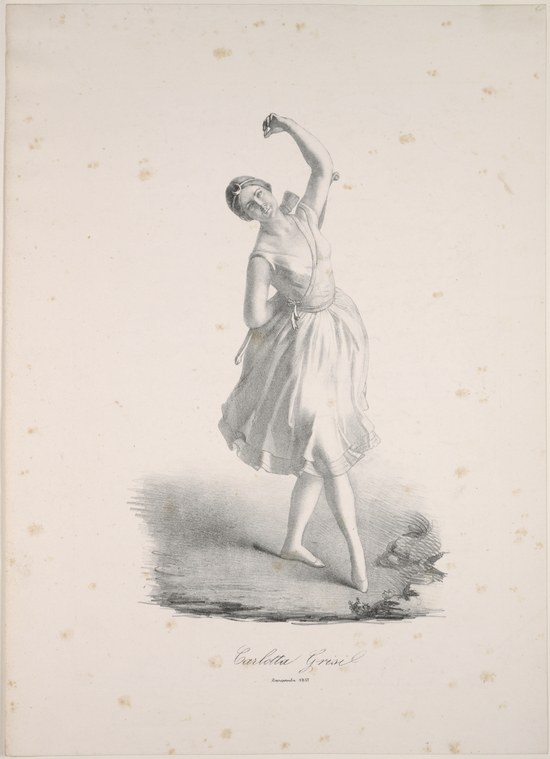
Carlotta Grisi carnevale 1847.
Unknown artist
- Collection:
- Prints depicting dance
- Source:
- New York Public Library
- Rights:
- Public domain — free to use, share and adapt.
- Recorded as:
- Public Domain
Carlotta Grisi was a pivotal figure in Romantic ballet—a dancer whose roles and technique shaped the form for a generation. This print is evidence of how ballet performers were celebrated and memorialized in the period before photography dominated portraiture; it also captures the specific aesthetic and technique of Romantic-era ballet in a form designed for study and circulation. For dancers and historians, it is a primary source showing how the body was positioned, dressed, and valued in a foundational moment of ballet's development.
What you are looking at
A single female dancer is shown in a moment of suspended, upward-reaching movement against a plain background. She wears a fitted bodice and a voluminous skirt that falls to mid-calf, characteristic of mid-nineteenth-century balletic dress. Her body is arched backward in an elegant line, with one arm raised overhead in a graceful curve and the other extended to the side. Her head is tilted back, and her gaze follows the lifted arm. The dancer stands en pointe or on the ball of her foot, with her supporting leg straight and her free leg extended. The composition isolates the figure in space, emphasizing the verticality and lift of the pose. The print is rendered in fine graphite or engraved line, with subtle shading that models the form of the body and the texture of the fabric. The background is deliberately blank, focusing all attention on the dancer's line and movement.
The dancing
The dancer presents a single, sustained vertical line extended upward and back. The supporting leg is fully extended and turned out, placed firmly beneath the body's center. The free leg is elongated and pointed, lifted slightly behind or held in a classical position. Both arms are engaged in the composition of the line: the overhead arm continues the arc of the torso, while the lower arm provides counterbalance and grace. The head is released back in harmony with the curve of the spine, suggesting a moment of extension and elevation rather than active stepping or traveling.
The dance depicted
This is a portrait of Romantic-era classical ballet, most likely a study of a specific moment from a ballet choreography or a technical pose taught within the ballet vocabulary of the period. The inscription identifies this as "Carlotta Grisi carnevale 1847"—a reference to the Italian-born prima ballerina Carlotta Grisi, one of the greatest dancers of the 1840s and creator of the role of Giselle. The title "carnevale" (carnival) suggests this may document a performance, costume, or theme associated with Carnival, though the dress is standard mid-nineteenth-century ballet attire rather than carnival costume. The pose itself—an extension en pointe with arched back and lifted port de bras—is foundational to Romantic ballet technique and reflects how ballet was danced and valued at the height of the Romantic movement.
How it was made
This is a lithograph or engraved print, executed in fine line and tonal wash to create dimension and suggest the fabric's fall and the body's musculature. The technique allows for wide reproduction and circulation; this type of souvenir print was sold to ballettomanes and opera audiences in major European cities, serving as both a record of celebrated dancers and a teaching tool for gesture and form. The medium's precision and its capacity for fine modeling made it ideal for disseminating images of star performers and codifying the look of Romantic ballet technique for those who could not attend performances.
About this work
This is a portrait print of the celebrated ballerina Carlotta Grisi, captured in a canonical pose of Romantic ballet technique. The image documents both a specific performer and a moment in balletic vocabulary—the extension and épaulement (arm and torso carriage) that defined the aesthetic of ballet in the mid-nineteenth century. As a mass-produced print, it is a record of how ballet was visualized, taught, and consumed during one of the art form's most influential periods. The work sits at the intersection of theater history, dance technique, and print culture: it is simultaneously a portrait of a star, a technical diagram, and a commodity circulated among ballet enthusiasts across Europe.
How to look at it
Look first at the line the dancer's body makes: it is a continuous curve from the lifted foot, through the extended supporting leg, the arched spine, and the raised arm, with the head released back into the curve. This is the fundamental aesthetic of Romantic ballet—the body conceived as a series of graceful, elongated lines rather than as a vehicle for complex footwork. The artist has chosen a moment of suspension and display rather than a traveling step, emphasizing the refinement and weightlessness that audiences associated with the female dancer of this period. Notice also the care taken in rendering the fabric of the skirt: its volume and the way it hangs suggest both the dancer's upward lift and the material reality of mid-nineteenth-century stage costume.
The artist
The artist is not recorded. Prints of this kind were produced by commercial print publishers and studios in London, Paris, and continental Europe, often executed by skilled but unnamed engravers and lithographers working from live observation or from drawings by theatrical illustrators. The style and execution suggest a mid-nineteenth-century professional atelier; such prints were standard merchandise in the lobby of opera houses and theaters, and were also sold separately to devoted followers of the ballet.
The period
The 1840s were the height of the Romantic movement in ballet. Carlotta Grisi danced the title role in Giselle in 1841 at the Opéra in Paris, and remained one of the most celebrated and highest-paid ballerinas of her era. This was a period when ballet was dominated by female dancers in ethereal, ghostly, or exotic roles, and when the pointe shoe and the romantic tutu became standard theatrical costume. The practice of circulating prints of celebrated dancers was at its peak; these images shaped public taste and served as mementos of theatrical experience. The year 1847 falls late in Grisi's peak performance years, though she continued to dance and tour throughout Europe.
Where it lives
This print is held in the Prints Depicting Dance collection of the New York Public Library. It is a single-sheet theatrical souvenir print, typical of the mass-produced ephemera circulated to ballet audiences in major European cities during the Romantic era.
Dance in this work
Questions about this work
Who was Carlotta Grisi?
Carlotta Grisi (1819–1899) was an Italian ballet dancer who became one of the most celebrated prima ballerinas of the Romantic era. She is best known for creating the role of Giselle in the 1841 Paris premiere of Giselle, and for her long career as a leading dancer at the Opéra in Paris and on tour across Europe. She was a technical innovator and a star of the first rank, commanding high fees and devoted audiences.
What does 'carnevale' mean in the title?
Carnevale (carnival) may refer to a carnival-themed performance or costume worn by Grisi in 1847, or it may simply be a topical title added by the print publisher. It does not necessarily indicate that the dress or pose shown is carnival costume; the ballet attire shown is standard Romantic-era stage dress. Without additional context about the specific performance, the exact meaning of the title remains uncertain.
How does this compare to photographs of Romantic-era dancers?
Few surviving photographs of Romantic-era ballet dancers exist, in part because photography was not widely used in the theater until the 1860s and later. Prints like this one were the primary visual record of how dancers looked, moved, and were costumed during the height of Romanticism. They were created by skilled observational artists and circulated as theatrical souvenirs, making them the closest thing to a recorded image of performance in this period.
What does the pose tell us about Romantic ballet technique?
The extended, arched line of the body—with the focus on verticality, epaulement (arm and upper-body carriage), and pointed feet—reflects the technical priorities of Romantic ballet. The pose emphasizes grace, elongation, and the illusion of weightlessness rather than the display of complex footwork or turning. It shows us that the ideal female dancer of this period was conceived as a figure of ethereal, sustained beauty rather than technical virtuosity.
More dance artwork





