49 works in this view — arrow keys or swipe to move between them.
Dance in Art
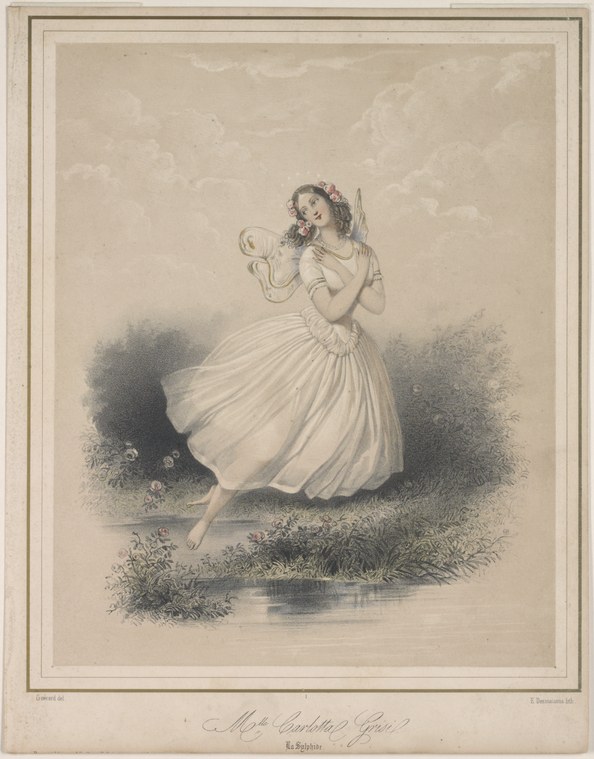
Mlle. Carlotta Grisi. La Sylphide.
Unknown artist
- Collection:
- Prints depicting dance
- Source:
- New York Public Library
- Rights:
- Public domain — free to use, share and adapt.
- Recorded as:
- Public Domain
Grisi was one of the great technicians and dramatic interpreters of mid-19th-century ballet, and the Sylph was one of the most coveted roles in the Romantic repertoire. This print is evidence of how a specific performance was circulated and remembered, and of the way theatrical prints shaped public knowledge of dance and dancers during an era when performance was ephemeral and most people knew dance through images.
What you are looking at
A young woman in a white, full-skirted dress stands alone in a woodland clearing beside a small stream. She wears a wreath or crown in her dark hair and holds one arm curved gracefully near her face in a dreamy, inward-looking pose. The ground around her is rendered in soft shadow with flowering plants and grasses; dark foliage frames the left side of the composition while the background recedes into pale, clouded sky. The overall mood is romantic and ethereal, the kind of nature setting that was central to Romantic ballet of the 1830s–40s.
The dancing
The dancer stands with her weight seemingly on one leg, the other barely marked beneath the full skirt. Her upper body is turned slightly inward; one arm is raised with the hand near her cheek in a gesture of reverie or longing, while the other arm hangs or rests at her side. The posture suggests lightness and elevation rather than grounding, consistent with the ethereal female dancers of Romantic ballet who were meant to appear weightless and otherworldly.
The dance depicted
This is a portrait of the role of the Sylph in *La Sylphide*, the defining work of Romantic ballet, first choreographed by Philippe Taglioni for his daughter Marie Taglioni in Paris in 1832. Carlotta Grisi, a celebrated Italian ballerina of the 1840s–50s, danced this role among many others and was known for her technical brilliance and dramatic range. The image captures a characteristic moment of the Sylph: alone, in nature, suspended between the human world and the supernatural, expressing the yearning and mystery that drove the narrative.
How it was made
This is a hand-coloured or tinted lithograph or engraving, likely a theatrical print made for sale to the public. The technique combines fine linear work in the figure and foliage with soft tonal washes to create atmosphere and shadow. Such prints were a major industry in the 19th century, circulating images of celebrated dancers and roles to audiences who could not attend performances, making them among the most accessible documents of Romantic-era dance practice.
About this work
This is a portrait print of the dancer Carlotta Grisi as the Sylph, the supernatural heroine of *La Sylphide*, the foundational work of Romantic ballet. The image captures the essential visual grammar of the Romantic ballet ideal: a solitary female figure, ethereal and dreaming, positioned in a natural landscape that frames her otherworldly character. As a theatrical print, it documents both a specific performance moment and a wider cultural obsession with the supernatural and with the ballerina as a vehicle for expressing the inexpressible. The work belongs in the history of dance not only because it portrays a celebrated dancer in an iconic role, but because it shows how Romantic ballet was disseminated, consumed, and imagined by the public.
How to look at it
Notice the Sylph's pose of reverie and the inward turn of her gaze—she is not performing for the viewer but lost in an interior state. The artist has chosen a moment of stillness and contemplation rather than action, consistent with Romantic aesthetics, which valued the suggestion of feeling over the display of technique. The delicate rendering of the skirt and the soft shadowing of the landscape work together to dematerialise the figure, making her seem caught between the earthly and the supernatural.
The artist
The artist is not recorded in the catalogue, but the print was likely produced by a commercial theatre print publisher in Paris or London, where such images were manufactured for profit and public consumption. These prints often credited neither the visual artist nor the lithographer, treating them as anonymous artisans serving the theatrical industry. The inscription at the bottom suggests professional publication.
The period
This print dates to the height of the Romantic ballet era, roughly 1830–1860, when supernatural narratives, ethereal female dancers, and the cult of the prima ballerina dominated European stages. *La Sylphide* (1832) established the formula: a young man glimpses a supernatural being, falls under her spell, and is destroyed by the encounter. The role of the Sylph became the proving ground for technical and dramatic ambition, and dancers like Marie Taglioni, Fanny Elssler, and Carlotta Grisi built their reputations in part on their interpretations of it. Theatrical prints were a booming business, reaching middle-class audiences who read dance partly through images and partly through romantic literature and opera.
Where it lives
The work is held in the NYPL's Prints collection depicting dance. It is a commercial theatrical print, likely issued in the 1840s–50s during or shortly after Grisi's performances in the role.
Dance in this work
Questions about this work
Who was Carlotta Grisi?
Carlotta Grisi (1819–1899) was an Italian ballerina famous for her technique, dramatic power, and versatility. She danced across Europe, from Milan to Paris to London, and created roles in major new works including Giselle (1841). She was also a celebrated interpreter of Romantic roles including the Sylph.
What is the Sylph and why was it important?
The Sylph is the supernatural heroine of *La Sylphide* (1832), the first great work of Romantic ballet. She represents the ideal of the unattainable, otherworldly woman, a theme that drove Romantic art across all media. The role became the signature test of a ballerina's technique and dramatic expressiveness.
How were theatrical prints made and who bought them?
Theatrical prints were produced by commercial publishers using lithography or engraving, then hand-coloured or tinted. They were sold to the paying public—middle-class theatre-goers, ballet enthusiasts, and collectors—much as playbills and souvenir programmes are today. They allowed people who had seen a performance to own a memento, and allowed those who had not to imagine what they had missed.
What is Romantic ballet?
Romantic ballet (roughly 1830–1870) was the first major movement in classical ballet, characterised by supernatural narratives, leading female roles, ethereal imagery, and the cult of the prima ballerina. Key works include *La Sylphide* and *Giselle*. It coincided with Romanticism in literature and art and shared its obsession with the otherworldly, the tragic, and the uncanny.
More dance artwork





