49 works in this view — arrow keys or swipe to move between them.
Dance in Art
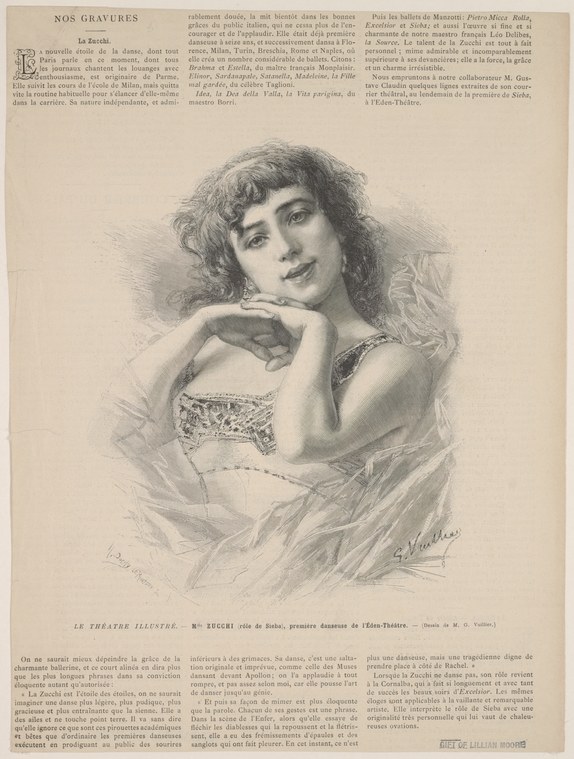
Mlle Zucchi (rôle de Sieba), première danseuse de l'Éden-Théâtre.
Unknown artist
- Collection:
- Prints depicting dance
- Source:
- New York Public Library
- Rights:
- Public domain — free to use, share and adapt.
- Recorded as:
- Public Domain
Virginia Zucchi was a transformative figure in ballet history, and her performances in Paris influenced the next generation of dancers and choreographers. This image documents not only her celebrity but the visual conventions through which Romantic ballet was marketed to the public: the emphasis on grace, beauty, and emotional refinement rather than technical virtuosity. For historians of theatrical portraiture and dance iconography, the work shows how dance imagery shaped audience understanding of what ballet was and what it meant.
What you are looking at
A young woman with dark, curly hair and a contemplative expression gazes downward and to the side, her chin resting on her raised hand in a pose of gentle reverie. She wears a delicate, light gauze garment that drapes loosely across her shoulders and upper body, leaving her arms bare. The fabric appears translucent and ethereal, catching light in soft gradations that suggest stage lighting. Her lower body fades into shadow. The entire composition is rendered in graphite or charcoal with careful attention to the play of light across her face and fabric, creating an intimate psychological portrait rather than a narrative scene. The background is blank, throwing full attention on the figure's quiet introspection.
The dancing
A single figure, seated or reclining, with weight shifted to one side and supported by an arm. The pose is static and contemplative rather than kinetic—the hand-to-chin gesture suggests thought or melancholy. There is no indication of active dance movement or weight transfer typical of performance. The body's angle and the soft drape of the costume suggest a moment of stillness rather than the suspended energy of mid-movement.
The dance depicted
The costume—a flowing, diaphanous wrap—is consistent with Romantic-era ballet practice, particularly the lightweight tunics worn by leading dancers of the 1880s–1890s. The title identifies the figure as Mlle Zucchi performing in the role of Sieba at the Éden-Théâtre in Paris. Virginia Zucchi was a celebrated Italian ballerina who became an international star and significantly influenced European and Russian ballet technique. However, the pose itself is not a moment of classical ballet movement but rather a studio study or psychological portrait capturing the performer at rest. This appears to be a promotional or artistic study rather than documentation of choreography in motion.
How it was made
This is a high-quality engraving or lithograph, likely printed from a drawing. The technique creates fine gradations of tone through careful line work and wash, achieving photographic subtlety in the rendering of fabric, skin, and shadow. The precision and finish suggest this was a commercial or promotional print, probably circulated in French theatrical journals or as a collectible portrait. The quality of reproduction and the inclusion of printed text indicate a professional publishing operation rather than a casual sketch.
About this work
This is a portrait study of a celebrated Romantic-era ballerina, Virginia Zucchi, in costume as the character Sieba. Rather than capturing a moment of choreography, the image presents the performer in a state of quiet introspection, using the aesthetic vocabulary of Romantic ballet—gauzy costume, idealized beauty, emotional interiority—while suspending the body in stillness. The work belongs in a gallery of dance not because it documents movement or technique, but because it reveals how theatrical dance was promoted, consumed, and mythologized in the late 19th century. The print is both a portrait of a celebrated artist and a window into the visual culture surrounding Romantic ballet performance.
How to look at it
Attend to the stillness of the pose and the absence of the dynamic line typical of ballet imagery. Notice how the artist has used light and shadow to model the figure's face and the translucent fabric, creating an effect of soft, theatrical radiance. The downward gaze and resting posture invite psychological reading—this is a portrait of interiority, not athleticism. The costume is minimal and ethereal, emphasizing the body's outline and the face's expressiveness rather than the display of technique. This is how the Romantic era visualized the ideal ballerina: not as a virtuoso but as a dreamer.
The artist
The artist is not recorded in the catalogue. However, the style and quality suggest a professional theatrical portrait artist working in Paris in the 1880s–1890s, during the height of Zucchi's European fame. The inclusion of her name and the theatre in the printed caption, along with the artist's signature at lower right, indicates this was a commissioned or authorized promotional work.
The period
This image dates to the height of the Romantic ballet period in France, when dancers like Zucchi were international celebrities and their portraits circulated widely in journals, prints, and theatrical ephemera. The 1880s–1890s saw a flourishing of theatrical photography and reproductive prints, which democratized access to images of famous performers. At the same time, this period marked the beginning of ballet's transition from the Romantic era toward the classical vocabulary that would dominate the 20th century. Zucchi's performances in Paris coincided with the rise of Russian imperial ballet, and her influence on dancers like Anna Pavlova was significant.
Where it lives
The work is held in the New York Public Library's collection of prints depicting dance, catalogued from unspecified sources. The printed text at the bottom indicates it was published as part of a series or journal feature on notable theatrical performers.
Dance in this work
Questions about this work
Who was Virginia Zucchi?
Virginia Zucchi (1847–1930) was an Italian prima ballerina who became one of the most celebrated dancers of the late 19th century. She performed across Europe and Russia, known for her technical mastery and dramatic presence. She was also a choreographer and teacher, and her influence on Russian imperial ballet was profound. Her Paris performances in the 1880s made her an international star.
What was the Éden-Théâtre?
The Éden-Théâtre was a Parisian theatre that hosted theatrical and musical performances in the late 19th century. It was one of several venues where leading dancers of the era performed for fashionable Parisian audiences.
Why is she not dancing in this image?
This is not a documentary image of a performance but rather a promotional portrait—a study of the performer at rest, designed to circulate as a print and to celebrate the dancer's beauty and celebrity rather than to document choreography. Such images were common in theatrical marketing of the period.
What does the costume tell us about Romantic ballet?
The light, translucent wrap is typical of Romantic-era ballet costume, which emphasized grace, ethereality, and freedom of movement over the structured tutus of later classical ballet. The costume allows visibility of the dancer's line and creates an impression of weightlessness and idealized beauty.
More dance artwork





