49 works in this view — arrow keys or swipe to move between them.
Dance in Art
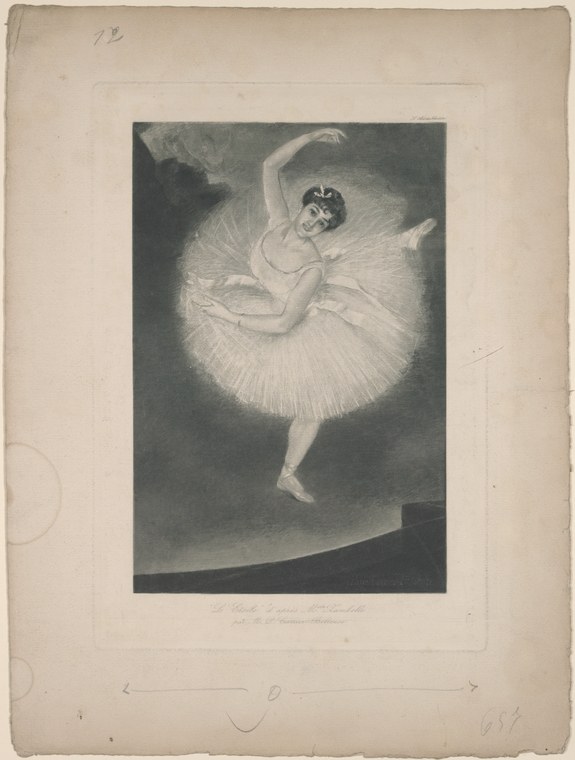
The cachucha as danced by Mademoiselle Duvernay, with Une valse sentimentale by A. Flèche.
Unknown artist
- Collection:
- Prints depicting dance
- Source:
- New York Public Library
- Rights:
- Public domain — free to use, share and adapt.
- Recorded as:
- Public Domain
This print is evidence of how the Romantic ballet incorporated vernacular Spanish dance as a vehicle for female virtuosity and exotic appeal. Mademoiselle Duvernay was a celebrated performer, and this image preserves the specific geometry and character of how the cachucha was executed in the ballet theater of the era—information that verbal description and archival records alone do not convey.
What you are looking at
A solo female dancer in a billowing white tutu dominates the composition, captured mid-movement against a dark ground. Her body is arched backward in a dramatic pose, one arm curved above her head in classical ballet port de bras, the other extended. The tutu, rendered with delicate linear hatching, flares in a wide circle around her hips and thighs, suggesting rapid rotation or the sustained suspension of a grand movement. Her dark hair is pulled back, and her face, shown in three-quarter view, expresses focused concentration. The lower portion of the composition shows a dark horizontal band suggesting a stage or ground plane. The work employs dramatic chiaroscuro—the dancer's pale form and white costume glow against deep shadow—creating theatrical intensity and focus. No accompaniment, scenery, or other figures are visible; the composition isolates and elevates the soloist's virtuosity.
The dancing
The dancer's frame is elegantly elongated, her torso arched in a pronounced backbend with her head tilted back. Her raised arm forms a classical rounded curve; her supporting leg appears straight and engaged, bearing her weight with apparent ease. The tutu's volume and the tilt of her body suggest she is either executing or pausing within a turning movement—a pirouette or fouetté—or a cambré (back arch) with rotational energy. The single isolated figure and the clarity of the silhouette suggest this is a study of technical mastery rather than a narrative moment.
The dance depicted
This is Romantic-era ballet, most likely from the mid-19th century, and the title identifies it as a depiction of the cachucha—a lively Spanish folk dance—as performed by a named ballerina, Mademoiselle Duvernay. The cachucha was a fashionable divertissement in Romantic ballet, executed in the classical technique but rooted in Spanish character dance. The dancer's classical ballet form—the turnout, the arm position, the engagement—confirms this is ballet's reading of the Spanish idiom rather than vernacular Spanish dance. The dramatic arching and the rotation suggested by the tutu's deployment indicate the kind of virtuoso embellishments nineteenth-century ballerinas brought to character dances.
How it was made
This is a lithographic or engraved print, identified by the tonal modeling achieved through fine linear hatching and the grayscale palette. The technique allowed for mass circulation of star performers' likenesses—these prints were popular as souvenirs of celebrated dancers and performances, sold to audiences and collectors. The soft gradation of light, the atmospheric depth created by the dark background, and the precision of the dancer's form suggest a skilled hand and a print made for an educated audience. The scale and mounting suggest this was a standalone popular print rather than an illustration in a periodical.
About this work
This print documents the star dancer Mademoiselle Duvernay performing the cachucha, a Spanish-inflected character dance that became a staple of the Romantic ballet stage in the 1830s-1850s. The work captures both the technical achievements of the era—the clarity of classical ballet technique applied to character material—and the cult of the individual virtuoso that defined Romantic dance. The image is a record of how Spanish idiom was refracted through the classical vocabulary of Paris and London, a cross-cultural moment made visible in a single sustained gesture.
The print belongs to a substantial tradition of dance ephemera and promotional portraiture from the nineteenth century. These images circulated widely, shaping public memory of famous dancers and performances and serving as mementos for theatergoers. The isolation of the figure and the dramatic lighting elevate the dancer as an object of admiration rather than situating her within narrative or spectacle.
How to look at it
Attend to the dancer's spinal arch and the curve of her arms: this is the aesthetic of the Romantic era, which valued épaulement (the movement of the shoulders and arms) and a softly rounded, elongated silhouette over the geometric precision of later ballet. The tutu, flared and billowing, was the Romantic tutu—shorter and fuller than both earlier skirts and the later tutus of the late nineteenth century. Note how the composition isolates the moment: this is not a narrative scene but a freeze-frame of technical display, a moment designed to be gazed upon rather than one within a story. The dramatic lighting—the glow of the pale figure against deep shadow—emphasizes the theatrical experience of watching the star performer.
The period
The cachucha became fashionable in European ballrooms and in theatrical dance in the 1830s, imported as part of the broader Romantic enthusiasm for folk idiom, exoticism, and the performance of national or regional identity. In the ballet theater, dancers like Fanny Elssler (who made the cachucha famous across Europe) and others performed the dance as a divertissement within longer works or as a standalone vehicle. The movement coincided with the peak of Romantic ballet, when the female dancer was the principal focus of theatrical attention and when technical virtuosity—turns, extensions, balances—was being showcased with growing elaboration. The fashion for Spanish dances in European concert halls reflected broader tastes for folk authenticity and orientalism that shaped art, music, and fashion of the 1830s-1850s.
Where it lives
This print is held in the New York Public Library's collection of prints depicting dance. It is catalogued by title but bears no recorded artist attribution; such popular prints were often released anonymously or under the name of the printer or publisher rather than the draftsman or lithographer.
Dance in this work
Questions about this work
Who was Mademoiselle Duvernay?
The catalogue record names her but provides no biographical detail. She was a ballet dancer active in the mid-nineteenth century, celebrated enough to be the subject of a distributed print portrait. Without further archival research, her career and repertoire cannot be established from this image alone.
What is the cachucha?
The cachucha is a lively, rhythmic Spanish folk dance in triple meter, with rapid footwork and hip movement. In the Romantic ballet theater, it was adapted and executed by trained classical dancers—usually women—as a character divertissement. The ballet version retained something of the Spanish style (the arm movements, the playfulness) but was embedded in classical technique and the aesthetic of the Romantic stage.
What is the connection to 'Une valse sentimentale'?
The title includes a reference to a sentimental waltz by A. Flèche, suggesting the print may document a program or a medley in which the cachucha and waltz were performed together or consecutively. The specific context—whether these dances were part of a longer work or standalone divertissements—cannot be established from the image.
Why was the Spanish cachucha popular in Paris and London ballet?
The Romantic era prized folk authenticity, exoticism, and national character. Spanish dance carried associations of passion, vivacity, and sensuality that appealed to Romantic aesthetics. Dancers like Fanny Elssler championed the cachucha and similar Spanish dances, and the fashion spread widely across European stages in the 1830s-1850s.
More dance artwork





