49 works in this view — arrow keys or swipe to move between them.
Dance in Art
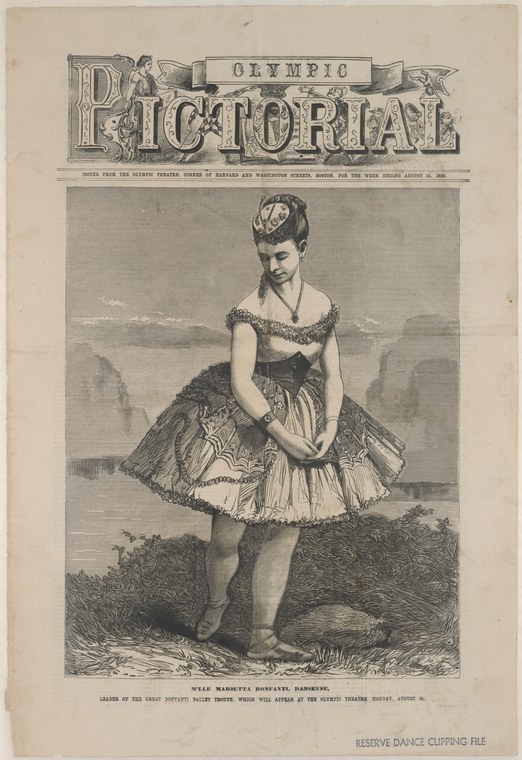
M'lle Marietta Bonfanti, danseuse, leader of the great Bonfanti ballet troupe, which will appear at the Olympic Theatre, Monday, August 16.
Unknown artist
- Collection:
- Prints depicting dance
- Source:
- New York Public Library
- Rights:
- Public domain — free to use, share and adapt.
- Recorded as:
- Public Domain
This print documents how Romantic ballet appeared to its audiences and how dancers were promoted to the paying public. It provides concrete visual evidence of mid-19th-century tutu design, bodice construction, and stage presentation—details that matter to dance historians studying how the ideal ballerina body was shaped and displayed. As a newspaper engraving, it also demonstrates the infrastructure of theatrical publicity and the international circulation of dance through print.
What you are looking at
A young woman in theatrical dress stands alone against a distant landscape, posed in a moment of stillness and contemplation. She wears a short tutu of white silk or muslin, decorated with dark embroidered or printed ornament at the hem, and a fitted dark bodice with off-shoulder sleeves trimmed in darker material. Her hair is arranged in an elaborate style typical of the mid-19th century, adorned with what appears to be a decorative band or tiara. She stands with one arm at her side and the other resting gently on her torso, her weight balanced and her posture erect. The background is rendered in soft tones, with distant hills or water visible, creating an atmospheric backdrop that isolates the figure. The engraving technique produces fine hatching that models her form and creates texture in the fabric and landscape.
The dancing
A single standing figure, positioned frontally, with weight evenly distributed and posture upright in the manner of theatrical presentation. Her arms are positioned low and to the sides rather than extended—the right arm resting against her body, the left hanging naturally. This is not a moment of active movement but of posed display, the classic attitude of a dancer presented to the audience during a moment of repose or character revelation. The stance suggests training and control, with the legs straight and the body held in alignment.
The dance depicted
This is a portrait of a ballerina in the Romantic era style, most likely depicting a scene from one of the grand ballets of the 1850s. The short tutu, the pointe work implicit in the leg line, and the character of the costume—delicate, ethereal, decorated—place this firmly in the world of Romantic ballet as danced by celebrated prima ballerinas of the period. The costume has elements of exotic or character dress, suggesting a specific role within a ballet narrative rather than classical academic costume. Bonfanti was known for performing in grand spectacle ballets and likely appeared in roles calling for this kind of decorated, character-tinged costume.
How it was made
This is a wood engraving or steel engraving, a reproductive print technique that allowed multiple impressions to be distributed to newspapers and illustrated journals. The fine parallel lines and careful modeling of form through hatching and cross-hatching are characteristic of engraving. The technique was well-suited to theatrical publicity of the period—economical to produce in quantity and capable of capturing fine detail in costume, hair, and facial features. This would have been a newspaper illustration or playbill image, distributed to publicize Bonfanti's performance at the Olympic Theatre.
About this work
This engraving is a theatrical portrait of Marietta Bonfanti, a prominent ballerina of the mid-19th century, published to advertise her troupe's appearance in London in August 1852. It presents her in a moment of stillness during performance, dressed in the short tutu and character costume typical of Romantic-era grand ballets. The work is both a record of how a celebrated dancer dressed and moved in the theatre and a document of how ballet was marketed to the public in the 1850s—through printed images of individual performers in costume, disseminated through the press. As a theatrical advertisement, it belongs to the history of dance publicity and the commercial machinery that supported international touring ballet companies in the Victorian era.
How to look at it
Attend to the specificity of the costume: the depth of the tutu, the style of the bodice, the cut of the sleeves, and the way the fabric is drawn suggest a particular moment in tutu evolution and a particular character within a ballet narrative rather than abstract classical dancing. The artist has chosen a moment of stillness and display rather than active movement—a common choice for theatrical portraits, as it allowed the viewer to study the costume and the dancer's face without the blur of motion. Notice how the pose is both relaxed and formal, suggesting the trained control of the professional dancer while also presenting her as a figure of visual spectacle.
The artist
The artist is not recorded. This appears to be a commercial engraving produced by a theatrical print shop or newspaper engraving department, likely in London, as part of the publicity machinery for the Olympic Theatre production. Such theatrical portraits were typically executed rapidly and often uncredited, created by engravers working from photographs, sketches, or costume descriptions provided by theatre management.
The period
The 1850s were the height of the Romantic ballet era, when Romantic choreography (emphasizing narrative, fantasy, and the ethereal quality of the ballerina) was at its artistic peak but already being challenged by the rise of the grand spectacular ballet with large corps de ballets, exotic settings, and emphasis on technical display. Bonfanti's troupe represented the latter trend—grand spectacle ballets with multiple soloists and elaborate production design. Theatrically, this was the era when illustrated newspapers and theatrical journals had made theatrical portraiture a form of mass media, and ballet was a major attraction for middle- and upper-class audiences in major cities.
Where it lives
This engraving is part of the collection of theatrical prints held by the New York Public Library (NYPL), a major repository of 19th-century theatrical imagery. It was collected as documentation of theatrical history and the visual culture of dance rather than as fine art, and should be understood as a newspaper or playbill image rather than a gallery print.
Dance in this work
Questions about this work
Was Marietta Bonfanti a real dancer?
Yes. She was a prominent Italian ballerina of the mid-19th century and led a touring company that performed across Europe and North America. The inscription confirms that she appeared with her troupe at the Olympic Theatre in London on Monday, 16 August 1852 (the year is cut off in the visible portion but is implied by the printing style and theatrical context). She was known for her technical skill and for appearing in grand spectacle ballets.
Why is she wearing such a short skirt?
By the 1850s, the Romantic tutu had shortened considerably from earlier forms, sitting at or just above the knee. This length allowed the audience to see the dancer's legs and footwork clearly while maintaining the aesthetic of the feminine, ethereal ballerina. The short tutu also made virtuosic movement and pointe work more visible. The decoration at the hem—the darker ornamental band—was typical of the period and might represent embroidery, printed pattern, or applied trim.
Is this a photograph or an engraving?
This is an engraving, not a photograph. You can see the characteristic fine parallel lines (hatching) used to create tone and model form. Engravings were the primary way theatrical portraits were reproduced for newspapers and playbills in the 1850s. While the image may have been based on a photograph or a sketch, it was translated into engraving to allow printing in the newspaper or journal format.
What can we learn from her costume?
The costume tells us several things: that this is a character role within a ballet narrative (suggested by the decorated hem and the hybrid styling of the bodice); that tutu length and construction had evolved significantly by the 1850s; and that costume decoration was expected to be visible and prominent in theatrical presentation. The off-shoulder treatment and the style of the bodice suggest a non-European character—perhaps Oriental, Italian, or Spanish—typical of the exotic settings and narratives that dominated grand ballet in this period.
More dance artwork





