49 works in this view — arrow keys or swipe to move between them.
Dance in Art
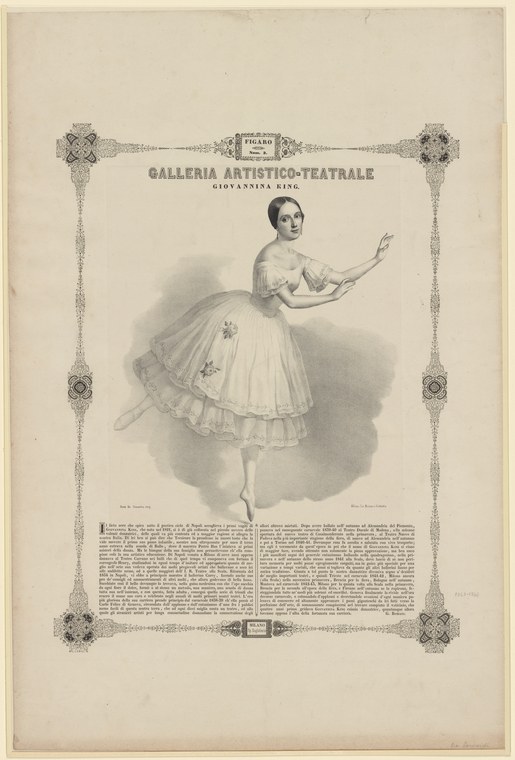
Giovannina King (b. 1821) in third arabesque.
Unknown artist
- Collection:
- Prints depicting dance
- Source:
- New York Public Library
- Rights:
- Public domain — free to use, share and adapt.
- Recorded as:
- Public Domain
This print is a primary document of Romantic ballet technique and aesthetics at a moment when the vocabulary of positions and the fame of individual dancers were being systematized and celebrated through mechanical reproduction. It shows us not only what the arabesque penché looked like when performed at the height of its prestige, but how 19th-century theatre made dancers into recognizable, collectible figures. For historians, it is evidence of both the technical demands placed on female dancers and the commercial apparatus that surrounded the ballet stage.
What you are looking at
A young female dancer in mid-movement against a plain background, framed by an ornate decorative border typical of 19th-century theatrical prints. The dancer wears a Romantic-era ballet costume: a fitted bodice with short sleeves, a knee-length tulle skirt embellished with small floral sprigs, and flat ballet slippers. Her body is in a clear arabesque penché position—the supporting leg straight and turned out, the working leg extended high behind at or above hip level, her torso angled forward into the line. Her arms frame the movement, one extended forward and slightly upward in a graceful line, the body and limbs forming the long diagonal silhouette characteristic of Romantic ballet. The print is finely engraved, with careful attention to the fall of fabric and the definition of muscle and bone. Below the image is a substantial text block in Italian, identifying the subject and discussing the performance.
The dancing
A solitary dancer, fully turned out, supports her entire weight on her right leg in perfect turnout while the left leg extends sharply upward and backward in arabesque penché. The supporting leg is absolutely straight; the extended leg describes a clean line. Her upper body folds slightly forward from the hip, creating the characteristic Romantic-era carriage in which the torso elongates rather than remaining bolt upright. The port de bras is restrained and graceful, with arms positioned to frame rather than dominate the line of the legs. The positioning and musculature visible in the engraving demonstrate strong technical understanding of the demanding balance and strength required for this sustained position.
The dance depicted
This is unambiguously Romantic-era theatrical ballet. The arabesque penché was among the signature positions of early 19th-century ballet technique and aesthetics—a demonstration of elevation, flexibility, turnout, and ethereal weightlessness that defined the ideal female dancer of the period. The costume, technique, and presentation all date to the 1830s–1850s. The Italian text identifies the subject as Giovannina King and the position as 'third arabesque.' King was a performer of this era, and the specificity of naming both dancer and position suggests this is a documentary print made to record a celebrated performer in a celebrated position—the kind of theatrical print that circulated as a collectible image of admired dancers, often sold at the stage door or through print shops.
How it was made
This is a finely detailed engraving on paper, employing the stippled and linear techniques characteristic of mid-19th-century theatrical portraiture. The ornamental border—with its cartouches, scrollwork, and symmetrical flourishes—marks it as part of the 'Galleria Artistico-Teatrale' (Artistic-Theatrical Gallery), a commercial series of prints documenting celebrated performers. Engraving allowed for precise reproduction and wide circulation; the fine linewerk captures anatomical detail and the texture of the tulle skirt with a delicacy impossible in other media. This was a popular and relatively affordable format for admirers of the theatre to own images of their favorite dancers.
About this work
This is a documentary print of Giovannina King, a dancer of the Romantic ballet era, captured in the arabesque penché—a defining technical and aesthetic position of early 19th-century ballet. The engraving is part of a commercial theatrical print series (Galleria Artistico-Teatrale) and served as both a performance record and a collectible image of an admired performer. It survives as evidence of how Romantic-era ballet was understood, taught, and celebrated: technique codified, named, and circulated as portraiture. The image testifies to the emergence of ballet as a professional spectacle with a culture of fan collecting and the documentation of celebrated moments.
How to look at it
Attend to the absolute purity of the arabesque line: the straight supporting leg, the high extension, and the elongated torso that makes the body appear to float. Notice how the artist has chosen the moment of full suspension—not arrival, not descent, but the held peak of the movement. The restraint of the arms is also significant: they do not gesture or express drama, but frame and complete the geometry of the legs and spine. The ornamental border, with its theatrical cartouches, signals that this is not a generic ballet study but a portrait of a celebrated performer in a celebrated moment—a distinction that matters for understanding how Romantic ballet was circulated and remembered.
The artist
The artist is not recorded in the catalogue. However, the print is part of the Galleria Artistico-Teatrale series, a commercial Italian publication of theatrical portraits and documentation. This series employed skilled engravers working in the Romantic period to record celebrated singers, dancers, and actors in celebrated roles and moments. The level of technical finesse in the rendering of anatomy and drapery suggests a trained engraver with access to life studies or performance records.
The period
This print dates to the height of Romantic ballet (circa 1830s–1850s), when the ballerina dominated the stage and the arabesque became an icon of the feminine ideal in dance—weightless, ethereal, technically demanding, yet apparently effortless. It is also the period of the birth of theatrical celebrity and fan culture; dancers like Marie Taglioni became international stars, and their images were mass-produced and collected. Italy was an important center for both ballet and printmaking in this period, and theatrical prints were a major genre of popular visual culture. The engraving testifies to the professionalization of ballet technique and the codification of positions into a systematic vocabulary.
Where it lives
The print is held in the New York Public Library's collection of prints depicting dance. It is identified as part of the Galleria Artistico-Teatrale (Artistic-Theatrical Gallery), an Italian series of theatrical documentation prints. Such prints were commercial products, sold at theatres and through print shops, and were intended for collectors and admirers of the performing arts.
Dance in this work
Questions about this work
What is an arabesque penché?
An arabesque penché is a classical ballet position in which the dancer stands on one straight, turned-out leg while extending the other leg high behind, with the torso tilted forward to create a long line from the head through the extended foot. It requires significant flexibility, balance, and strength. In Romantic ballet, it was considered one of the most beautiful and difficult of all positions and was a signature move for celebrated ballerinas.
Who was Giovannina King?
Giovannina King (b. 1821) was a professional ballet dancer of the Romantic era. The Italian text on this print documents her performance, but beyond what the print records, little biographical information appears in the catalogue. She was notable enough to be included in the Galleria Artistico-Teatrale, which documented only celebrated performers of the period.
Why is this print in a dance collection?
This is a documentary record of a celebrated ballet position performed by a named dancer at the height of the Romantic ballet era. It is also evidence of how ballet dancers became celebrities and how their images were circulated and collected. For historians and dancers, it is a primary source on both technique and the culture of performance and spectatorship in 19th-century theatre.
How was a print like this made?
This is an engraving, made by incising fine lines into a metal plate (usually copper) with a burin (a sharp tool). The plate is then inked and pressed onto paper, creating a mirror image of the original design. Engraving was a skilled, labor-intensive process but allowed for precise detail and multiple impressions, making it an ideal medium for distributing images of admired performers to a wide audience.
More dance artwork





