49 works in this view — arrow keys or swipe to move between them.
Dance in Art
Carlotta Pochini [facsimile signature]
Unknown artist
- Collection:
- Prints depicting dance
- Source:
- New York Public Library
- Rights:
- Public domain — free to use, share and adapt.
- Recorded as:
- Public Domain
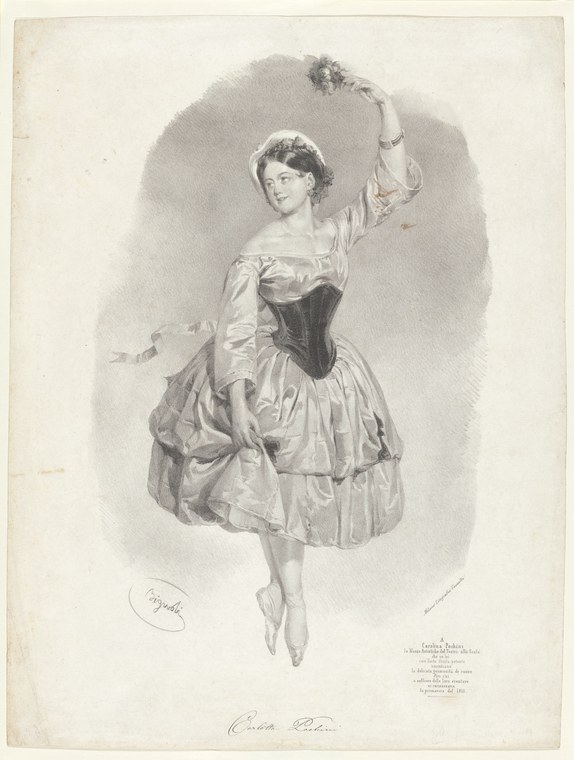
This image is documentary evidence of how Romantic ballet was actually performed and what individual dancers brought to their roles. Portrait prints of named performers are rare; most survive only in anonymous form or through written review. Pochini's presence in this lithograph—her name signed clearly, her specific pose recorded—gives us a named body and a named moment in dance history that might otherwise be forgotten.
What you are looking at
A young woman in mid-nineteenth-century dress is captured in a moment of energetic movement against a soft, atmospheric background. She wears a pale silk dress with a black corset or bodice, the skirt billowing and caught mid-motion around her legs, revealing the silhouette of active dancing. Her right arm is raised with what appears to be a scarf or fabric accessory held aloft, creating a diagonal line of movement across the composition. Her left arm extends to balance the pose. She stands on the balls of her feet in a position of springy elevation, her head tilted slightly upward with an expression of engagement. The lighting is soft and diffused, creating gentle shadows that model her form and emphasize the three-dimensionality of the figure against the pale ground. The overall effect is one of captured motion—the instant before, during, or after an exuberant gesture.
The dancing
A single female dancer stands in a lifted position, rising onto her toes with bent knees that suggest spring and elevation. Her frame is open and expansive: one arm raised overhead at an angle, the other extended to the side for balance. The raised arm appears to hold or wave a length of fabric—possibly a handkerchief, shawl, or scarf—which adds visual weight and narrative to the gesture. Her torso is held upright, her head turned slightly upward, and her face shows expression. This is the vocabulary of a confident, virtuosic performer at the height of a movement phrase, not a static pose.
The dance depicted
This is almost certainly a Romantic-era theatrical ballet solo, most likely from the 1840s based on the costume and the style of the signature. The dancer is Carlotta Pochini (or Pocci), a minor but recorded performer in the ballet world of that period. The image documents a specific moment from a choreographed piece—likely a variation or solo turn that showcased the dancer's technical ability and expressiveness. The raised arm with fabric, the lifted position, and the upward gaze are characteristic of the Romantic ballet vocabulary: ethereal, buoyant, and emotionally engaged. The dress places her in the world of mid-nineteenth-century European theatre dance.
How it was made
This is a lithograph or crayon lithograph, as indicated by the soft tonal modeling, the characteristic grain, and the signature mark visible in the lower left. The technique allowed the artist to capture subtle gradations of light and shadow across the dancer's form and fabric, and to render the softness of her expression. The pale background and the figure emerging from it are hallmarks of lithographic portraiture. Lithographs of this type were made as souvenir prints, circulated among theatre-goers, and sometimes sold as collectibles, making this a mass-market image despite its apparent delicacy.
About this work
This is a portrait print of a Romantic-era ballet dancer, Carlotta Pochini, frozen in a moment of performance. It documents not just the dancer's likeness but her physical vocabulary and the aesthetic values of mid-nineteenth-century theatrical dance: verticality, elevation, emotional openness, and the controlled use of drapery and accessories. The work belongs in a gallery of dance imagery because it is a direct record of how a working dancer of the period moved, what she wore, and how her art was marketed and memorialized. It is simultaneously a portrait, a technical record, and a souvenir of live performance—three functions collapsed into a single image.
How to look at it
Notice the moment the artist has chosen: not a static address to the viewer, but a captured instant of motion and expression. The dancer's weight is on the balls of her feet; her body is not at rest. The raised arm and the floating fabric are at the climax of the gesture, and her upward gaze suggests emotion or aesthetic rapture. Observe how the soft lithographic technique—the absence of hard lines, the gentle modeling—conveys the intangible quality the Romantics prized: the sense that the dancer is weightless, spiritual, more otherworldly than human. This is not a display of technical difficulty but an image of the dancer's inner life.
The period
This lithograph dates to the 1840s–1860s, the height of the Romantic ballet era in Europe. Dancers like Carlotta Grisi, Fanny Cerrito, and Lucile Grahn dominated the stage, and the vocabulary seen here—the lifted frame, the emotional expression, the use of fabric—was their language. The technique of making portrait prints of named performers was common and profitable; theatres and publishers issued them to feed the public appetite for images of celebrated dancers. Lithography made this possible at a cost accessible to theatre-goers, unlike oil portraiture. This was the golden age of the prima ballerina as celebrity.
Where it lives
This print is held in the New York Public Library's collection of dance-related prints and belongs to the category of theatrical souvenirs and performance documentation. It is one of thousands of similar lithographs made during the Romantic era to commemorate and promote individual dancers.
Dance in this work
Questions about this work
Who was Carlotta Pochini?
Pochini was a working ballet dancer of the mid-nineteenth century, active during the height of the Romantic era. Beyond this portrait print, little is documented about her career or performances. She appears to have been a soloist capable of performing substantial roles, but she was not among the most celebrated prima ballerinas of her time. This print may be one of the primary surviving records of her existence as a performer.
What is the fabric she is holding?
Most likely a handkerchief, scarf, or length of gauze—common props in Romantic ballet. Dancers used them to add visual extension to the arm line, to create loops and waves in the air, and to enhance the impression of weightlessness and ethereality. In some ballets, the prop carried symbolic meaning; in others it was purely a tool for choreographic effect.
How was this print made?
This is a lithograph, a printmaking process that uses a flat stone or metal plate treated with greasy and water-repellent substances. The artist drew on the stone with crayon or ink, and the image was then printed in multiple copies. The soft tonal effects and the gentle modeling of light and shadow visible here are characteristic of the medium. Lithographs could be produced in large quantities at relatively low cost, making them ideal for theatrical souvenirs.
Why did theatres make prints of dancers?
Theatre prints served multiple purposes: they functioned as advertising for upcoming performances, as souvenirs for fans to take home, as a form of celebrity merchandise, and as documentation of celebrated performers. Collecting prints of famous dancers was a common hobby, and prints were sold in theatre lobbies and through print shops. For historians, they provide visual evidence of costume, pose, and the aesthetic values of the period.
More dance artwork





