49 works in this view — arrow keys or swipe to move between them.
Dance in Art
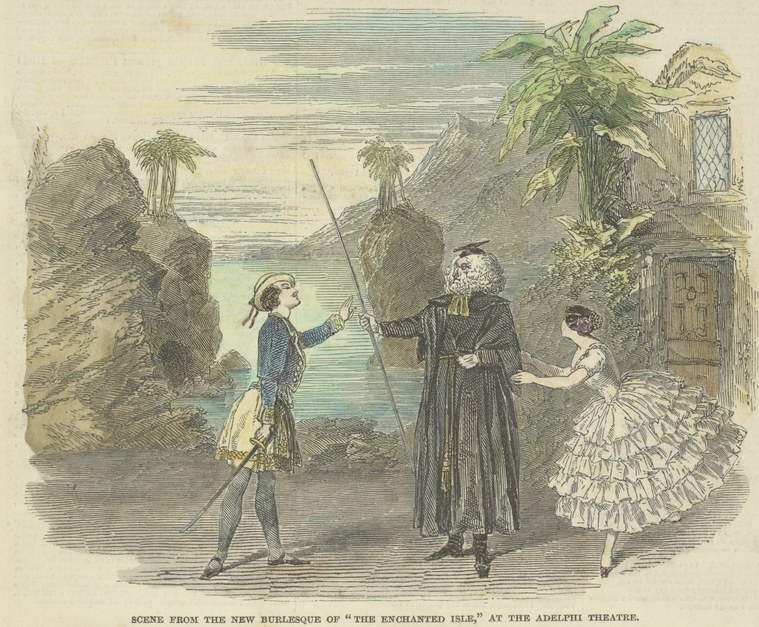
Scene from the new burlesque of "The enchanted isle," at the Adelphi Theatre
Unknown artist
- Collection:
- Prints depicting dance
- Source:
- New York Public Library
- Rights:
- Public domain — free to use, share and adapt.
- Recorded as:
- Public Domain
Burlesque theatre was a major form of popular entertainment and dance spectacle in the 19th century, and theatrical scene prints like this are among the primary visual documentation of how performers appeared, how stages were dressed, and what narrative and visual traditions shaped public entertainment. The image reveals the centrality of the female form and spectacular costume to burlesque's appeal, and the theatrical conventions of the period for staging drama and romance.
What you are looking at
A theatrical scene set in a rocky, tropical landscape with palm trees flanking a body of water under a pale sky. Three figures occupy the foreground on a sandy beach or shore. At center-left stands a young man in naval uniform—dark jacket, light breeches, and a cap—holding a long staff or spear at an angle across his body. To his right, a tall figure in a dark cloak and ornate helmet (suggesting a classical or fantastical warrior) faces him. On the far right stands a young woman in an elaborate white ball gown with multiple tiers of ruffles and flouncing, her posture graceful and her gaze directed toward the uniformed figure. The composition suggests a moment of theatrical drama or confrontation, frozen mid-scene. A fortified structure with a barred window is visible at the right edge. The engraving's fine hatching and tonal gradations create depth and atmosphere, emphasizing the romance and spectacle of the tableau.
The dancing
The three figures are positioned in an open, informal grouping rather than a closed dance hold. The woman's posture is upright and poised, her weight evenly distributed, her arms relaxed at her sides—the stance of a performer aware of the audience. The naval officer's body is angled toward her, his arm raised to grip the staff, creating an open, expansive frame. The cloaked figure stands as an intermediary, facing the officer. None of the figures display the close partnership or synchronized hold of ballroom or couple dances; instead, they occupy distinct positions in a narrative tableau, suggesting staged drama rather than partnered dance.
The dance depicted
This is a burlesque theatrical scene rather than a representation of a specific dance style. The title indicates it is from 'The Enchanted Isle,' a burlesque performed at the Adelphi Theatre. While burlesque in the 19th century often incorporated musical numbers, comic choreography, and female performers in spectacular costumes and poses, this engraving captures a dramatic moment rather than a moment of actual dancing. The woman's magnificent costume and posed elegance suggests the visual spectacle that made burlesque famous, and her placement as a central figure of attention is characteristic of burlesque performance. However, no active dance movement is depicted—the figures are static, arranged for theatrical effect rather than captured mid-movement.
How it was made
This is a hand-colored engraving, identifiable by the fine parallel lines (hatching) used to model form and suggest tone, combined with selective hand-coloring in watercolor or similar pigment. The engraving technique allowed for mass reproduction and wide circulation of theatrical imagery, making this likely a souvenir or promotional print distributed to audiences or advertised in theatrical newspapers and playbills. The combination of precise line-work and tinted color was characteristic of theatrical scene illustrations in mid-19th-century Britain, serving as both documentation and publicity for popular productions.
About this work
This is a scene illustration from a mid-19th-century theatrical burlesque performed at London's Adelphi Theatre. The engraving captures three figures in a dramatic tableau: a uniformed naval officer, a cloaked classical figure, and a woman in an extravagant white ball gown, set against a romantic tropical backdrop. While burlesque as a theatrical form frequently featured dance and spectacle, this particular image freezes a moment of dramatic encounter rather than depicting active choreography. The work belongs to the tradition of theatrical scene prints that documented and promoted London's popular entertainment, offering audiences and potential patrons a glimpse of the visual splendor and narrative intrigue that drew crowds to the playhouse.
How to look at it
This is a moment of dramatic confrontation or revelation frozen in a theatrical tableau. Notice the careful composition: the woman is positioned as the focal point, her costume and posture commanding attention, while the two male figures are arranged to frame and direct the eye toward her. The tropical setting—the rocky outcrops, palm trees, and sea—signals exotic fantasy rather than naturalism. The ornate classical armor and naval uniform suggest a plot involving adventure, shipwreck, or magical transformation. The engraving's tonal modeling through hatching creates atmosphere and theatrical lighting, emphasizing the romantic drama of the scene. To understand this image fully, one would need to know the plot of 'The Enchanted Isle'—but the composition itself tells us this is a moment designed for visual splendor and audience delight.
The period
This engraving dates from the era of Victorian burlesque (mid-to-late 19th century), when the Adelphi Theatre was one of London's leading venues for musical burlesques—comic, spectacular theatrical productions that combined music, dance, satire, and extravagant scenery and costumes. Burlesque in this period was distinct from later 20th-century burlesque: it was mainstream family entertainment, featuring elaborate production values, topical humor, and celebrated performers (often women) in stunning costumes and striking poses. The tropical setting and classical-fantastical elements reflected the period's taste for exoticism, adventure narratives, and visual transformation on stage. Theatrical scene prints were a major form of commercial image-making and fan culture, circulated among audiences, collected, and used to advertise productions.
Where it lives
This print is held in the New York Public Library's collection of prints depicting dance. It is a theatrical scene illustration, likely published as a souvenir or promotional image for the Adelphi Theatre production, part of the tradition of 19th-century theatrical ephemera that documented and advertised popular entertainments.
Dance in this work
Questions about this work
Is this print showing a dance or a dramatic scene?
It is a dramatic scene from a theatrical burlesque, rather than a depiction of active dancing. However, burlesque productions in the 19th century were known for incorporating dance, music, and spectacular physical performance. This particular engraving captures a moment of narrative drama rather than choreography—the figures are posed and static rather than mid-movement. The image is valuable for showing how burlesque performers appeared, how they were costumed, and what kind of visual spectacle audiences came to see.
What was the Adelphi Theatre known for?
The Adelphi Theatre was a major London playhouse famous for staging musical burlesques in the 19th century. These were comic, spectacular theatrical productions featuring elaborate scenery, music, dance, and female performers in stunning costumes. The theatre was a center of popular entertainment and helped make burlesque a dominant form of theatrical spectacle.
What is 'The Enchanted Isle' about?
The catalogue record does not provide a plot summary. However, the title and the visual elements—the tropical setting, classical armor, naval uniform, and references to enchantment—suggest a fantastical adventure narrative, possibly involving shipwreck, magic, or transformation. To fully understand the scene, one would need to consult theatre histories or playbill records from the Adelphi Theatre.
More dance artwork





