49 works in this view — arrow keys or swipe to move between them.
Dance in Art
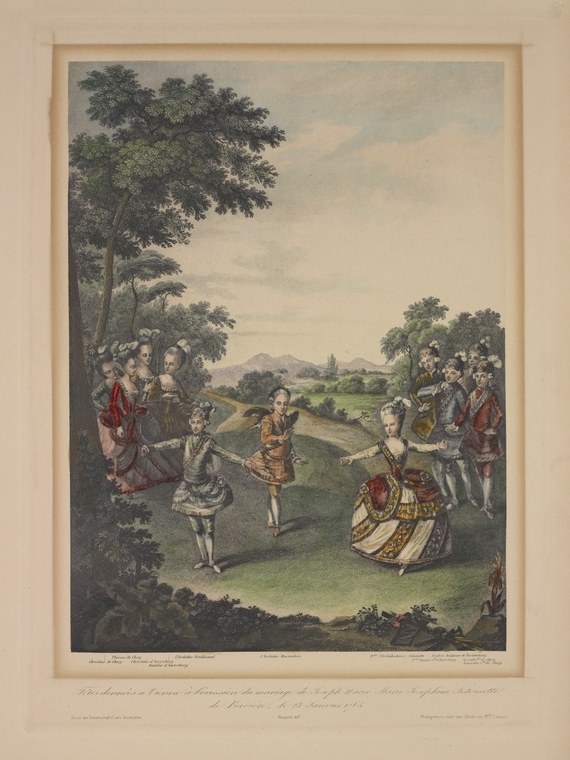
Fêtes données à Vienne à l'occasion du mariage de Joseph II avec Marie Josephine Antoinette de Baviére, le 23 Janvier 1765
Unknown artist
- Collection:
- Prints depicting dance
- Source:
- New York Public Library
- Rights:
- Public domain — free to use, share and adapt.
- Recorded as:
- Public Domain
This print is an invaluable record of court dress, spatial arrangement, and ceremonial protocols governing formal court assembly in the late 18th century—the context in which minuets, contradances, and other court dances were actually performed. It shows how dance was integrated into hierarchical court spectacle and what the physical vocabulary of aristocratic formality looked like before bodies began to move into actual dance figures.
What you are looking at
A formal outdoor celebration unfolds in an arcadian landscape: two groups of courtiers face each other across a manicured lawn, with dense foliage framing the left side and a distant town visible in the sunlit middle ground. The left group clusters beneath tall trees; the right assembles near architectural structures. The figures wear jewel-toned silks—reds, blues, golds—with the women in wide panniers and high headdresses, the men in coats with stockings and heeled shoes. A central space remains open, suggesting a cleared dancing ground. The entire scene radiates the studied elegance of 18th-century court spectacle, with the composition and hand-coloring typical of commemorative prints distributed after major royal events.
The dancing
The figures are arranged in two distinct facing groups rather than in active dance formation. Those visible in the foreground stand or gesture toward the open space with arms raised or extended in greeting and salutation. The postures are formal and processional rather than those of active dancers mid-step; the figures appear to be participating in a ceremonial moment of arrival or presentation. The wide skirts and rigid posture of the women, combined with the men's stiff-legged stance, suggest the constrained movement vocabulary of formal court dress rather than the freedom needed for vigorous dancing.
The dance depicted
This print commemorates a specific royal wedding celebration rather than depicting a particular named dance style. The title identifies it as festivities held in Vienna on 23 January 1765 for the marriage of Joseph II and Maria Josepha of Bavaria. The scene shows what appears to be a formal promenade, reception, or grand march—the ceremonial opening movements that preceded actual dancing at 18th-century court celebrations. No specific dance type is identifiable from the poses or configuration; this is court spectacle and pageantry rather than a representation of a danced performance.
How it was made
This is a hand-colored engraving or aquatint, a technique that allowed precise detail and wide distribution of royal commemorative imagery across European courts and aristocratic collectors. The fine lines of the engraving render the architectural landscape and intricate costumes with clarity, while the watercolor overlay adds jewel tones and atmospheric depth. As a print rather than a unique artwork, this served a documentary and celebratory function—recording the event for those who did not attend and circulating images of imperial spectacle and court fashion to an educated elite audience across Europe.
About this work
This is a documentary print commemorating the Vienna wedding festivities of Archduke Joseph II in January 1765. It presents the formal ceremonial opening of the celebration—a grand assembly and procession in which the assembled court figures in elegant dress occupy an ordered landscape, facing toward a central space reserved for formal proceedings and dancing. The work belongs to a well-established tradition of commemorative court prints that recorded major dynastic events, particularly the elaborate court festivals that were central to 18th-century Habsburg statecraft. It documents not a specific dance but the courtly rituals and display of rank that framed dancing within the larger spectacular event.
How to look at it
Attend to the careful spatial composition: the two groups frame an empty dancing ground, and the gazes and gestures of the figures orient toward that space, suggesting this captures the moment before dancing begins—a formal reception or grand march in progress. Notice the extreme formality and rigidity of the poses, the elaborate control of the body within tight, expensive clothing. The print records not the virtuosity of the dancers themselves but the protocol, hierarchy, and architectural grandeur within which court dance was staged. The distant prospect and careful perspective situate this dance moment within a larger landscape and suggest the public, processional character of court celebration.
The artist
The artist is not recorded in the catalogue. The print is inscribed with a privilege or permission line and carries the conventions of Viennese court print production of the 1760s. The hand-coloring and compositional approach are consistent with the output of court engravers working for Habsburg imperial commissions, likely a specialist in architectural and ceremonial documentation.
The period
The 1760s were a moment of transition in European court culture. Formal court dances—particularly the minuet—remained central to aristocratic life and training, but the enormous, elaborate festival spectacles of the early 18th century (like those documented in Weigel's or Dukes of Württemberg prints) were giving way to a more restrained neoclassicism. The marriage of Joseph II was a significant diplomatic event, and the Vienna court maintained the tradition of publishing commemorative prints of major celebrations. This image reflects the last great age of the court festival as a vehicle for displaying imperial power and dynastic alliance.
Where it lives
The work is held in the Prints collection at the New York Public Library as part of their dance imagery holdings. It is a commemorative engraving produced and distributed by the Vienna court in the aftermath of the January 1765 wedding festivities.
Dance in this work
Questions about this work
What dance are they doing?
This print shows the formal assembly and opening ceremonies of a court celebration, not an actual dance in progress. The figures are likely participating in a grand march or processional—a ceremonial gathering before the ball itself began. Specific danced figures would have followed, but this image documents the stately preparation and hierarchical display that preceded dancing.
Why is everyone standing still?
Court celebrations of this era began with formal ceremonies—arrivals, greetings, processions—in which the assembled company moved slowly and deliberately according to rank and protocol. Actual dancing, often minuets or contradances, came later in the evening. This print captures the ceremonial phase, when control, formality, and proper dress were more important than movement.
How do we know this is Vienna in 1765?
The title is inscribed at the bottom of the print in French, identifying it as celebrations held in Vienna on the occasion of Joseph II's marriage on 23 January 1765. This was a major event in Habsburg court life and would have been commemorated by official court prints distributed to noble houses across Europe.
What is the technique of this print?
This is a hand-colored engraving or aquatint—fine metal lines rendered on paper and then tinted with watercolor by hand or stencil. The technique allowed wide circulation of the image and the detailed rendering of costume and architecture while maintaining the prestige of a hand-finished artwork.
More dance artwork





