49 works in this view — arrow keys or swipe to move between them.
Dance in Art
Jeux
Unknown artist
- Collection:
- Prints depicting dance
- Source:
- New York Public Library
- Rights:
- Public domain — free to use, share and adapt.
- Recorded as:
- Public Domain
This drawing documents the moment when balletic training and modernist graphic design converged, showing how early 20th-century artists understood the dancer's body as an instrument of abstract form rather than narrative spectacle. For anyone studying the visual culture of the Ballets Russes or the relationship between dance and graphic modernism, this work is a direct record of how that collaboration was imagined and represented.
What you are looking at
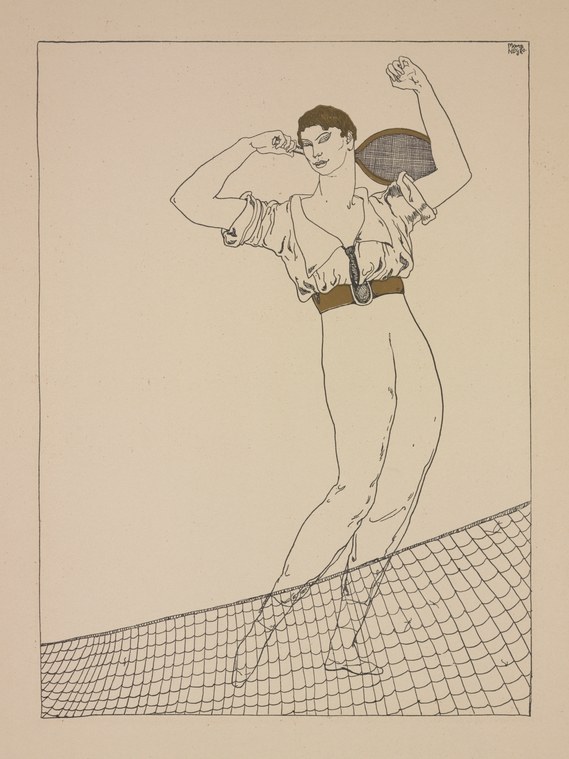
A single male figure is depicted mid-leap against a net, drawn in a spare linear style characteristic of early modernist illustration. He is shirtless, wearing only light-colored breeches and a brown belt, with his body stretched in an athletic, almost violent extension through space. His left arm is raised with the fist clenched, the right arm pulled back, and his legs are in a wide split or scissors position. His posture suggests explosive power and balletic elevation. Below him, the tennis net is rendered in careful perspective with a crosshatch of fine lines that emphasize the work's graphic precision. The figure floats above the net rather than appearing grounded, creating a sense of momentary suspension. The drawing is contained within a thin rectangular border, and the overall composition is spare: figure, net, void. The style suggests a design or fashion illustration rather than documentary representation.
The dancing
A single male figure in a state of maximal extension, with the body held in what appears to be a grand battement or split leap. The arms are held in opposition—one raised and clenched, one pulled back—creating a sense of dynamic tension and control. The torso is upright and engaged, the legs spread in a nearly horizontal split, and the overall carriage suggests trained athletic movement rather than casual sport. The figure's musculature is indicated by clean contour lines, and the weight appears to be suspended, weightless, in the instant captured.
The dance depicted
The image most likely depicts a moment from *Jeux* (Games), a 1913 Vaslav Nijinsky work famously set to Debussy's score and known for its erotic subtext and athletic, flirtatious movement vocabulary. The tennis setting, the youthful male body, and the sense of playful combat align with the ballet's subject matter of three adolescent dancers at a garden party where a lost tennis ball becomes a pretext for seduction and rivalry. However, the image could equally represent a generalized modernist celebration of athletic youth and movement, common in European graphic design of the 1910s–1920s. The figure's training in balletic extension is clear, but the work does not otherwise reveal the narrative or choreographic detail that would confirm the dance's identity with absolute certainty.
How it was made
This is a line engraving or fine pen-and-ink drawing, possibly printed as a relief or intaglio process. The technique is economical and assured: the figure is defined almost entirely by a continuous outline with minimal internal shading, while the tennis net below is rendered through careful linear perspective and crosshatching to suggest receding space and material texture. This approach—avoiding tonal modeling in favor of pure line and pattern—was characteristic of Art Deco and German Expressionist graphic design in the early 20th century. The technique's efficiency and elegance suggest this was created for reproduction in a portfolio, journal, or design publication rather than as a unique artwork, and would have circulated among avant-garde audiences familiar with Nijinsky's revolutionary ballet.
About this work
This is a graphic study of a male dancer in explosive extension, most likely related to Vaslav Nijinsky's 1913 ballet *Jeux* and the modernist artistic ferment that surrounded Sergei Diaghilev's Ballets Russes. The work captures a moment of balletic virtuosity—a figure suspended in the air in a split leap—against the unlikely setting of a tennis court, rendered in the clean linear language of early 20th-century avant-garde design. Whether or not it documents the specific choreography of *Jeux*, it exemplifies the way that ballet became a subject for fine artists and designers in the modernist period, a site where classical training could be reimagined as radical abstraction. The work belongs to a broader moment when dance was seen not merely as entertainment but as a vehicle for artistic innovation and the study of the human body in motion.
The image speaks to the cultural centrality of the Ballets Russes between 1909 and the 1920s, when Nijinsky's performances and Diaghilev's collaborations with avant-garde composers, designers, and writers transformed dance into a multimedia art form. Works of this kind circulated as fashion illustrations, portfolio pieces, and gallery works, and they shaped how modernism and the graphic arts engaged with the dancing body.
How to look at it
Attend to the moment of suspension captured in the figure's posture: the split is not naturalistic or fully extended, but held in a state of gathered power and control. The opposition of the arms—raised and clenched against pulled-back and extended—creates a sense of dynamic tension that reads as balletic rather than merely athletic. The tennis net below frames the figure and anchors it to a specific, unexpected setting; the contrast between the refined movement of the body and the crude geometry of the net (a sport's implement, not a dance floor) is central to the work's meaning. Notice how the artist uses pure line to define form rather than volume or shadow, a choice that emphasizes the abstraction and elegance of the figure's geometry.
The period
The drawing dates to or reflects the aesthetic of the 1910s–1920s, a period when the Ballets Russes under Sergei Diaghilev was the dominant force in European dance and a laboratory for collaboration between choreography, music, visual art, and graphic design. Vaslav Nijinsky's *Jeux* (premiered 1913) was one of the most controversial and formally innovative works of the era, with a libretto by Michel Fokine depicting three dancers at play in a suburban garden, the movement intimate and erotic rather than grand and imperial. The ballet's association with youth, athleticism, and ambiguous eroticism made it a natural subject for visual artists and designers exploring modernist abstraction and the figure. This work exemplifies the way that dance—and particularly Nijinsky—inspired a parallel discourse in the visual arts about form, abstraction, and the representation of movement.
The graphic language of this piece—economical line, spatial perspective, and the reduction of the figure to pure contour—reflects both Art Deco principles and the influence of German Expressionist design, both of which were circulating widely in the period. The clean, almost heraldic quality of the line suggests a work created for reproduction and distribution, part of the modern apparatus of graphic culture that included fashion illustrations, theatrical posters, and portfolio publications.
Where it lives
The work is held in the New York Public Library's collection of prints depicting dance. It appears in the NYPL's catalogue as title *Jeux* with no recorded artist, date, or medium, making it difficult to establish provenance or publication history. It may be a design study, a printed broadsheet or portfolio piece, or a page from an illustrated book or journal.
Dance in this work
Questions about this work
Is this about Nijinsky's Jeux?
The title and the image's subject—a youthful male figure in a balletic split above a tennis net—strongly suggest a connection to Nijinsky's controversial 1913 ballet *Jeux*, which was set in a garden and featured erotically charged movement between three dancers around a lost tennis ball. However, the catalogue record offers no confirmation of this attribution. The image may document the ballet or may be a generalized modernist celebration of athletic youth inspired by the same cultural moment.
What technique was used to make this?
The work appears to be a fine engraving or pen-and-ink drawing, likely created for reproduction as a print or published illustration. The artist has used minimal shading, relying on clean contour lines and linear perspective (especially in the rendering of the tennis net) to create form and space. This economical approach was characteristic of Art Deco and German Expressionist graphic design in the early 20th century.
Who is the artist?
The artist is not recorded in the NYPL's catalogue. The work is held anonymously, making it impossible to establish the creator's identity or to situate the work within a specific artistic practice or publication.
Why is the dancer above a tennis net?
The tennis net is the key to understanding the work's probable subject: Nijinsky's *Jeux* was a ballet set in a contemporary garden where three dancers enacted a playful, erotic encounter around a lost tennis ball. The net references that setting and the unconventional choice to depict balletic movement in a modern, secular space rather than on a theatrical stage or in an allegorical landscape.
More dance artwork





