49 works in this view — arrow keys or swipe to move between them.
Dance in Art
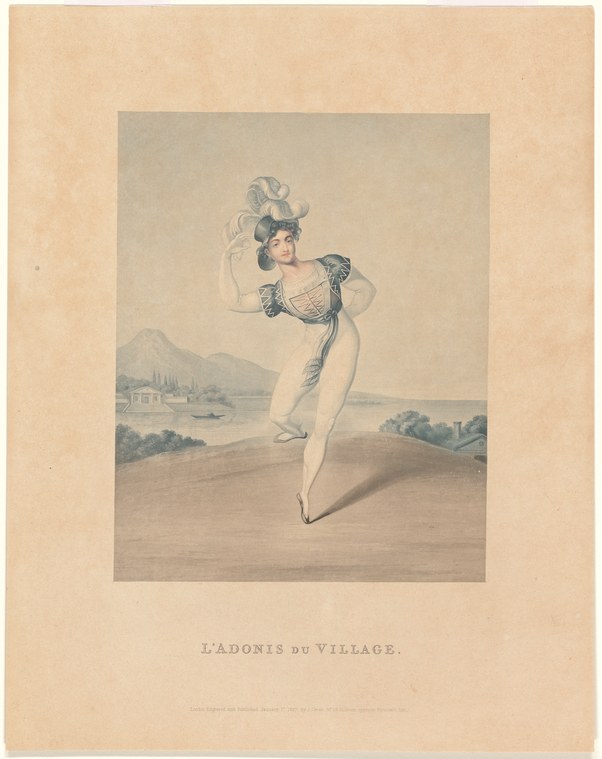
L'Adonis Du Village
Unknown artist
- Collection:
- Prints depicting dance
- Source:
- New York Public Library
- Rights:
- Public domain — free to use, share and adapt.
- Recorded as:
- Public Domain
This image is a primary document of Romantic ballet aesthetics and the cult of the prima ballerina. It shows exactly how the arabesque—perhaps the defining position of ballet—was understood and valorized at the moment when ballet technique was being codified and popularized. For historians and dancers, it is direct visual evidence of body ideals, costume conventions, and the commercial machinery of early modern dance celebrity.
What you are looking at
A young woman stands alone in a stylized landscape, posed in a graceful arabesque-like attitude. She wears a high-waisted white Empire gown with puffed sleeves edged in dark trim, and her dark hair is crowned with an ornamental headdress of pale ribbons or fabric loops. Her body is angled three-quarter to the viewer, weight primarily on one leg while the other extends behind in an elevated line. The setting is a shallow stage-like space with a distant vista of mountains, architectural structures, and cypress trees rendered in pale washes—a theatrical backdrop suggesting an Italianate idyll. The foreground is a simple tan ground plane. The figure is the sole focus; the landscape is decorative and diminished, emphasizing the dancer as the subject of display.
The dancing
The dancer's frame is upright and elongated, with the extended leg held in a high arabesque or attitude derrière, the supporting leg nearly straight, and the arms positioned in classical ballet carriage—one arm extended forward and across the body, the other held at a gentle angle. The pose suggests effortless elevation and weightlessness. The body is linear and refined, with an emphasis on the vertical line from crown to extended foot. There is a single figure only, isolated and centered. The posture conveys control, elegance, and the balletic ideal of the early nineteenth century.
The dance depicted
This is almost certainly a Romantic-era ballet illustration, likely from the 1830s–1840s, when such prints were circulated widely as publicity and souvenirs. The pose, the Empire waist, the idealized feminine form, and the pastoral setting are all hallmarks of Romantic ballet. The title *L'Adonis du Village* (The Village Adonis) is paradoxical—it names a male classical figure yet depicts a female dancer, suggesting either a travesty role or a whimsical poetic conceit common in ballet narratives of the period. The arabesque and the refined classical line suggest a trained professional, likely a prima ballerina. The isolation of the figure and the emphasis on the leg line and carriage are consistent with how ballet technique was celebrated in contemporary prints.
How it was made
This is a hand-coloured engraving or aquatint, as evidenced by the fine line work, the subtle gradations of tone in the background landscape, and the delicate washes of blue and brown pigment applied by hand. The medium allowed for reproducibility—multiple copies could be sold as prints to audiences, theatre-goers, and dance enthusiasts—making this a form of mass circulation that shaped the public image of ballet and its stars in the nineteenth century. The hand-colouring adds individuality to each print while maintaining the precision of the engraved line.
About this work
This is a theatrical souvenir print commemorating a specific ballet performance or dancer, most likely from the 1830s–1840s. It belongs to a rich tradition of ballet imagery that emerged during the Romantic era, when prints of celebrated dancers became collectable objects and marketing tools. The work captures a single moment of perfect pose—the arabesque as the apotheosis of feminine grace and technical mastery—and presents it for contemplation divorced from narrative or musical context. It is a still-life of movement, a freeze-frame that became a cultural icon.
The print circulated among ballet aficionados, aspirant dancers, and theatre patrons, shaping ideals of beauty and technique during a pivotal moment in ballet history. Prints like this one documented and promoted the stars of the day, and they remain valuable evidence of how ballet was visualized, performed, and consumed in early-nineteenth-century Europe.
How to look at it
Observe the precise line of the arabesque and the way the artist renders the dancer's weight, balance, and control through the angle of the supporting leg and the extension of the working leg. Note how the vertical and horizontal lines create a cross or X shape—a dynamic equilibrium that suggests both stillness and potential motion. The ornamental headdress and the simplified landscape draw attention back to the figure and her pose; they are supporting players. Look at how the hand-colouring picks out the shadows and contours without obscuring the engraved line—this is a technique that allowed printmakers to suggest three-dimensionality and volume while maintaining the graphic clarity of the image.
The artist
The artist is not recorded. The print was published and likely distributed through theatrical or commercial channels in France or Italy, where ballet prints were a flourishing market in the 1830s–1840s. Many such prints were produced anonymously or under studio names rather than individual artists' names; the focus was on the ballet and the dancer, not the engraver.
The period
This work was made during the height of the Romantic ballet movement, when the art form became synonymous with ethereal femininity, poetic narrative, and technical virtuosity. The 1830s and 1840s saw the rise of the prima ballerina as a celebrity figure—stars like Marie Taglioni, Fanny Elssler, and Carlotta Grisi were international sensations. This era also witnessed the standardization of classical ballet technique and vocabulary, and the arabesque became a signature of the dancer's mastery and grace. Prints served as merchandise, publicity, and visual record all at once, helping to cement the visual grammar of ballet for audiences across Europe.
Where it lives
This work is held in the New York Public Library's collection of prints depicting dance. It is a theatrical souvenir or promotional print, likely produced and sold in the 1830s–1840s as a collectable item and memento of a stage performance or celebrated dancer.
Dance in this work
Questions about this work
Who danced in L'Adonis du Village?
The artist and publication details are not recorded in the catalogue, so the identity of the dancer and the specific performance remain unknown. However, the quality of the print and the prominence of the pose suggest it commemorated a celebrated performer, likely a prima ballerina of the Romantic era such as Marie Taglioni or a contemporary.
Why is the title masculine when the dancer is female?
The paradox reflects the conventions of Romantic ballet, which often featured travesty roles—women dancing as male characters—or used poetic conceits that played with gender and mythology. The title *L'Adonis du Village* may be a playful or whimsical name for a pastoral ballet character, or it may indicate that the performer was a celebrated female dancer known for such roles.
What technique is the dancer performing?
The pose is an arabesque or attitude derrière in classical ballet—a position in which the dancer stands on one leg with the other leg extended behind the body at a high angle, while maintaining an upright, graceful carriage. This was (and remains) one of the most admired and photogenic positions in ballet, prized for its display of line, control, and feminine elegance.
How were these prints made and distributed?
Prints like this were made using engraving or aquatint techniques, which allowed multiple copies to be produced from a single plate. They were then hand-coloured, typically by assistants in a workshop, and sold to theatre audiences, collectors, and dance enthusiasts. This made them an early form of mass-market merchandise and fan culture around ballet stars.
More dance artwork





